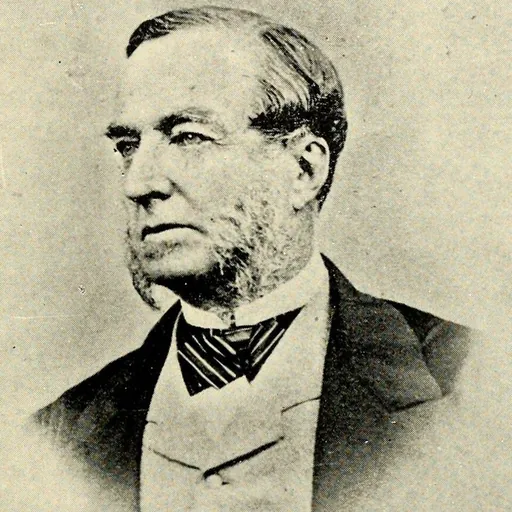
William Chearnley
British military officer and former commanding officer of the 63rd Regiment, Halifax Rifles
About William Chearnley
Lived 1809 – 1871 (aged 61–62). William Chearnley was a British indian Agent and military officer.
William Chearnley (18 January 18099 July 1871) was a British military officer who became Nova Scotia Indian Commissioner and the commanding officer of the Halifax Volunteer Battalion.
Early life William Chearnley was born on 18 January 1809 at Salterbridge, County Waterford, British Ireland. He was the son of Anthony Chearnley, the High Sheriff of County Waterford and grandson of the late Archbishop William Newcome, Lord Primate of Ireland. Serving on the regiment in Nova Scotia from 1830 to 1833 and from 1839 to 1841. When the regiment left in 1833, Chearnley remained in Halifax. William Chearney was made a captain of the 8th (The King's) Regiment of Foot stationed in Halifax, Nova Scotia on 7 August 1835.
Starting in the 1850s, William Chearnley served as a Commissioner of Indian Affairs (similar to Indian agent) for Nova Scotia. He held the role from 1853 to 1862.
Chearnley, an avid hunter and sportsman, explored and took advantage of the wilderness in Nova Scotia and New Brunswick during the early 1850s.
His hunting and fishing activities took him to Guysborough, Halifax, and Lunenberg counties and the Beech Hill district, where he stayed at the old inn on Fort St. in Chester. He hunted with Joseph Penall of Gold River, another one of his Mi'kmaw guides. At Saint Augustine's Roman Catholic Cemetery in Chester, Nova Scotia, Chearnley erected a stone with the following inscription: "In memory of Joseph Pennall, Indian, By Wm. Chearnley, A.D. 1859. Gone to death's call is Indian Joe; Moose, deer rejoice, here buried rests your deadliest foe."
In 1854, the Nova Scotia-based agent expressed skepticism about the Mi'kmaq's work ethic, stating, "Their character is such that I fear we shall always find them to be a people unwilling to work." On 4 March of that year, Chearnley corresponded with Joseph Howe, Nova Scotia's first Commissioner of Indian Affairs. He also suggested her as a subject for a portrait by British artist William Gush during his visit to Nova Scotia in 1858. On 10 February 1859, Chearnley's 1858 report disclosed that £300 had gone toward buying 1,226 blankets for distribution throughout different sections of the province. The following year's report, he acquired many second-hand greatcoats with that year's funds.
Chearnley was appointed captain of the Chebucto Grays (or the 12th Company) on 15 December 1859. He was also linked to the Halifax Rifles, a regiment composed of prominent Irishmen and those of Irish descent. On 15 May 1860, he was appointed as the commanding officer of the Halifax Volunteer Battalion. The battalion was formed by six companies, including the Scottish Rifles, the Chebucto Grays, Mayflower Rifles, Halifax Rifles, Irish Volunteers, and Dartmouth Rifles. Capt. Chearnley, despite his expanded role, remained captain of the Grays and still looked after "his boys." He led the first battalion drill on 30 May 1860 at the South Barracks yard. The Grays, under Chearnley's disciplined leadership, rapidly improved their drill efficiency. Chearnley was in command of the volunteer rifle brigade on 24 July 1860 upon the landing of the Prince of Wales (future King Edward VII) in Halifax. By April 1861, the Halifax Rifles and Chearnley's Chebucto Grays drilled together at the drill shed on Spring Garden Road.
Col. William Chearnley accepted the colours on behalf of the 63rd Regiment on 10 November 1862, a gift from the City of Halifax in recognition of their dedication to training for Canada's defense.
Chearnley supplied a moose head that was stuffed and mounted by Halifax taxidermist Andrew Downs. The moose head was first showcased at the Halifax Court House, then moved to Dalhousie College and the council room of the Province House, before being shipped to the 1862 International Exhibition in London. In 1863, Capt. Chearnley, joined by Campbell Hardy, and Westcote W. Lyttleton, held an exhibition in the armoury of the volunteers' drill-room in Halifax. The exhibits included oil and water-color paintings as well as engravings.
Chearnley, A. Downs, and C. Hardy in 1864 outlined regulations for the Nova Scotia Inland Fisheries and Game Protection Society.
Promoted to lieutenant colonel on 20 June 1865, Chearnley led the Halifax Volunteer Battalion until 1871, when Maj. Mackinlay took over.
Personal life On 2 June 1856, Chearnley was granted land in Colchester County. His main residence was located on Gottigen Street in Halifax.
William Chearnley married a Halifax woman with the surname McNab, who moved to Rome with their daughter years after his death. His daughter was named Janet Edith Musgrave.
He also had a son, William Chearnley, a mixed-race boy whom Chearnley owned, acknowledged as his son, and whose education he ensured. He resided in Truro, worked as a pullman porter on the Intercolonial Railway, and later joined the Reid Newfoundland Railway. The battalion turned out in force in July to honor Col. Chearnley’s funeral, where the 63rd Regiment conducted the firing salute as part of the tribute. He was buried in Camp Hill Cemetery.
Don’t just read it —
keep it.
Full-length biographies made to live with: read them, listen on the way to work, watch them tonight.
- E-book
- Audio
- Video
Instant download · yours to keep · every purchase keeps this site free
Important facts
People in William Chearnley's life
Named in this biography and alive at the same time




Related people
Same field, nearest in time



Contemporaries
People whose lives overlapped William Chearnley's




Frequently asked questions
Who was William Chearnley?
British military officer and former commanding officer of the 63rd Regiment, Halifax Rifles
When was William Chearnley born?
William Chearnley was born on 18 January 1809 in County Waterford, Salterbridge.
When did William Chearnley die?
William Chearnley died in 1871 in Boston.
What was William Chearnley's occupation?
William Chearnley was an indian Agent and military officer.
What nationality was William Chearnley?
William Chearnley was British.
Sources & further reading
· Wikipedia: William Chearnley
Cite this page
APA: Biography.guide. (2026). William Chearnley. https://biography.guide/william-chearnley/
MLA: "William Chearnley." Biography.guide, https://biography.guide/william-chearnley/.
Chicago: "William Chearnley." Biography.guide. https://biography.guide/william-chearnley/.
Data last updated: 2026-09-22 · Spot an error? Report a correction.
Portrait: Wikimedia Commons · author & licence
Page generated 2026-09-27 05:02 UTC