About William Burton
Lived 1609 – 1657 (aged 47–48). William Burton was an English writer.
William Burton (1609–1657) was an English schoolmaster and antiquary, best known for his posthumously-published commentary on the Antonine Itinerary.
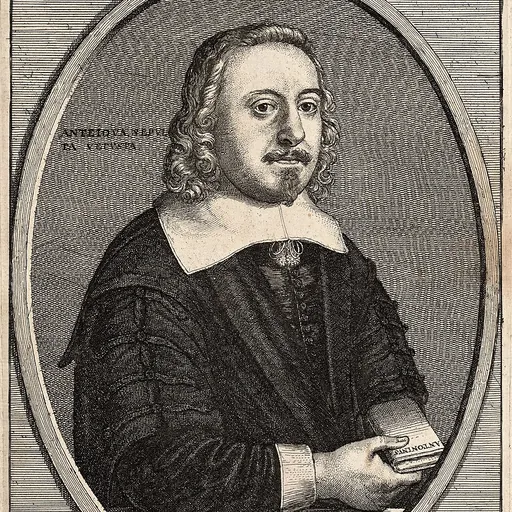
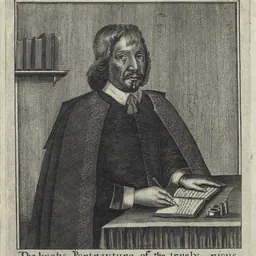
William Burton holds a book with inscription ANTONINUS, frontispiece portrait by Wenceslas Hollar.
Life The son of William Burton, sometime of Atcham, in Shropshire, he was born in Austin Friars, London, and educated at St. Paul's School. He became a student in Queen's College, Oxford, in 1625; but as he had not sufficient means, Thomas Allen, perceiving his merit, induced him to migrate to Gloucester Hall, and conferred on him a Greek lectureship there. He was a Pauline exhibitioner from 1624 to 1632. In 1630 he graduated B.C.L., but, poverty forcing him to leave the university, he became the assistant or usher of Thomas Farnaby, the schoolmaster.
Some years later he was appointed master of the free school at Kingston-upon-Thames, in Surrey, where he continued till two years before his death, when, suffering from dead palsy, he retired to London. He died on 28 December 1657, and was buried in a vault under the church of St. Clement Danes, in the Strand. White Kennett called him "the best topographer since Camden, while Anthony Wood relates James Ussher's high opinion of him.
Works His works are:
In [laudem] doctissimi, clarissimi, optimi senis, Thomæ Alleni ultimo Septembris mdcxxxii Oxon iis demortui, exequiarum justis ab alma Academia postridie solutis, orationes binæ (the first by Burton, the second by George Bathurst), London, 1632 Nobilissimi herois Dn. C. Howardi comitis Nottinghamiæ ἀποθέωσις ad illustrissimum V. Dn. C. Howardum, comitem Nottinghamiæ, fratrem superstitem (London, 1 April 1643), on a small sheet The beloved City: or, the Saints' Reign on Earth a Thousand Years, asserted and illustrated from 65 places of Holy Scripture, London 1643, translated from the Latin of Johann Heinrich Alsted Clement, the blessed Paul's fellow-labourer in the Gospel, his First Epistle to the Corinthians; being an effectuall Suasory to Peace, and Brotherly Condescension, after an unhappy Schism and Separation in that Church, London, 1647, 1652, translated from Patrick Young's Latin version, who has added "Certaine Annotations upon Clement" Græcæ Linguæ Historia (Veteris Linguæ Persicæ λείψανα) 2 parts, London, 1657 A Commentary on Antoninus his Itinerary, or Journies of the Roman Empire, so far as it concerneth Britain, London, 1658. With portrait engraved by Wenceslaus Hollar, and a "Chorographicall Map of the severall Stations"
Don’t just read it —
keep it.
Full-length biographies made to live with: read them, listen on the way to work, watch them tonight.
- E-book
- Audio
- Video
Instant download · yours to keep · every purchase keeps this site free
Important facts
People in William Burton's life
Named in this biography and alive at the same time



Related people
Same field, nearest in time

Contemporaries
People whose lives overlapped William Burton's





Frequently asked questions
Who was William Burton?
English schoolmaster and antiquary
When was William Burton born?
William Burton was born in 1609.
When did William Burton die?
William Burton died on 28 December 1657.
What was William Burton's occupation?
William Burton was a writer.
What nationality was William Burton?
William Burton was English.
Sources & further reading
· DBpedia: William Burton (antiquary, died 1657)
Cite this page
APA: Biography.guide. (2026). William Burton. https://biography.guide/william-burton-writer-1609/
MLA: "William Burton." Biography.guide, https://biography.guide/william-burton-writer-1609/.
Chicago: "William Burton." Biography.guide. https://biography.guide/william-burton-writer-1609/.
Data last updated: 2026-09-23 · Spot an error? Report a correction.
Portrait: Wikimedia Commons · author & licence
Page generated 2026-09-27 05:08 UTC