
Wenceslaus Hollar
Czech cartographer, painter of nature, portrait painter and engraver
About Wenceslaus Hollar
Lived 1607 – 1677 (aged 69). Wenceslaus Hollar was a German printmaker, cartographer, illustrator, graphic artist, engraver and draftsperson.
Wenceslaus Hollar ( , ; 13 July 1607 – 25 March 1677) was a Czech engraver, etcher and painter. He spent much of his life in England. He often created cityscapes and landscapes, including vedutas. He was born in Prague, died in London, and was buried at St Margaret's Church, Westminster.
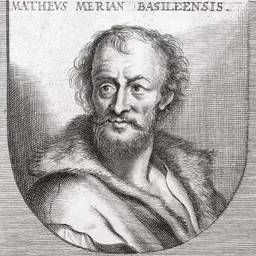
Early life Václav Hollar was born on 13 July 1607 in Prague, Bohemia. After his family was financially ruined by the Sack of Prague in the Thirty Years' War, the young Hollar, who had been destined for the legal profession, decided to become an artist. The earliest of his works that have come down to us are dated 1625 and 1626; they are small plates, and one of them is a copy of a "Virgin and Child" by Dürer, whose influence upon Hollar's work was always great. In 1627 he was in Frankfurt where he was apprenticed to the renowned engraver Matthäus Merian.
It was in 1636 that he attracted the notice of the famous nobleman and art collector Thomas Howard, 21st Earl of Arundel, then on a diplomatic mission to the imperial court of Emperor Ferdinand II. Employed as a draftsman, he travelled with Arundel to Vienna and Prague.
During his first year in England he created "View of Greenwich", later issued by Peter Stent, the print-seller. Nearly 3 feet (0.9 m) long, he received thirty shillings for the plate, a small fraction of its present value. Afterwards he fixed the price of his work at fourpence an hour, and measured his time by a sand-glass. On 4 July 1641 Hollar married a lady-in-waiting to the Countess of Norfolk. Her name was Tracy; they had two children. Arundel had left England by 1642, and Hollar passed into the service of the Duke of York, taking with him his young family.
Hollar joined the Royalist Regiment and was captured by parliamentary forces in 1645 during the siege of Basing House. After a short time he managed to escape. In Antwerp in 1646, he again met with the Earl of Arundel. During this period of the unrest of the Civil Wars, he worked in Antwerp, where he produced many of his most renowned works, including Dutch cityscapes, seascapes, depictions of nature, his "muffs" and "shells". In 1652 he returned to London, and lived for a time with Faithorne near Temple Bar. During his return to England a desperate and successful engagement was fought by his ship, the Mary Rose, under Captain John Kempthorne, against seven Algerian men-of-war; a battle which Hollar etched for Ogilby's Africa,
He lived eight years after his return, still producing illustrations for booksellers, and continuing to produce well-regarded works until his death, for example a large plate of Edinburgh dated 1670. He died in extreme poverty, his last recorded words being a request to the bailiffs that they would not carry away the bed on which he was dying. His architectural drawings, such as those of Antwerp and Strasbourg cathedrals, and his views of towns, are to scale, but are intended as pictures as well. He reproduced decorative works of other artists, as in the famous chalice after Mantegna's drawing.
Collections of Hollar's work are kept in the British Museum in London, the print room at Windsor Castle, the Fisher Library at the University of Toronto, the National Gallery in Prague, and the Virginia Museum of Fine Arts Frank W. Raysor Collection.
Hollar's works were first catalogued in 1745 by George Vertue, with a second edition in 1759. The prints were subsequently catalogued in 1853 by Gustav Parthey and in 1982 by Richard Pennington. A new complete illustrated catalogue has been published in the New Hollstein German series. Much of Hollar's work is available online from the University of Toronto in its Wenceslaus Hollar digital collection. The Folger Shakespeare Library also holds some 2000 prints, drawings, and other works by Hollar.
A very rare original copper plate produced by Hollar has survived, an engraving of the city of Kingston upon Hull in Yorkshire, and is held in the British Library.
Hollar engraved a costume book entitled Livre curieux contenant la naifve representation des habits des femmes des diverses parties du monde comme elles s'habillent a present (Entertaining book containing the simple depiction of the clothes of women from different parts of the world as they dress now) The book includes a series of 28 plates representing the attire of common women, mostly from European countries, from the 17th century. The book was published in 1662 in Paris by Baltazar Moncornet.
Legacy The (Wenceslaus Hollar Secondary School of Art), a High School of Arts and Higher Art School in Prague, is named after him.
Don’t just read it —
keep it.
Full-length biographies made to live with: read them, listen on the way to work, watch them tonight.
- E-book
- Audio
- Video
Instant download · yours to keep · every purchase keeps this site free
Important facts
more
Winceslaus Hollar, Wenceslaus Holar, Wenceslas Hollar, Weneeslas Von Pracha Hollar, Wenceslaus von Prachna Hollar, Wenzel Vaclav, Weneceslas von Pracha, Vaclav Holar, Vincestaus Hollard, Hollard, Vinceslas, Allemand Hollar, Hollar, wenzel holler, Wencelaus Hollar, Weneeslas von Pracha, Wenceslaus Hollar Bohemus, Wenceslas Hollae, Wenzl Hollar, William Hollar, Venceslas Hollarius BohemusPeople in Wenceslaus Hollar's life
Named in this biography and alive at the same time


Related people
Same field, nearest in time

Contemporaries
People whose lives overlapped Wenceslaus Hollar's





Frequently asked questions
Who was Wenceslaus Hollar?
Czech cartographer, painter of nature, portrait painter and engraver (1607-1677)
When was Wenceslaus Hollar born?
Wenceslaus Hollar was born on 13 July 1607 in Prague, New Town.
When did Wenceslaus Hollar die?
Wenceslaus Hollar died on 25 March 1677 in London.
What was Wenceslaus Hollar's occupation?
Wenceslaus Hollar was a printmaker, cartographer, illustrator, graphic artist, engraver and draftsperson.
What nationality was Wenceslaus Hollar?
Wenceslaus Hollar was German.
Sources & further reading
· Wikipedia: Wenceslaus Hollar
Cite this page
APA: Biography.guide. (2026). Wenceslaus Hollar. https://biography.guide/wenceslaus-hollar/
MLA: "Wenceslaus Hollar." Biography.guide, https://biography.guide/wenceslaus-hollar/.
Chicago: "Wenceslaus Hollar." Biography.guide. https://biography.guide/wenceslaus-hollar/.
Data last updated: 2026-09-25 · Spot an error? Report a correction.
Page generated 2026-09-27 05:12 UTC