
About William Atherton
Lived 1793 – 1863 (aged 69–70). William Atherton was a writer.
William Atherton (January 10, 1793 – September 11, 1863) was an American soldier and a veteran of the War of 1812 from Kentucky. He was a private in the 1st Rifle Regiment commanded by Lieutenant Colonel John Allen, and served in the Army of the Northwest under Brigadier General James Winchester and Major General William Henry Harrison. In 1842, Atherton published an account that detailed his wartime service with the Kentucky militia, including their defeat at the Battle of Frenchtown and the subsequent murder of a number of wounded prisoners by Indigenous allies of the British. In his narrative, Atherton recounted his time as a captive of the Potawatomi and his later imprisonment by the British.
Early life Little is known about Atherton's early life. According to his gravestone, he was born on January 10, 1793, possibly in Virginia, and likely came to Shelbyville in Shelby County, Kentucky at a young age. Shelby County was established in 1792, the same year that Kentucky became a state, and is named for Isaac Shelby, the first Governor of Kentucky.
War of 1812
Atherton was one of the 25,010 Kentuckians who served during the War of 1812, fighting against both the British and their Native American allies. This represented about five out of every six men then of military age.
In August 1812, at the age of nineteen, Atherton enlisted as a private in Captain John Simpson's company of the 1st Rifle Regiment. In September, Atherton participated in the destruction of Miami villages in the vicinity of Fort Wayne, and in the construction of Fort Winchester at the confluence of the Auglaze and Maumee rivers. He endured the deprivations suffered by Brigadier General Winchester's army when they were compelled by the weather to remain encamped on the Maumee River east of Fort Winchester for almost two months.
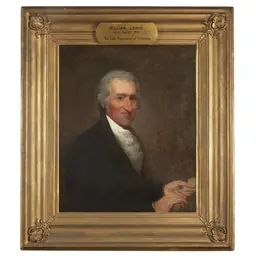
In late December, Major General Harrison ordered Winchester to move downriver to the Maumee Rapids in preparation for a campaign to retake Detroit and advance into Upper Canada. While at the rapids Winchester received word that Frenchtown, a small settlement on the River Raisin, was lightly defended, and was led to believe that the British intended to raze the village. Ignoring his orders from Harrison to remain at the rapids, Winchester dispatched Lieutenant Colonel William Lewis and Lieutenant Colonel John Allan to Frenchtown.
Atherton was wounded in the shoulder on January 18, 1813, during the first engagement at Frenchtown when Lewis and Allan forced a small detachment of militia and Potawatomi to retreat. In an account written years later, Atherton described the tactics used by the enemy as they withdrew:
Their method was to retreat rapidly until they were out of sight, (which was soon the case in the brushy woods,) and while we were advancing they were preparing to give use another fire; so we were generally under the necessity of firing upon them as they were retreating. During the charge, I saw several of our brave boys lying upon the snow wallowing in the agonies of death.
After receiving a false report that Harrison was approaching from the south, Procter ordered an immediate withdraw. Since there was a shortage of sleighs, severely wounded prisoners were left behind under the care of a few attendants. Atherton chose to remain behind to help with the wounded. He and the others were under the impression that the British would soon send back sleighs to retrieve them.
On the morning of January 23, about 200 Indigenous warriors entered the village. They robbed the wounded of their clothing and blankets, killed those unable to walk, and burned the buildings that had housed them. Atherton was taken captive by the Potawatomi. He witnessed the murder of Captain Paschal Hickman, Captain Nathaniel Hart negotiating for his life, and the burning of one of the makeshift hospitals.
Atherton and other survivors were taken away but any who struggled to keep up were killed. On the road north from Frenchtown he saw "the bodies of those poor hapless boys who had made the attempt, but were too badly wounded to travel, massacred, scalped, and stripped."
Later life
Atherton arrived back home at Shelbyville on June 20, 1814.
In 1842, Atherton reluctantly published his account of his experiences during the war including the Battle of Frenchtown, his captivity among the Potawatomi, his internment by the British, and his journey home to Kentucky. In the forward to his Narrative of the Suffering and Defeat of the North-Western Army under General Winchester he wrote:
I think it proper that the rising generation should know what their fathers suffered, and how they acted in the hour of danger; that they sustained the double character of "Americans and Kentuckians." Atherton preferred his treatment by the Potawatomi to that of the British. His account has been frequently referenced in histories of the War of 1812, notably in Pierre Berton's 1980 The Invasion of Canada. and Ralph Naveaux's 2022 Invaded on All Sides. The American public broadcaster noted the uniqueness of Atherton's narrative in educational material that accompanied the documentary:
An audio recording of Atherton's narrative, read by James E. Carson, has been produced by LibriVox.
Don’t just read it —
keep it.
Full-length biographies made to live with: read them, listen on the way to work, watch them tonight.
- E-book
- Audio
- Video
Instant download · yours to keep · every purchase keeps this site free
Important facts
People in William Atherton's life
Named in this biography and alive at the same time


Related people
Same field, nearest in time



Contemporaries
People whose lives overlapped William Atherton's





Frequently asked questions
Who was William Atherton?
American soldier
When was William Atherton born?
William Atherton was born in 1793.
When did William Atherton die?
William Atherton died in 1863.
What was William Atherton's occupation?
William Atherton was a writer.
Sources & further reading
· DBpedia: William Atherton (soldier)
Cite this page
APA: Biography.guide. (2026). William Atherton. https://biography.guide/william-atherton-writer/
MLA: "William Atherton." Biography.guide, https://biography.guide/william-atherton-writer/.
Chicago: "William Atherton." Biography.guide. https://biography.guide/william-atherton-writer/.
Data last updated: 2026-09-20 · Spot an error? Report a correction.
Page generated 2026-09-27 04:57 UTC