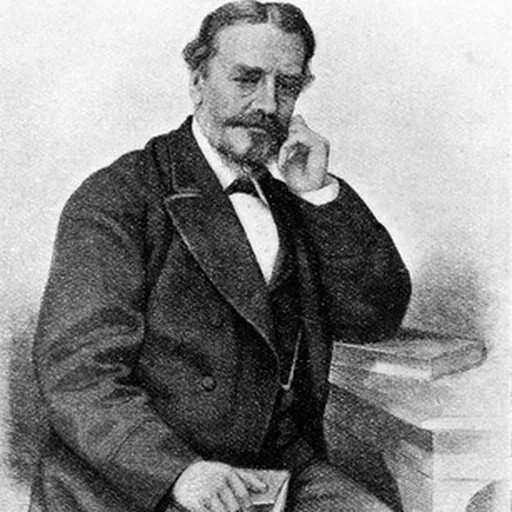
About William Adams
Lived 1823 – 1904 (aged 80). William Adams was a British engineer and railway engineer.
William Adams (15 October 1823 – 7 August 1904) was an English railway engineer. He was the Locomotive Superintendent of the North London Railway from 1858 to 1873; the Great Eastern Railway from 1873 until 1878 and the London and South Western Railway from then until his retirement in 1895. He is best known for his locomotives featuring the Adams bogie, a device with lateral centring springs (initially made of rubber) to improve high-speed stability. He should not be mistaken for William Bridges Adams (1797–1872) a locomotive engineer who, confusingly, invented the Adams axle – a radial axle that William Adams incorporated in designs for the London and South Western Railway.
History Adams was born on 15 October 1823 in Mill Place, Limehouse, London, where his father was resident engineer of the nearby East and West India Dock Company. After private schooling in Margate, Kent he was apprenticed to his father's works. The railway surveyor Charles Vignoles had previously worked on the construction of the London dock basins and this association then secured a position for Adams as an assistant in his drawing office. The final years of apprenticeship were spent at the Orchard Wharf works of Miller & Ravenhill, builders of engines for steamships.
In 1848 Adams became assistant works manager for Philip Taylor, an ironfounder, millwright and former assistant to Marc Brunel, who had formed , a partnership to build and install marine engines from workshops in Marseille and Genoa. Fluent in French and Italian, Adams soon found himself effectively a superintendent engineer for the Royal Sardinian Navy, with the standing of a government official. (The Kingdom of Sardinia then encompassed Genoa and much of what is now north-west Italy.) In 1852 he married Isabella Park, the daughter of another English millwright working in Genoa. When Taylor and Prandi failed through debt in 1852, Adams returned to England.
On his return to England Adams initially worked as a surveyor: considering possible routes for a railway on the Isle of Wight, overseeing construction work at Cardiff Docks and planning and equipping new workshops at Bow for the East and West India Docks and Birmingham Junction Railway, soon to change its name to the North London Railway. This led to his appointment as the company's locomotive engineer in 1854, a post he held for eighteen years. Here he introduced his noted series of 4-4-0 tank engines,
Adams produced five locomotive designs for the GER, including two sizes of suburban passenger tank engine, an express passenger class, and a design for heavy coal traffic. This last, the 527 class, was the first 2-6-0 to be built for service in Britain, although they did not enter service until his successor Massey Bromley had taken office and incorporated some modifications to the design. He also designed the highly successful 1 class 4-4-2T for the London Tilbury and Southend Railway, most of which gave more than fifty years service.
On the LSWR he designed 524 locomotives, supervised the expansion of Nine Elms Works and the transfer of the Carriage and Wagon Works to Eastleigh. Failing health forced his retirement on 29 May 1895 whilst living in Carlton House on Putney Hill. He lived elsewhere in Putney until his death on 7 August 1904. Five of Adams's locomotives survived into preservation; two 'B4's, one 'O2', one 'T3' and one '415' radial tank. As of October 2023, two were in full working order and operational; O2 No. 24 "Calbourne" of 1891 on the Isle of Wight Steam Railway, and T3 No. 563 of 1893 on the Swanage Railway.
Locomotives North London
see: Locomotives of the North London Railway
Great Eastern 61 class 0-4-4T 265 class 4-4-0 K9 class 0-4-2T 230 class 0-4-0T 527 class 2-6-0
LT&SR 1 class 4-4-2T
LSWR 380 class 4-4-0 135 class 4-4-0 395 class 0-6-0 415 class 4-4-2T "Radial tanks" (noted for their long service on the Lyme Regis branch line). 445 class 4-4-0 460 class 4-4-0 A12 class 0-4-2 "Jubilees" T1 class 0-4-4T O2 class 0-4-4T (noted for their long service on the Isle of Wight). X2 class 4-4-0 T3 class 4-4-0 B4 class 0-4-0T "Dock tanks" G6 class 0-6-0T T6 class 4-4-0 X6 class 4-4-0
Don’t just read it —
keep it.
Full-length biographies made to live with: read them, listen on the way to work, watch them tonight.
- E-book
- Audio
- Video
Instant download · yours to keep · every purchase keeps this site free
Important facts
People in William Adams's life
Named in this biography and alive at the same time



Related people
Same field, nearest in time


Contemporaries
People whose lives overlapped William Adams's

Frequently asked questions
Who was William Adams?
locomotive superintendent of several railways (1823–1904)
When was William Adams born?
William Adams was born on 15 October 1823 in Limehouse.
When did William Adams die?
William Adams died on 7 August 1904 in Putney.
What was William Adams's occupation?
William Adams was an engineer and railway engineer.
What nationality was William Adams?
William Adams was British.
Sources & further reading
· DBpedia: William Adams (locomotive engineer)
Cite this page
APA: Biography.guide. (2026). William Adams. https://biography.guide/william-adams-engineer/
MLA: "William Adams." Biography.guide, https://biography.guide/william-adams-engineer/.
Chicago: "William Adams." Biography.guide. https://biography.guide/william-adams-engineer/.
Data last updated: 2026-09-23 · Spot an error? Report a correction.
Portrait: Wikimedia Commons · author & licence
Page generated 2026-09-27 05:05 UTC