
About Will Herberg
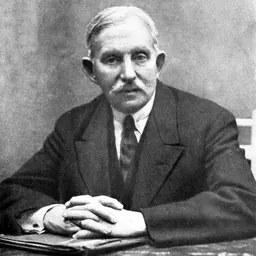
Lived 1901 – 1977 (aged 75). Will Herberg was an American sociologist, theologian and philosopher.
William Herberg (June 30, 1901 – March 26, 1977) was an American writer, intellectual, and scholar. A communist political activist during his early years, Herberg gained wider public recognition as a social philosopher and sociologist of religion, as well as a Jewish theologian. He was a conservative thinker during the 1950s and a contributor to the National Review magazine.
Biography Early years William Herberg, commonly known as "Will," was born on June 30, 1901, to a Jewish family in the shtetl of Lyakhavichy, Belarus, located near the city of Minsk in what was then part of the Russian Empire. His father, Hyman Louis Herberg (1874–1938), and mother, the former Sarah Wolkow (1872–1942) were themselves born in the same provincial village. The boys aided the family income by helping with belt-making, although a very high priority was placed by his mother on education, and great financial sacrifices were made to ensure that the two boys stayed on an academically oriented path. Herberg was suspended from City College in the fall of 1920 due to frequent absences from military science class, accentuated by an altercation with the officer in charge of the course. Herberg finished his career at City College having completed 94 of the 131.5 credits needed for graduation. However, he later received three honorary doctorates, the first in 1956.
Political radicalism The exact timetable of Will Herberg's radicalization is unclear; according to his brother, Ted Herberg, Will's difficulty with the military science officer, his subsequent dismissal from college, and the troubled financial situation of his family led him to the ideas of revolutionary socialism. Be that as it may, by 1925 Herberg was a prominent member of the Young Workers League (YWL) — youth section of the Workers (Communist) Party — and a contributor to the group's weekly newspaper, The Young Worker.
Following the split of party leader Jay Lovestone and his co-thinkers in 1929, Herberg remained loyal to them, a decision earning his expulsion from the party on September 10, 1929. Thereafter Herberg joined the so-called Lovestoneites, remaining with that organization until its termination at the end of 1940, serving as editor of the group's weekly newspaper, Workers Age.
Protestant, Catholic, Jew He later turned away from Marxism and became a religious conservative, founding the quarterly Judaism with Robert Gordis and Milton R. Konvitz. During the 1960s, he was the religion editor of the conservative journal National Review, and he also taught at Drew University.
Herberg's 1955 book Protestant, Catholic, Jew: An Essay in American Religious Sociology created a sociological framework for the study of religion in the United States. Herberg demonstrated how immigration and American ethnic culture were reflected in religious movements and institutions. It has been described as "one of the most influential books ever written about American religion." During the 1950s, that book and the 1951 essay Judaism and Modern Man set out influential positions on Judaism and on the American religious tradition in general.
Herberg also wrote that anti-Catholicism is the antisemitism of secular Jewish intellectuals.
"Cut flower culture" For some time, Herberg has mistakenly been credited with coining the phrase "cut-flower culture" to describe the spiritual rootlessness of modern European and American societies. Though he did refer to the concept in his 1951 book, Judaism and Modern Man, he credits the idea to another: "The attempt made in recent decades by secularist thinkers to disengage these religious values from their religious context, in the assurance that they could live a life on their own as a 'humanistic' ethic, has resulted in what one writer has called our 'cut-flower' culture [emphasis mine]. " The original author to whom Herberg referred to was Quaker Philosopher of Religion, D. Elton Trueblood, who coined the term "cut-flower civilization" in his 1944 book, The Predicament of Modern Man.
Opposition to Civil Rights Movement In his September 7, 1965 National Review article, "'Civil Rights' and Violence: Who Are the Guilty Ones?", Herberg wrote of his opposition or skepticism towards the Civil Rights Movement, feeling, like many of his colleagues at National Review at the time, that the civil rights campaign was moving too quickly and broke up the fabric of American society in an overly socially disruptive manner, not friendly to proper social cohesion. They supported what is often termed the Booker T. Washington position of "gradual reform."
Final years, death, and legacy Herberg's final published work saw print in the middle of 1973. From that time his health deteriorated steadily, culminating with the discovery of an inoperable brain tumor. Herberg died on March 26, 1977; he was 75 years old at the time of his death.
Herberg's memorial service was held in the Great Hall of Drew University in Madison, New Jersey, and was attended by a throng of rabbis, professors, and former students and political associates. Herberg was buried in Morris Plains, New Jersey, next to the grave of his previously departed wife, Anna.
Herberg was a traditionalist conservative and contributor to traditionalist publications such as Russell Kirk's Modern Age and to William F. Buckley, Jr.'s conservative magazine National Review, which published a special issue in August 1977 in Herberg's honor.
Footnotes
Works American Revolutionary Traditions. New York: New Workers School, 1932. The Heritage of the Civil War. New York : Workers Age Publishing Association, 1932. Dialectical Materialism. New York: New Workers School, 1933. Historical Materialism. New York: New Workers School, 1933. The NRA and American Labor. New York : Workers Age Publishing Association, 1933. Theoretical System of Leninism. New York: New Workers School, 1934. Outline for the Study of Dialectical Materialism and the Life of Man. New York: New Workers School, 1935. Foundations of Marxism: Study Outline. New York: New Workers School, 1936. Marxism and Modern Political Thought. New York: New Workers School, 1936. Marxism and Political Thought. New York: New Workers School, 1930s. Which Program for Revolutionists? New York: New Workers School, 1930s. The CIO, Labor's New Challenge. New York: Workers Age Publishing Association, 1937. Rivera Murals: Permanent Exhibition. New York: International Ladies' Garment Workers' Union, 1943. Bureaucracy and Democracy in Labor Unions. New York: Great Island Conference, 1947. The Theology of Reinhold Niebuhr. New York: Frontier Fellowship, 1950. Judaism and Modern Man: An Interpretation of Jewish Religion. New York, Farrar, Straus and Young, 1951. "Jewish Labor Movement in the United States: Early Years to World War I," Industrial and Labor Relations Review, vol. 5, no. 4 (July 1952), pp. 501–523. In JSTOR. Protestant, Catholic, Jew: An Essay in American Religious Sociology. Garden City, NY: Doubleday, 1955. Jewish Labor in the US: Its History and Contributions to American Life. New York: Jewish Labor Committee, Atran Center for Jewish Culture, 1955. The Writings Of Martin Buber. (Editor.) New York: Meridian Books, 1956. Four Existentialist Theologians: A Reader from the Works of Jacques Maritain, Nicholas Berdyaev, Martin Buber, and Paul Tillich. Garden City, NY: Doubleday, 1958. Athens and Jerusalem: Confrontation and Dialogue Durham: University of New Hampshire, 1965. Challenge to Morality: A Symposium. (Contributor.) Tallahassee, FL: Florida State University, 1966. Dimensions Symposium: Human Values in a Technological Society. (Contributor.) New York: UAHC, 1971. On Academic Freedom. (Contributor.) Washington, DC: American Enterprise Institute for Public Policy Research, 1971. Martin Buber: Personalist Philosopher in an Age of Depersonalization. West Hartford, CT: Saint Joseph College, 1972. The State of the Churches in the USA 1973 as Shown in their Own Official Yearbooks: A Study Research. Sun City, AZ: Ecumenism Research Agency, 1973. Faith Enacted As History: Essays in Biblical Theology. Philadelphia: Westminster Press, 1976. From Marxism to Judaism: The Collected Essays of Will Herberg. (David G. Dalin, ed.) New York: Marcus Wiener Publishing Co., 1989. Jewish Perspectives on Christianity: Leo Baeck, Martin Buber, Franz Rosenzweig, Will Herberg, and Abraham J. Heschel. (Contributor.) New York: Crossroad, 1990.
Don’t just read it —
keep it.
Full-length biographies made to live with: read them, listen on the way to work, watch them tonight.
- E-book
- Audio
- Video
Instant download · yours to keep · every purchase keeps this site free
Important facts
People in Will Herberg's life
Named in this biography and alive at the same time




Related people
Same field, nearest in time

Contemporaries
People whose lives overlapped Will Herberg's




Frequently asked questions
Who was Will Herberg?
American sociologist (1901–1977)
When was Will Herberg born?
Will Herberg was born on 30 June 1901 in Liachavičy.
When did Will Herberg die?
Will Herberg died on 26 March 1977 in Morristown.
What was Will Herberg's occupation?
Will Herberg was a sociologist, theologian and philosopher.
What nationality was Will Herberg?
Will Herberg was American.
Sources & further reading
Cite this page
APA: Biography.guide. (2026). Will Herberg. https://biography.guide/will-herberg/
MLA: "Will Herberg." Biography.guide, https://biography.guide/will-herberg/.
Chicago: "Will Herberg." Biography.guide. https://biography.guide/will-herberg/.
Data last updated: 2026-09-25 · Spot an error? Report a correction.
Page generated 2026-09-27 05:11 UTC