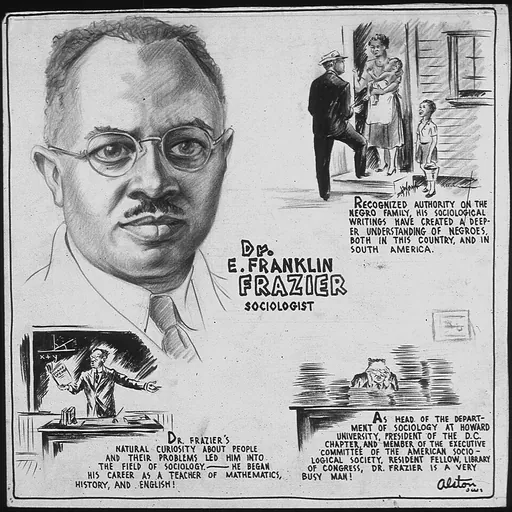
E. Franklin Frazier
American sociologist and writer
About E. Franklin Frazier
Lived 1894 – 1962 (aged 67). E. Franklin Frazier was an American sociologist, university teacher, writer and historian.
Poster from Office of War Information. Domestic Operations Branch. News Bureau, 1943
Edward Franklin Frazier (; September 24, 1894 – May 17, 1962), was an American sociologist and author, publishing as E. Franklin Frazier. His 1932 Ph.D. dissertation was published as a book titled The Negro Family in the United States (1939); it analyzed the historical forces that influenced the development of the African-American family from the time of slavery to the mid-1930s. The book was awarded the 1940 Anisfield-Wolf Book Award for the most significant work in the field of race relations. It was among the first sociological works on Black people researched and written by a black person.
In 1948 Frazier was elected as the first black president of the American Sociological Association. He published numerous other books and articles on African-American culture and race relations. In 1950 Frazier helped draft the UNESCO statement The Race Question.
Frazier wrote a dozen books in his lifetime, including The Black Bourgeoisie, a critique of the black middle class in which he questioned the effectiveness of African-American businesses to produce racial equality.
Biography Frazier was born in Baltimore in 1894 as one of five children of James H. Frazier, a bank messenger, and Mary (Clark) Frazier, a homemaker. He attended the Baltimore public schools, which were legally segregated in those decades. Upon his graduation in 1912 from the Colored High and Training School in Baltimore (renamed in 1923 as Frederick Douglass High School), Frazier was awarded the school's annual scholarship to Howard University, a prominent historically black college.
He graduated with honors from Howard in 1916. Frazier was a top scholar, pursuing Latin, Greek, German and mathematics. He also participated in extracurricular activities including drama, political science, the National Association for the Advancement of Colored People (NAACP), and the Intercollegiate Socialist Society. He was elected as class president in both 1915 and 1916.
Following graduation from Howard, Frazier attended Clark University in Worcester, Massachusetts, where he earned a master's degree in 1920.
An Atlanta paper carried an editorial against Frazier's work, which indirectly publicized his article. Already planning to move to Chicago, Frazier and his family left Atlanta early because of severe threats made against them due to the controversy and hostility among whites generated by his article. After founding and leading the D.C. chapter of the American Sociological Association, Frazier was elected as its first black president in 1948. He was one of dozens of sociologists, psychologists and other social scientists who helped draft and sign the article, The Effects of Segregation and the Consequences of Desegregation: A Social Science Statement, published in 1953 and entered as a major piece of evidence in the Brown vs Board of Education Supreme Court case.
In his research and writing, Frazier adopted an approach that examined economic, political and attitudinal factors that shape the systems of social relationships. He continually pressed to find the "social reality" in any context he investigated. His stature was recognized by his election in 1948 as the first black president of the American Sociological Association. "He was established as the leading American scholar on the black family and was also recognized as a leading theorist on the dynamics of social change and race relations."
Frazier's position emphasized African-American cultural developments as a process of accommodation to new conditions in the Americas. Frazier's Black Bourgeoisie, the 1957 English translation of a work first published in French in 1955, was a critical examination of the adoption by middle-class African Americans of a subservient conservatism. His book received "mixed reviews and harsh criticism from the black middle and professional class. Yet Frazier stood solidly by his argument that the black middle class was marked by conspicuous consumption, wish fulfillment, and a world of make-believe." The study argued that the economic expansion of Europe remained the most important factor underlying race relations. Likewise, it argued that the new regional power structure birthed out of the Cold War gave non-white peoples an increasingly important role in international affairs with the UN also acting as an arena for the struggles emergent in race relations.
Frazier published eight books, 89 articles and 18 chapters in books edited by others.
Frazier died on May 17, 1962, age 67, in Washington, D.C. He has been ranked among the most important African Americans for his influence on institutions and practices to accept the demands by African Americans for economic, political and social equality in American life.
Some of Frazier's writings generated controversy in the black community for their focus on the effects of slavery and how it divided the black family. During the McCarthy era, when there was conservative political pressure against liberals, Frazier supported civil rights for African Americans; he was also a member of the Council on African Affairs.
Legacy and honors Howard University named its E. Franklin Frazier Center for Social Work Research after him. Clark University created a chair and professorship in his name: The E. Franklin Frazier Chair and Professor of English.
Published works The Free Negro Family: a Study of Family Origins Before the Civil War (Nashville: Fisk University Press, 1932) The Negro Family in Chicago (Chicago: University of Chicago Press, 1932) The Negro Family in the United States (Chicago: University of Chicago Press, 1939) Negro Youth at the Crossways: Their Personality Development in the Middle States (Washington, D.C.: American Council on Education, 1940) The Negro Family in Bahia, Brazil (1942) The Negro in the United States (New York: Macmillan, 1949) The Integration of the Negro into American Society (editor) (Washington, D.C.: Howard University Press, 1951. Bourgeoisie noire (Paris: Plon, 1955) Black Bourgeoisie (translation of Bourgeoisie noire)(Glencoe, IL: Free Press, 1957) Race and Culture Contacts in the Modern World (New York: Knopf, 1957) The Negro Church in America (New York: Schocken Books, 1963) On Race Relations: Selected Writings, edited and with an introduction by G. Franklin Edwards, (Chicago: University of Chicago Press, 1968)
Don’t just read it —
keep it.
Full-length biographies made to live with: read them, listen on the way to work, watch them tonight.
- E-book
- Audio
- Video
Instant download · yours to keep · every purchase keeps this site free
Important facts
People in E. Franklin Frazier's life
Named in this biography and alive at the same time

Related people
Same field, nearest in time

Contemporaries
People whose lives overlapped E. Franklin Frazier's

Frequently asked questions
Who was E. Franklin Frazier?
American sociologist and writer (1894–1962)
When was E. Franklin Frazier born?
E. Franklin Frazier was born on 24 September 1894 in Baltimore.
When did E. Franklin Frazier die?
E. Franklin Frazier died on 17 May 1962 in Washington, D.C..
What was E. Franklin Frazier's occupation?
E. Franklin Frazier was a sociologist, university teacher, writer and historian.
What nationality was E. Franklin Frazier?
E. Franklin Frazier was American.
Sources & further reading
· Wikipedia: E. Franklin Frazier
· DBpedia: E. Franklin Frazier
Cite this page
APA: Biography.guide. (2026). E. Franklin Frazier. https://biography.guide/e-franklin-frazier/
MLA: "E. Franklin Frazier." Biography.guide, https://biography.guide/e-franklin-frazier/.
Chicago: "E. Franklin Frazier." Biography.guide. https://biography.guide/e-franklin-frazier/.
Data last updated: 2026-09-22 · Spot an error? Report a correction.
Portrait: Wikimedia Commons · author & licence
Page generated 2026-09-27 05:01 UTC