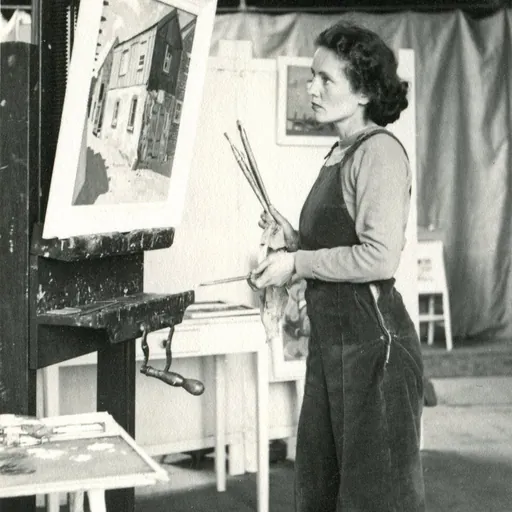
About Wilhelmina Barns-Graham
Lived 1912 – 2004 (aged 91). Wilhelmina Barns-Graham was a British painter and artist.
Wilhelmina Barns-Graham CBE (8 June 1912 – 26 January 2004) was one of the foremost British abstract artists, a member of the influential Penwith Society of Arts.
Early life
Wilhelmina Barns-Graham, known as Willie, was born in St Andrews, Fife, on 8 June 1912, daughter of Allan Barns-Graham, head of a Scottish landed gentry family—he owned estates named Lymekilns and Cambuslang in Lanarkshire, Kirkhill in Ayrshire, Fereneze in Renfrewshire, and Carbeth Guthrie in Stirlingshire, Scotland—and his wife Wilhelmina Menzies, daughter of Charles Bayne Meldrum, whose family of minor Scottish gentry owned the estates of Dura and Balmungo, Fifeshire. Barns-Graham's parents were second cousins. As a child she showed very early signs of creative ability. It was at school that Wilhelmina decided that she wanted to be an artist after one of her paintings was chosen to be displayed on the wall there; she stated later in life that "painting chose me, not I it". where, after some dispute with her father, and six months at the Edinburgh College of Domestic Science, she enrolled in 1931. During her time at College Barns-Graham was taught by tutors including portrait painter David Alison and painter William MacTaggart, her friends there included the influential Scottish painters Robert MacBryde, Robert Colquhoun, Margaret Mellis and William Gear. Since birth Barns-Graham suffered from weakness of the lungs, exacerbated by stress or anxiety, and in 1933 she contracted pleurisy forcing her to take a break from College. Barns-Graham finally graduated with her diploma in 1936. Barns-Graham moved near to where a group of modernist artists had settled, at Carbis Bay, including her College friend, Margaret Mellis, and Mellis's husband Adrian Stokes. This was a pivotal moment in her life. On one of her first evenings there she met the sculptor Barbara Hepworth who made an immediate and lasting impression on her she then went on to meet Borlase Smart, Alfred Wallis and Bernard Leach, as well as the painter Ben Nicholson and the sculptor Naum Gabo. After two weeks in St Ives, Barns-Graham acquired her first studio, directly below the Porthmeor Gallery which was the administrative headquarters of the St Ives Society of Artists. And in the third, in July/ August 1948, with (alongside Berlin, Wells, and Lanyon) Bryan Wynter, Kit Barker, David Haughton, Patrick Heron, and Adrian Ryan.
Barns-Graham's first opportunity to exhibit in London came when her work was included in a group exhibition of six at the Redfern Gallery. This was due to the introduction and support of Patrick Heron who visited Barns-Graham's studio in St Ives and was excited by her work. This was a pivotal moment in her artistic career, inspiring Barns-Graham to embark on a series of glacier paintings that she would revisit for decades to come.
In the same year she married the young author and aspiring poet, and later noted architect, David Lewis; the marriage was annulled in 1960. With the exception of a short teaching term at Leeds School of Art (1956–1957), where fellow St Ives artist Terry Frost, and future studio-mate Stass Paraskos were studying, and three years in London (1960–1963), she lived and worked in St Ives.
Further travels to the US – on a tour of public and private art collections organised by the Contemporary Art Society – and the Netherlands in the 1960s; and to Orkney, Lanzarote, and Barcelona in the 1980s and 1990s provided rich stimulus for Barns-Graham's artistic practice.
In the second half of the twentieth century, when St Ives had ceased to be a pivotal centre of modernism, Barns-Graham's work and importance as an artist was sidelined, in part by an art-historical consensus that she had been only as a minor member of the St Ives school. In 1999 she was elected an honorary member of the Royal Scottish Academy and the Royal Scottish Watercolourists. She was awarded a CBE in 2001, the same year that saw the publication of the first major monograph on her life and work, written by Lynne Green — W.Barns-Graham : A Studio Life (Lund Humphries).
Also in 2024, a plaque was unveiled by the Wilhelmina Barns-Graham Trust at Barns-Graham's birthplace, in St Andrews.
Barns-Graham's name is one of those featured on the sculpture Ribbons, unveiled in 2024.
Barns-Graham's work is now owned by a number of public collections including the Arts Council of Great Britain, Tate Britain, the British Museum and the Victoria and Albert Museum.
Artistic style Through the course of her life Wilhelmina Barns-Graham's work generally lay on the divide between abstract and representational, typically drawing on inspirations from landscape. From as early as the age of eight Barns-Graham had been creating abstract shapes with coloured chalks. From 1940, when she arrived in Cornwall, her pictures were exploratory and even tentative as she began to develop her own method and visual language. The influence of St Ives then began to take hold as local shapes and colours became apparent – the Cornish rocks, landscape and buildings. Perhaps the most significant innovation at this time derived from the ideas of Naum Gabo, who was interested in the principle of stereometry – defining forms in terms of space rather than mass. Barns-Graham's series of glacier pictures that started in 1949, inspired by her walks on the Grindelwald Glacier in Switzerland, reflect the idea of looking at things in a total view, not only from the outside but from all points, including inside. In 1952 her studies of local forms became more planar and two dimensional. From the mid-1950s Barns-Graham developed a more expressionist and free form attitude following journeys to Spain.
In the early 1960s, reflecting the turmoil in her personal life, Barns-Graham adopted a severe geometrical form of abstraction as a way of taking a fresh approach to her painting. Combined with an intuitive sense of colour and design, the work often has more vitality than is immediately apparent. Squares tumble and circles flow across voids. Colour and movement come together and it is at this point in her work that St Ives perhaps exerts the least influence; rather, this approach more likely reflects an interest in the work of Josef Albers who was exciting UK artists at this time, in embracing new possibilities offered by the optical effects of a more formulaic abstraction.
Nonetheless there is evidence to suggest that many images did stem from observations of the world around her. This is seen in a series of ice paintings in the late 1970s and then in a body of work that explores the hidden energies of sea and wind, composed of multiple wave-like lines drawn in the manner of Paul Klee. The Expanding Form paintings of 1980 are the culmination of many ideas from the previous fifteen years – the poetic movement in these works revealing a more relaxed view.
From the late 1980s until her death, Barns-Graham's paintings became increasingly free; an expression of life and free flowing brushwork not seen since the late 1950s. Working mainly on paper (there are relatively few canvases from this period) the images evolved to become, initially, highly complex, rich in colour and energy, and then, simultaneously, bolder and simpler, reflecting her enjoyment of life and living. "In my paintings I want to express the joy and importance of colour, texture, energy and vibrancy, with an awareness of space and construction. A celebration of life – taking risks so creating the unexpected." (Barns-Graham, October 2001) This outlook is perfectly expressed in the extraordinary collection of screen prints that she made with the Graal Press of Edinburgh, between 1999 and 2003.
Solo exhibitions
Downing Gallery, St Ives, 1947, 1949 and 1954 Redfern Gallery, London, 1949/52 Roland, Browse and Delbanco, London, 1954 Scottish Gallery, Edinburgh, 1956. 1959, 1960 and 1981 City Art Gallery, Wakefield, 1957 Richard Demarco Gallery, Edinburgh and The Bear Lane Gallery, Oxford 1968 Sheviock Gallery, Cornwall and Park Square Gallery, Leeds, 1970 Marjorie Parr Gallery, London, 1971 Wills Lane Gallery, St Ives, 1976 The New Art Centre, London, 1978 LYC Museum and Art Gallery, Cumbria, 1981 The Crawford Centre, St Andrews and Henry Rothschild Exhibition, Germany, 1982 The Piers Art Centre, Orkney, 1984 Gillian Jason Gallery, London, 1987 Ancrum Gallery, Roxburghshire, 1988/1990 Scottish Gallery, London, 1989 Retrospective exhibition, touring: Newlyn Art Gallery, Penzance; City Art Gallery, Edinburgh; Perth Museum and Art Gallery; Crawford Art Centre, St Andrews and Maclaurin Art Gallery, Ayr, 1989–1990 Crawford Art Centre, St Andrews and The Royal Cornwall Museum, Truro, 1992 W Barns-Graham at 80, William Jackson Gallery, London touring to: Lillie Art Gallery, Milngavie; Abbott Hall Art Gallery, Kendal; Royal Albert Memorial Museum, Exeter; Dundee Art Galleries & Museum, Dundee and Wakefield Art Gallery, Wakefield, 1992–1993 Drawings 1945–1960, Art First, London; and The Wolf at the Door, Penzance, 1994 Art First, London, 1995 The Scottish Gallery, Edinburgh, 1995 Scottish National Gallery of Modern Art, 1996–1997 Art First, London; The New Millenium Gallery, St Ives, 1997 The McGeary Gallery, Brussels and Art First, London, 1999 Wilhelmina Barns-Graham: An Enduring Image, Tate Gallery, St Ives; W Barns-Graham Prints, Exeter University; Art First, London and Scottish National Gallery of Modern Art, 1999–2000 Wilhelmina Barns-Graham – Painting as Celebration, Crawford Art Centre, St Andrews; Aberdeen Art Gallery; Royal Cornwall Museum; Graves Art Gallery, Sheffield; City Art Gallery and Museum, York; Peter Scott Gallery, Lancaster University and Ferens Art Gallery, Kingston upon Hull W. Barns-Graham: A Celebration at 90, Scottish Gallery, Edinburgh; W. Barns-Graham at 90: A tribute from Art First, Art First, London, 2002 Wilhelmina Barns-Graham, 1912–2004: A tribute – Recent Paintings and New Prints, Art First, London, 2004
'Wilhelmina Barns-Graham, Nature in Motion' , Museum Belvédère, The Netherlands, 2026
Don’t just read it —
keep it.
Full-length biographies made to live with: read them, listen on the way to work, watch them tonight.
- E-book
- Audio
- Video
Instant download · yours to keep · every purchase keeps this site free
Important facts
more
Wilhelmina LewisPeople in Wilhelmina Barns-Graham's life
Named in this biography and alive at the same time





Related people
Same field, nearest in time


Contemporaries
People whose lives overlapped Wilhelmina Barns-Graham's





Frequently asked questions
Who was Wilhelmina Barns-Graham?
British artist (1912–2004)
When was Wilhelmina Barns-Graham born?
Wilhelmina Barns-Graham was born on 8 June 1912 in St Andrews.
When did Wilhelmina Barns-Graham die?
Wilhelmina Barns-Graham died on 26 January 2004 in St Andrews.
What was Wilhelmina Barns-Graham's occupation?
Wilhelmina Barns-Graham was a painter and artist.
What nationality was Wilhelmina Barns-Graham?
Wilhelmina Barns-Graham was British.
Sources & further reading
· Wikipedia: Wilhelmina Barns-Graham
· DBpedia: Wilhelmina Barns-Graham
Cite this page
APA: Biography.guide. (2026). Wilhelmina Barns-Graham. https://biography.guide/wilhelmina-barns-graham/
MLA: "Wilhelmina Barns-Graham." Biography.guide, https://biography.guide/wilhelmina-barns-graham/.
Chicago: "Wilhelmina Barns-Graham." Biography.guide. https://biography.guide/wilhelmina-barns-graham/.
Data last updated: 2026-09-22 · Spot an error? Report a correction.
Portrait: Wikimedia Commons · author & licence
Page generated 2026-09-27 05:00 UTC