
Wilhelm Zahn
German navy officer and WWII submarine commander
About Wilhelm Zahn
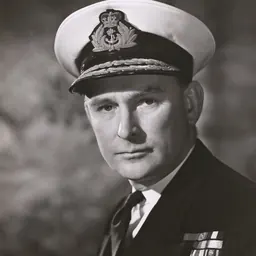
Lived 1910 – 1976 (aged 66). Wilhelm Zahn was a submariner, soldier, military officer and marineoffizier.
Wilhelm Zahn (29 July 1910 – 14 November 1976) was a German Kriegsmarine officer during the Second World War. He began his career as a U-boat First Watch Officer, then advanced to the rank of commander and was finally promoted to Korvettenkapitän on 1 April 1943.
As commander of U-56 he was able to avoid detection by the destroyers surrounding and came in close proximity to the British flagship, launching three torpedoes against her whilst she was carrying Winston Churchill and two senior officers of the British Navy. Following that incident he became widely known as the "man who almost killed Churchill" amongst the U-boat submariner corps.
U-boat action
U-56 At 10 a.m. on 30 October 1939, protecting the Home Fleet west of the Orkney Islands. His vessel came within striking distance of two capital ships, and . Rodney was the lead ship of the convoy and Zahn decided to wait until it passed and concentrated his sights on Nelson. A G7e torpedo (middle) similar to the ones used by U-56 against the Nelson. He fired three torpedoes from U-56s three torpedo tubes The incident has been described as the "most important non-sinking" of the conflict.
U-69 On 30 October 1941 Zahn took command of U-69 for the first time. It was the U-boat's sixth patrol, the previous five patrols being under Lieutenant commander Jost Metzler when from February to July 1941 sank approximately eleven British ships of about . Once at sea Zahn opened the sealed mission orders from Dönitz instructing him to go to the Störtebeker patrol zone named after a German pirate, lying to the east of the Azores. He was to search for supply ships originating from Cape Town and going to England through Gibraltar under code name OS11. On 3 November 1941 Zahn reached the area and wrote in his log "Now begins the tedious business of searching".
In the early morning of 18 January 1942 U-69 with Zahn in command left St. Nazaire setting for a course toward the mid-Atlantic. U-69 came within 500 miles of Long Island, New York and since it was running low on fuel and could not positively identify a potential target as an enemy vessel, Zahn decided not to attack. U-69 was then ordered closer to the American coast but after increased anti-submarine activity Zahn decided on sailing for Grand Banks near Newfoundland. On 17 March 1942, after some more unsuccessful encounters at sea, Zahn brought U-69 to St. Nazaire after a mission in the Atlantic lasting thirty eight days without sinking any ship. Dönitz, in his post-mission appraisal report of Zahn's actions, wrote "Although opportunities presented themselves the commander once again has had no success. This cannot be attributed solely to lack of luck. The commander lacks skill both in general operations and in attacking." Dönitz did not approve of Zahn's tactics of just following a convoy of ships instead of launching an attack against it during the day and also blamed him for not following the convoy closely enough and for losing contact with it eventually, saying "Proper tactics would have been to head for the convoy at full speed and to decide on a daylight attack-or at the very least to have kept so close to the enemy as not to lose him, as was the case here". He then relieved Zahn of his command of U-69 and appointed him to a different post.
Although Zahn had the highest rank on the ship, Petersen, as a merchant marine captain, had formal command of the vessel, a fact that ran counter to the sensibilities of Zahn, who was unwilling to accept Petersen's authority. At the same time, Zahn had military priorities which differed from those of civilian captain Petersen but since he did not have the legal authority to impose his decisions on the civilian captain,
Zahn as the commander and Military Transport Leader of the Second Submarine Training Division wanted to effect standard navy war procedure during the transport of the naval trainees which included cruising at high speed and submarine avoidance precautions such as travelling near the coast with the ship in total darkness. Zahn's plans were met with resolute opposition from captain Petersen.
However, Zahn knew that Wilhelm Gustloff was rated at 16 knots top speed and was annoyed at Petersen's insistence for keeping at the lower speed limit of 12 knots, which made the ship an easier target for submarines. Another point of disagreement between the two captains was the shape of the route. Zahn supported a zigzag submarine avoidance path while Petersen proposed a linear path to minimise travel time. Petersen also proposed cruising in deep waters and with the lights on to avoid collision with minesweeping ships which were reported as being present in the area at the time.
Eventually the two captains agreed on a zigzag course. This did not prevent the sinking of the ship by a Soviet submarine.
The paper The Good Captain and the Bad Captain: Joseph Vilsmaier's Die Gustloff and the Erosion of Complexity published in the journal German Politics and Society analyses Joseph Vilsmaier two-part television series in the light of the conflict between the two captains and its symbolism regarding the politics of conflict and social responsibility between the civilian and military sides of German society at the time. Zahn is depicted by Karl Markovics and in the two-part series he is called captain Wilhelm Petri. Petri is depicted as obsessed with military directives and efficiency in contrast to the civilian captain who is portrayed as caring for the refugees and their plight. The paper finds such portrayal of the main characters simplistic and counter to current scholarship on the subject.
Don’t just read it —
keep it.
Full-length biographies made to live with: read them, listen on the way to work, watch them tonight.
- E-book
- Audio
- Video
Instant download · yours to keep · every purchase keeps this site free
Important facts
People in Wilhelm Zahn's life
Named in this biography and alive at the same time



Related people
Same field, nearest in time


Contemporaries
People whose lives overlapped Wilhelm Zahn's





Frequently asked questions
Who was Wilhelm Zahn?
German navy officer and WWII submarine commander (1910–1976)
When was Wilhelm Zahn born?
Wilhelm Zahn was born on 29 July 1910 in Ebensfeld.
When did Wilhelm Zahn die?
Wilhelm Zahn died on 14 November 1976.
What was Wilhelm Zahn's occupation?
Wilhelm Zahn was a submariner, soldier, military officer and marineoffizier.
What nationality was Wilhelm Zahn?
Wilhelm Zahn's recorded nationality: Nazi Germany.
Sources & further reading
Cite this page
APA: Biography.guide. (2026). Wilhelm Zahn. https://biography.guide/wilhelm-zahn/
MLA: "Wilhelm Zahn." Biography.guide, https://biography.guide/wilhelm-zahn/.
Chicago: "Wilhelm Zahn." Biography.guide. https://biography.guide/wilhelm-zahn/.
Data last updated: 2026-09-20 · Spot an error? Report a correction.
Page generated 2026-09-27 05:25 UTC