
About Wilhelm Nowack
Lived 1897 – 1990 (aged 92). Wilhelm Nowack was a German politician.
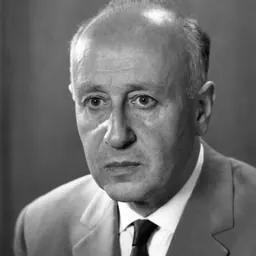
Wilhelm Nowack (28 August 1897 – 31 July 1990) was a German economist who became a journalist and, more briefly, a radio producer. He was also politically engaged (DDP/DStP, FDP). A committed believer in democracy and supporter of the German republic, in 1924 he was a co-founder of the Reichsbanner Schwarz-Rot-Gold movement. Much later, between 1949 and 1952, he served as a member of the ”Bundestag” (West German parliament), based at that time in Bonn. In 1951 he accepted an appointment as State Minister for Finance and Reconstruction for Rhineland-Palatinate, and just over a year later he resigned his seat in the Bundestag.
Life and career Wilhelm Nowack was born at Altenburg, a small town at the eastern end of Thuringia in central-southern Germany After successfully completing his schooling he moved on to study Economics and Civil Law at the universities of Berlin and Innsbruck. It was at Innsbruck that in approximately 1920 he received his doctorate. His university studies had been interrupted by the war. Between 1914 and 1918 he served his country as a soldier. Between 1924 and 1929 he worked as Managing Editor on the “Illustrierte Reichsbanner-Zeitung”, a weekly illustrated magazine produced initially in Magdeburg and then, between 1926 and 1933, in Berlin. Circulation peaked in 1929 at slightly more than 100,000 copies. As an official publication produced for the Reichsbanner Schwarz-Rot-Gold, the “Illustrierte Reichsbanner-Zeitung” was clearly political in its objectives and republican in its sympathies. Republicanism, in the context of Germany in the 1920s, meant support for democratic government and rejection of the widespread hankering after a return to all the traditional pomp and values of the empire years between 1871 and 1918. It also meant rejection of the political extremism of left and Nazi Party which was becoming increasingly mainstream across western Europe, and especially in Germany, during the 1920s.
After the war, which the region that would become the state of Rhineland-Palatinate under French military administration between May 1945 and May 1949, Nowack was initially employed as a radio editor. There is a reference to his having worked for the National Broadcasting Corporation between 1940 and 1945, and he continued to work in the broadcasting sector for some months, now based at Bad Ems in the extreme north of the region. He soon switched back to print media, however, teaming up with the buioding engineer Peter Josef Stein to found the Koblenz-based Rhein-Zeitung (refional newspaper): the first edition was printed towards the end of April 1946. He moved on after just one year, selling his share in the newspaper enterprise to Walter Twer, a businessman from nearby Nassau. During the later 1940s he also headed up the Economics Section at the office of the “Oberpräsident” (head administrator) of Koblenz, before moving on in 1947 to a top advisory position as an “Oberregierungsrat” with the Economics Ministry for the newly configured state of Rhineland-Palatinate. He stayed with the DDP after 1930 when the party rebranded and relaunched itself as the Deutsche Staatspartei in a desperate effort to dissuade voters, badly hit by the economic backwash from the Wall Street crash, from transferring their political support to populist politicians. There is no indication that Wilhelm Nowack was involved in party politics between 1933 and 1945, but he was arrested on a number of occasions, apparently in connection with his activity as a freelance journalist. He was also a member of the FDP National Executive between 1954 and 1959 and deputy party chairman during 1955/56.
Parliamentarian Wilhelm Nowack served – not without breaks – as a member of the Rhineland-Palatinate State Parliament between its inception in 1947 and his exclusion from it in 1958. He was elected to serve as leader of the FDP parliamentary group between 1948 and 1951.
Early retirement Nowack's sudden retirement from parliament and from ministerial office towards the end of 1958 came in connection with a criminal investigation which concluded, in December 1961, with a conviction, a 2,000 Mark fine and a six-month suspended (i.e. probationary) prison sentence.
The affair of Prosecutor Drach In October 1958 Dr. Nowack resigned his office as regional Finance Minister of Rhineland-Palatinate. According to detailed and well researched press reports he had purchased 20 shares in a company called "Schnellpressenfabrik Frankenthal AG", which was 75% state owned, and of which Nowack, was the ex-officio chairman by virtue of his ministerial office. He had acquired his shares at a price equivalent to 120% of their par value. At around the same time the company had itself acquired shares from a private investor at roughly 200% of their par value. The conclusion to be inferred was that Nowack had acquired his shares for only 60% of their theoretical "true" value, causing an equal and opposite loss to the company. The total value at which Nowack had acquired his shares was 216,000 Marks, implying a loss to the company of 144,000 Marks. Coalition partners and opposition groups in the Rhineland-Palatinate State Parliament had held back from any immediate response to press reports of the matter in June 1958, giving them time to check carefully the extent to which any parliamentary colleagues might be vulnerable to similar accusations, in the event of launching an attack in parliament and/or through the media against Nowack; but during the later summer of 1958 the state premier Peter Altmeier had come under increasing pressure to persuade Nowack to resign. Regardless of speculation in respect of possible criminal implications, Nowack had clearly acted unwisely in defiance of an avoidable conflict of interest, and he appears never to have denied having enriched himself through the transaction. It should be stressed that Nowack always maintained that he had done nothing wrong in acquiring shares at a discount to which, as an "employee" of the company, he was entitled. The state prosecutor in the criminal investigation which ebnsured was the Frankenthal Chief District Prosecutor, Leonhard Drach. His name was included in Albert Norden's "Brown Book" in which the author "outed" approximately 1,800 members of the West German political and administrative establishment whom he claimed to have identified as former Nazis. As a very old man, when interviewed, Leonhard Drach was still maintaining that he had only acted in accordance with the law ("Ich habe nur nach Recht und Gesetz gehandelt").
Don’t just read it —
keep it.
Full-length biographies made to live with: read them, listen on the way to work, watch them tonight.
- E-book
- Audio
- Video
Instant download · yours to keep · every purchase keeps this site free
Important facts
People in Wilhelm Nowack's life
Named in this biography and alive at the same time



Related people
Same field, nearest in time




Contemporaries
People whose lives overlapped Wilhelm Nowack's


Frequently asked questions
Who was Wilhelm Nowack?
German politician (1897-1990)
When was Wilhelm Nowack born?
Wilhelm Nowack was born on 28 August 1897 in Altenburg.
When did Wilhelm Nowack die?
Wilhelm Nowack died on 31 July 1990 in Feldafing.
What was Wilhelm Nowack's occupation?
Wilhelm Nowack was a politician.
What nationality was Wilhelm Nowack?
Wilhelm Nowack was German.
Sources & further reading
Cite this page
APA: Biography.guide. (2026). Wilhelm Nowack. https://biography.guide/wilhelm-nowack/
MLA: "Wilhelm Nowack." Biography.guide, https://biography.guide/wilhelm-nowack/.
Chicago: "Wilhelm Nowack." Biography.guide. https://biography.guide/wilhelm-nowack/.
Data last updated: 2026-09-26 · Spot an error? Report a correction.
Page generated 2026-09-27 05:13 UTC