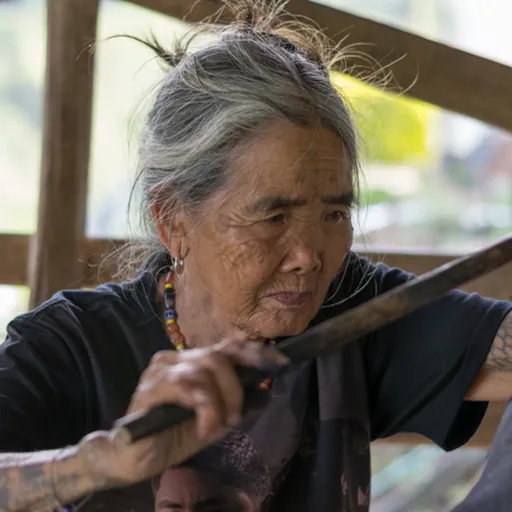
Whang-od
Filipino tattoo artist
About Whang-od
Born 1917. Whang-od is a Filipino tattoo artist.
Whang-od Oggay (first name pronunciation: ; February 17, 1917), also known as Maria Oggay, is a tattoo artist from the village of Buscalan within Tinglayan, Kalinga, Philippines. She is often described as the "last" and oldest mambabatok (traditional Kalinga tattooist)
At the age of 11, she began tattooing Butbut headhunters and women. Butbut warriors traditionally earned tattoos from deeds in combat. With the end of tribal warfare in the region, Whang-od continues to practice traditional tattooing on tourists visiting Buscalan.
Unlike the majority of Filipinos, she does not speak Filipino or English. She only communicates in Kalinga, her native language, and Ilocano, a lingua franca of Northern Luzon.
In April 2023, 106-year-old Whang-od appeared on the cover of Vogue Philippines Beauty Issue, making her the oldest living person to ever be on the cover of Vogue.
The National Commission for Culture and the Arts (NCCA) conferred on Whang-od the prestigious Dangal ng Haraya Award at Tabuk, the capital of Whang-od's ethnic province of Kalinga, in 2018. She was nominated for the National Living Treasures Award (Gawad Manlilikha ng Bayan) in 2017. Her nomination is still being processed by the NCCA.
Biography Career
Whang-od started tattooing at the age of 15, Traditionally, only men with special tattooing ancestry were allowed to learn the art. Whang-od was an exception due to her talent and potential seen by her father. In later life, Whang-od's chosen apprentices consisted of only women, breaking the patrimonial tradition for the first time in recorded Kalinga history. Despite breaking tradition, her community accepted her decision. She has been doing the batok, the traditional hand-tapped tattooing, on male headhunters who earned the tattoos by protecting villages or killing enemies. She also tattoos women of the Butbut people in Buscalan, Kalinga, primarily for aesthetic purposes.
She was first tattooed as a teenager Fatok is the term used for tattooing women to show beauty and wealth. When a woman's arm is tattooed just like Whang-od's own tattoos, the family of the woman is obliged to pay the tattoo artist a piglet or a bundle of harvested rice (locally called as dalan). Drew Arellano, Liza Diño and Ice Seguerra.
Her early tattoo works did not earn her any income but due to the influx of tourists in her town, she was earning at least Php 5,000 a day for her tattooing in 2015.
The tattoo ink she uses is composed of indigenous materials, usually a mixture of charcoal and water that is tapped into the skin using a thorn from a calamansi or pomelo tree. This ancient technique of batok dates back a thousand years and is relatively painful compared to conventional techniques. She uses designs found in nature and basic geometric shapes.
Aside from being a tattoo artist, Whang-od is a respected village elder and plays the nose flute. She also does agricultural tasks such as feeding pigs in order to get to her. There are no direct flights to Buscalan village, as it is a rural area about 400 kilometers north of Manila City. International tourists that fly in from out of the country to Manila, Philippines, will then board a bus for 4-6 hours to the next stop, Baguio. From Baguio, another 4-6 hour bus ride is required to get to Bontoc, the nearest town to Buscalan Village. Once in Bontoc, travellers must seek local transportation like tricycles and jeepneys that will take them further up the mountains towards the village. Finally, the last step before seeing Whang-Od after about 12-15 hours of travel, is a 2-3 hour hike into the mountains usually led by a local guide. While the journey is a bit rigorous, tourists and travellers found it to be all a part of the experience to be able to experience the “last” and oldest mambatok.
Personal life When she was very young, Whang-od had a boyfriend named Ang-Batang, a Butbut warrior. She performed a batok on Ang-Batang after the warrior's first victory in a battle.
She later decided never to marry and has no children, However, these successors have not performed the other works of a mambabatok, and their own tattoos are not as intricate as those of Whang-od. The practice of Kalinga tattoos was almost extinct and the idea was obscure, "The tradition of Batok has changed with the modern times in the last millennia." will soon be inaccurate. It is said Whang-od is now teaching 20 young girls, plus her grandnieces the art of mambabatok so that the tradition and knowledge will not die with her and so that her legacy will be carried through her students and grandnieces. Out of the twenty young students that she teaches, only Grace Palicas and Ilyang Wigan are considered her only real apprentices; due to tradition, the apprenticeship of batok must only be passed down and taught to blood relatives. Whang-od's "signature" tattoo consists of three dots, representing herself and her blood-related apprentices and representing a next generation in her art. These Kalinga tattoos, despite consisting of symbols occurring in nature carrying simple geometric patterns, do not carry the same meaning they had when they were earned through warfaring culture. However, the government and some groups doubted her claim as she has not presented any valid documents to prove her birth date. There were no birth date recordings in many hinterland areas in the Philippines, such as Buscalan, during the time Whang-od was said to be born, recordings of birth dates on paper was not a part of the community's culture at the time, and past ethnic tensions that fueled tribal wars.
Recognition
Due to Whang-od's status as the last mambabatok of her generation, Some netizens were campaigning for her to be given the National Living Treasures Award instead.
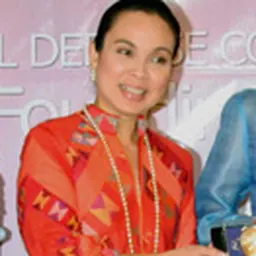
In 2015, Senator Miriam Defensor Santiago urged the Philippine Senate through a resolution that Whang-od should be nominated as one of the National Living Treasures (GAMABA or Gawad Manlilikha ng Bayan in Tagalog), who are of equal rank to National Artists. Senator Nancy Binay through a senate resolution in June 2016 enjoined the Philippine senate to nominate Whang-od as a National Living Treasure. Likewise, her nomination as National Artist or National Living Treasure has been backed by Senator and United Nations ambassador Loren Legarda through a separate Senate resolution.
Former National Commission for Culture and the Arts of the Philippines (NCCA) chair Felipe de Leon Jr. also expressed his support for Whang-od's nomination and argued that the role of a mambabatok is to become the beacon of togetherness and support of the community. The nomination was accepted by the NCCA through a ceremony within the event.
On June 12, 2018, the National Commission for Culture and the Arts announced that the prestigious Dangal ng Haraya Award will be given to Whang-od on June 25 at Tabuk, Kalinga, the capital of Whang-od's home province. The final stages of the GAMABA (National Living Treasures Award) Committee is still ongoing.
Events Whang-od was present during Dutdutan Tattoo Expo 2012 held in the Philippines where she had her own booth. Whang-od's image is included in an exhibit at the Royal Ontario Museum in Canada. The exhibit is entitled Tattoos: Ritual. Identity. Obsession. Art and it was first shown on April 2, 2016. They did not know about Whang-od until a visitor told them. Organizers of the Manila Fame was criticized after a photo that went viral in social media surfaced.
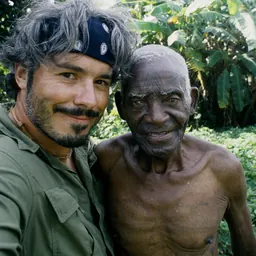
In media American anthropologist Lars Krutak visited Kalinga in 2007 and documented Whang-od's tattoo works.
In 2017, Whang-od was featured in the Dayaw series of the NCCA and ABS-CBN News Channel, where her contributions to the country's national identity and heritage were presented by former NCCA Chairman Felipe De Leon Jr. and Senator Loren Legarda. Her life story was featured in Wagas, a GMA News TV's drama series in 2017, where Janine Gutierrez portrayed Whang-od.
In 2025 she was featured in Treasure of the Rice Terraces, a documentary film by Filipino-Canadian filmmaker Kent Donguines.
Alleged exploitation by Nas Daily
In 2021, Nas Daily, a foreigner who was a YouTuber, created Whang-od Academy on his Nas Academy without the consent of Whang-od. The National Commission on Indigenous Peoples then became involved to review the validity of the issue. Whang-od's grandniece accused Nas on Twitter. Nas replied back but later suffered backlash. As a result, the academy was scrapped.
Don’t just read it —
keep it.
Full-length biographies made to live with: read them, listen on the way to work, watch them tonight.
- E-book
- Audio
- Video
Instant download · yours to keep · every purchase keeps this site free
Important facts
People in Whang-od's life
Named in this biography and alive at the same time






Related people
Same field, nearest in time


Contemporaries
People whose lives overlapped Whang-od's

Frequently asked questions
Who is Whang-od?
Filipino tattoo artist
When was Whang-od born?
Whang-od was born on 17 February 1917 in Tinglayan.
What is Whang-od's occupation?
Whang-od is a tattoo artist.
What nationality is Whang-od?
Whang-od is Filipino.
Sources & further reading
Cite this page
APA: Biography.guide. (2026). Whang-od. https://biography.guide/whang-od/
MLA: "Whang-od." Biography.guide, https://biography.guide/whang-od/.
Chicago: "Whang-od." Biography.guide. https://biography.guide/whang-od/.
Data last updated: 2026-09-21 · Spot an error? Report a correction.
Portrait: Wikimedia Commons · author & licence
Page generated 2026-09-27 05:01 UTC