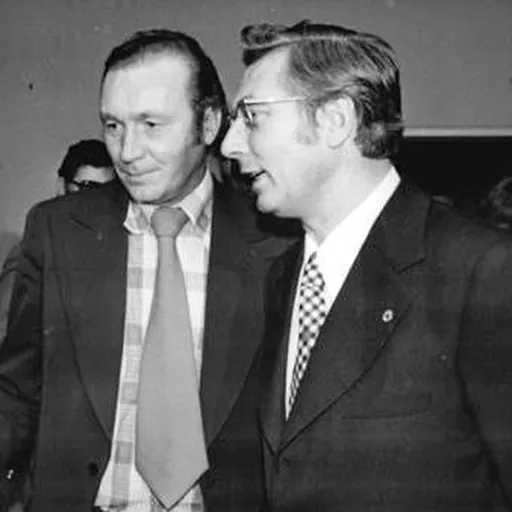
About Werner Lamberz
Lived 1929 – 1978 (aged 48). Werner Lamberz was a German politician.
Werner Lamberz (14 April 1929 – 6 March 1978) was a senior politician in the German Democratic Republic (East Germany).
In a system under which political advancement was generally achieved only slowly and the men who reached the higher levels of government generally did so after decades of patient progression, Lamberz was unusual because of the speed of his promotion. Despite having spent three years during the 1940s attending an Adolf Hitler Leadership School, During the 1970s he was sometimes seen as a possible successor to his political ally, the country's leader Erich Honecker. The cause of the accident in which Lamberz and his three fellow travelers lost their lives has been a subject for media speculation ever since it happened.
Life
Early life and Nazi years Werner Lamberz was born in Mayen in the Eifel region, approximately 36 kim (22 miles) to the west of Koblenz. His father, Peter Lamberz, was a building worker and local leader ("Politleiter") in the (since 1933 illegal) Communist Party. Werner Lamberz attended the elite boarding school at Sonthofen till 1944. A significant aspect of Werner Lamberz's long career as an official with the FDJ was the close relationship it enabled him to form and sustain with the organisation's founder and constant supporter, the country's future leader, Erich Honecker, who himself headed up the FDJ's central council till 1955. A number of the evidently "staged" photographs of the East German leader Erich Honecker in the 1970s feature Werner Lamberz, sitting or (as here ) standing one or two rows, close behind the leader. This picture, taken on the occasion of a high profile state visit by Fidel Castro, shows the Cuban and East German leaders studying a map of Cuba while Friedrich Ebert and Werner Lamberz look on supportively. Because there is a wall behind the people it has even been possible, here, to top off the entire composition with a portrait of Lenin. He became a candidate for Politburo membership in 1970 and a Politburo member just eight months later, in 1971,
Because he was the leader of the Central Committee's agitation department, the responsibilities of Werner Lamberz included keeping the domestic press in line. The nation's news editors were required to attend weekly "Discussion Debates" ("Argumentationssitzungen") at the party headquarters. Sometimes the precise wording of headlines and the formulation of texts was provided at these meeting. Lamberz was a "hands-on" propaganda chief, prone to telephoning editors individually late at night to give final instructions or to berate one of them savagely in respect of a minor oversight. Negotiations with such a potentially important trading and investment partner would under most circumstances have been handled by Hermann Axen, the senior Politburo member who was the architect of East German foreign policy during the 1960s and 1970s, but Axen was Jewish which made him an inappropriate negotiator to represent a government hoping to make progress with Muammar al-Gaddafi. None survived. The Germans who died along with Werner Lamberz were the Central Committee International Relations chief, Paul Markowski , the translator Armin Ernst and the news-photographer Hans-Joachim Spremberg, the man who took the photograph of Lamberz with Frank Beyer appearing at the top of this piece (2015). It was later reported that Lamberz's Libyan negotiating partners had urged him to stay an extra night and not to risk traveling in a helicopter with a Libyan pilot who was known to have no experience of night flying. Nevertheless, Werner Lamberz received a state funeral and an urn believed to contain his ashes following cremation was placed beside the remains of other privileged East German politicians in the cemetery at Berlin-Lichtenberg.
Awards and honours 1964: Patriotic Order of Merit in bronze 1968: Banner of Labor 1968: Patriotic Order of Merit in gold
The list is not exhaustive. Streets were also named after Werner Lamberz, although they tended to be renamed after the East German state became discredited following German reunification in 1990.
Don’t just read it —
keep it.
Full-length biographies made to live with: read them, listen on the way to work, watch them tonight.
- E-book
- Audio
- Video
Instant download · yours to keep · every purchase keeps this site free
Important facts
People in Werner Lamberz's life
Named in this biography and alive at the same time



Related people
Same field, nearest in time






Contemporaries
People whose lives overlapped Werner Lamberz's
Frequently asked questions
Who was Werner Lamberz?
German politician (East Germany)
When was Werner Lamberz born?
Werner Lamberz was born on 14 April 1929 in Mayen, Russian Wikipedia.
When did Werner Lamberz die?
Werner Lamberz died on 6 March 1978 in Libya.
What was Werner Lamberz's occupation?
Werner Lamberz was a politician.
What nationality was Werner Lamberz?
Werner Lamberz was German.
Sources & further reading
Cite this page
APA: Biography.guide. (2026). Werner Lamberz. https://biography.guide/werner-lamberz/
MLA: "Werner Lamberz." Biography.guide, https://biography.guide/werner-lamberz/.
Chicago: "Werner Lamberz." Biography.guide. https://biography.guide/werner-lamberz/.
Data last updated: 2026-09-22 · Spot an error? Report a correction.
Portrait: Wikimedia Commons · author & licence
Page generated 2026-09-27 04:59 UTC