
Werner E. Reichardt
German physicist and biologist
About Werner E. Reichardt
Lived 1924 – 1992 (aged 68). Werner E. Reichardt was a German physicist, biologist and university teacher.
Werner E. Reichardt (30 January 1924 – 18 September 1992) was a German physicist and biologist who helped to establish the field of biological cybernetics. He co-founded the Max Planck Institute for Biological Cybernetics, and the Journal of Biological Cybernetics.
Life As a young student, Werner Reichardt was a pupil in the laboratory of Hans Erich Hollmann, a pioneer of ultra-shortwave communication. Because of his knowledge he was drafted in 1941 to the German air force as a radio technician.There he met members of the resistance and established a covert radio connection with the Western Allies. In 1944 Reichardt was arrested by the Gestapo and sentenced to death, but escaped, and hid in Berlin until the end of the war.
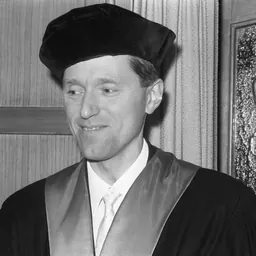
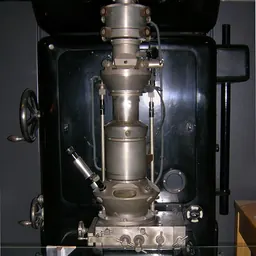
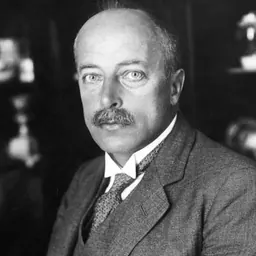
From 1946 to 1950 he studied physics at Technische Universität Berlin. From 1950 he was a doctoral student of Ernst Ruska, studying solid state semiconductors at the Fritz-Haber-Institut of the Max-Planck-Gesellschaft, and received his doctorate in 1952. From 1952 to 1954 he was an assistant at the Institute where his teacher Max von Laue was a large influence to his later research. During the war, Reichardt had known Bernhard Hassenstein, who had studied optomotor turning behaviour after the war. Realising these experiments could be formalised in a similar way to electronics experiments, he developed interdisciplinary theories of motion perception. In 1954, Reichardt became a Postdoctoral Fellow at the California Institute of Technology at the invitation of Max Delbrück. From 1955 he was assistant at the Max Planck Institute for Biophysical Chemistry in Göttingen under Karl Friedrich Bonhoeffer. In 1958 he founded together with Bernhard Hassenstein and Hans Wenking the cybernetics research group at the Max-Planck-Institute of Biology in Tübingen. In 1968 the department was transformed into the independent Max Planck Institute for Biological Cybernetics.
Reichardt died at the age of 68 years after collapsing at the end of a symposium organised in his honour.
Work Reichardt's findings have contributed to understanding of information processing in nervous systems. From joint work (with Bernhard Hassenstein and Hans Wenking) on the visual system of insects and its effect on the flight orientation, the correlation model developed the idea that the visual system of man could be similarly investigated, and led to a general theory of motion perception
Reichardt detectors
In the 1950s, Reichardt and Hassenstein proposed a model explaining how a neuron, receiving input from photoreceptors that respond exclusively to changes in luminance, could be used to compute motion. Each photoreceptor detects changes in luminance at a specific location in visual space. By comparing the phase shifts of activity in adjacent cells, the model suggests the direction of movement can be determined as it passes from one neuron's receptive field to another. This concept, known as the Reichardt detector, has experimental evidence supporting its hypothesized behavior, although the exact the exact circuitry for this process has yet to be identified.
In honor of Reichardt's pioneering work, the Tübingen cluster of excellence Werner Reichardt Centre for Integrative Neuroscience (CIN; founded 2007/2008) was named after him.
Honors and awards 1965: Honorary Professor of the University of Tübingen 1970: full member of the Academy of Sciences and Literature Mainz 1971: full member of the German Academy of Sciences Leopoldina Hall 1972: foreign member of the American Academy of Arts and Sciences Cambridge (Massachusetts) 1978: foreign member of the Koninklijke Nederlandse Akademie van Wetenschappen, Amsterdam 1980: Pour le Mérite for Sciences and Arts, 1984: Senator of the Max Planck Society 1985: HP Heineken Prize for Biochemistry and Biophysics (together with Bela Julesz) 1988: foreign member of the National Academy of Sciences, Washington, D.C. 1989: foreign member of the American Philosophical Society Philadelphia 1989: Member of the Academia Europaea 1989: honorary doctorate of the RWTH Aachen
Don’t just read it —
keep it.
Full-length biographies made to live with: read them, listen on the way to work, watch them tonight.
- E-book
- Audio
- Video
Instant download · yours to keep · every purchase keeps this site free
Important facts
People in Werner E. Reichardt's life
Named in this biography and alive at the same time



Related people
Same field, nearest in time



Contemporaries
People whose lives overlapped Werner E. Reichardt's



Frequently asked questions
Who was Werner E. Reichardt?
German physicist and biologist (1924–1992)
When was Werner E. Reichardt born?
Werner E. Reichardt was born on 30 January 1924 in Berlin.
When did Werner E. Reichardt die?
Werner E. Reichardt died on 18 September 1992 in Tübingen.
What was Werner E. Reichardt's occupation?
Werner E. Reichardt was a physicist, biologist and university teacher.
What nationality was Werner E. Reichardt?
Werner E. Reichardt was German.
Sources & further reading
· Wikipedia: Werner E. Reichardt
· DBpedia: Werner E. Reichardt
Cite this page
APA: Biography.guide. (2026). Werner E. Reichardt. https://biography.guide/werner-e-reichardt/
MLA: "Werner E. Reichardt." Biography.guide, https://biography.guide/werner-e-reichardt/.
Chicago: "Werner E. Reichardt." Biography.guide. https://biography.guide/werner-e-reichardt/.
Data last updated: 2026-09-25 · Spot an error? Report a correction.
Page generated 2026-09-27 05:11 UTC