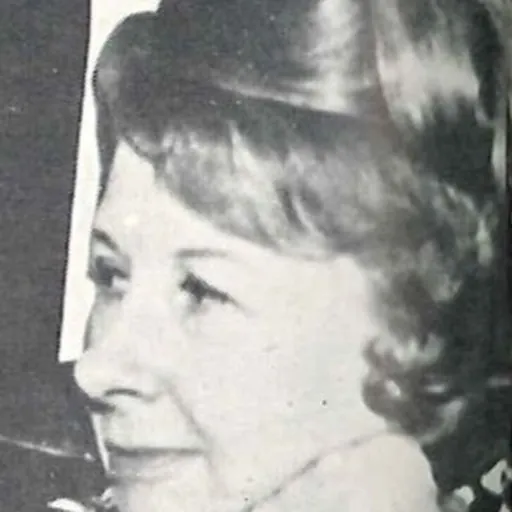
About Wendy Barnes
Lived 1916 – 2006 (aged 89). Wendy Barnes was a British broadcaster and announcer.
Wendy Dorothy Orchard, MBE (; 10 April 1916 – 11 February 2006), better known by her maiden name Wendy Barnes, was a British overseas radio broadcaster. From 1968 to 1974, she produced and hosted the talk show Time to Remember for Radio Hong Kong (RHK).
During her time at RHK, Barnes produced more than 200 episodes of Time to Remember. The programme featured interviews with personalities about their lives and their connections to the Far East, particularly Hong Kong. From 1971 onward, she also directed and hosted another popular current-affairs programme called Insight, which examined topical issues in depth. Later, she additionally served as RHK's Acting Controller of the English Service until she left in 1975.
Barnes began her broadcasting career with the British Broadcasting Corporation in 1942. Before joining RHK, she worked in broadcasting in London, Singapore, Vietnam, Egypt, Malta, Cyprus, and Kenya. She held positions including Station Controller of the Forces Broadcasting Service in Nairobi (1956–1959), Head of the English National Service of the Kenya Broadcasting Service (1959–1962), and, at the Kenya Broadcasting Corporation, Head of the General Service (1962–1963) and later Controller of the Television Programme Department (1963–1964).
After leaving RHK, Barnes returned to the United Kingdom and gradually withdrew from broadcasting. At 79, in 1995, she married William Orchard, a retiree at 73 who formerly served in the Hong Kong Government as an executive officer and later as a fisheries officer. She died in Chipping Norton, Oxfordshire, in 2006, at 89.
Early life Wendy Barnes was born on 10 April 1916 in London, United Kingdom. Her birth was registered as "Dorothy Wendy Barnes", although the name "Wendy Dorothy Barnes" appeared in later official records, including the Hong Kong Government Staff List and the 1976 New Year Honours List. She was more commonly known as "Wendy Barnes". while her younger sister, Rosamond Edith Barnes (1921–2003), was a child actor and actress active mainly in the 1930s and 1940s. The family originally lived on Penn Road in Islington, London, and later moved to St Dunstan's Road in Fulham. Barnes was no exception. According to the 1939 census, at 23, she was employed as a secretary at a film magazine.
Early broadcasting career After the outbreak of the Second World War in 1939, the United Kingdom's labour force underwent significant changes. With a substantial proportion of men called up for military service, the resulting labour shortages were increasingly filled by women. Radio Malaya, a government-run public service broadcaster, provided local programming, with broadcasts transmitted in English, Cantonese, Mandarin, French, Siamese, Indonesian, Dutch, and Burmese. She also travelled to Saigon (present-day Ho Chi Minh City), then the capital of French Indochina, where she wrote scripts for the French Colonial Broadcasting Service. Due to the service cut, Barnes was redeployed by the Foreign Office to the British Embassy in Cairo, Egypt by the Foreign Office.
In October 1956, Wendy Barnes interviewed Princess Margaret (pictured) during her royal visit to Kenya. After the Mau Mau rebellion subsided, visitor numbers to Kenya gradually increased, contributing to a more vibrant social life in Nairobi. As Station Controller, Barnes began interviewing visiting politicians, film stars, entertainers, and even members of the royal family. Among them was American actress Joan Crawford, who visited in 1956. Following the takeover, the KBS was organised into four channels, namely the English National Service, the Asian National Service, the African National Service and the Regional Services. Barnes, who had been Station Controller of FBS Nairobi, joined the KBS in 1959 as Head of the English National Service, bringing to a close about a decade of service with the FBS. When she joined the KBS, the newspapers credited her with having made FBS Nairobi "one of the liveliest programmes in Africa". Under this reorganisation, the former English National Service became the General Service, which Barnes continued to head. However, on the eve of Kenya's transition to a republic in 1964, the KBC was nationalised by the government and became the Voice of Kenya (VoK). As Barnes did not join the new broadcaster, her decade-long career in Kenya came to an end.
Radio Hong Kong Two years after returning from Kenya to the United Kingdom, Wendy Barnes was appointed in September 1966 as a programme supervisor at Radio Hong Kong (RHK), the predecessor of Radio Television Hong Kong (RTHK). Like the former KBS, RHK was a government department operating as a public broadcaster under the Hong Kong Government. She arrived in Hong Kong the following year to take up the post. Having lived in Kenya for a considerable period, she was also elected president of the East African Association (also known as the Jambo Club), an organisation formed by Hong Kong residents with an interest in East African affairs, in 1968.
At RHK, she produced and hosted more than 200 episodes of Time to Remember from 1968 to 1974. The programme was mainly broadcast on Sunday evenings on the English Service, and each episode ran about 45 to 50 minutes. Compared with the Kenyan version, most guests on the Hong Kong version were older Hong Kong residents, government officials and business figures about to leave Hong Kong, visitors with deep ties to Hong Kong, China, and the Far East, as well as others who happened to be visiting Hong Kong for various reasons.
Radio Hong Kong moved into its new headquarters at the Broadcasting House on Broadcast Drive in Kowloon, in 1969 (pictured). For more than six years on air, Time to Remember was one of RHK's most popular English-language programmes. Peter Gynt, the television and radio critic for the South China Morning Post, wrote more than once in praise of Barnes and her programme. He described her as "the finest radio producer outside the BBC", and said her "questions are carefully thought out and so we get a glimpse into the mind and background of people who are, for one reason or another, in the public eye". Her "thrusting" interview style never bored listeners and successfully "obtained for her programme just what she wanted, and how she wanted it" from her guests. The success of the programme even led journalist and writer Trea Wiltshire to interview Barnes in return, to review her broadcasting career. The interview was titled "A woman with a lifetime to remember..." and appeared in the South China Morning Post on 22 September 1968, with Wiltshire jokingly noting that "Today it is her Time to Remember". At first, the programme could be heard every Sunday and Wednesday evenings on the English Service, During the February 1974 United Kingdom general election, it even mounted a 24-hour marathon coverage on 1 March, the day after polling, closely following the voting and vote-counting process. The coverage featured "up-to-the-minute" news reports interspersed with live comments from observers in both the United Kingdom and Hong Kong, enabling local listeners to keep abreast of the latest political developments in the United Kingdom alongside a range of informed analysis.
In 1973, Barnes began serving as an acting senior programme supervisor, which required her to take on a broader range of duties. When her direct supervisor, Geoffrey Weeks, Controller of the English Service, was on leave, she also acted in that capacity. Following Weeks' sudden death in September 1974, Barnes was immediately and substantially promoted to senior programme supervisor, and concurrently appointed Acting Controller of the English Service on a permanent basis. These changes brought her even heavier responsibilities. Due to production difficulties, Time to Remember went off the air in July 1974, but Barnes continued to produce and host Insight. In addition, when Queen Elizabeth II made her first royal visit to Hong Kong in May 1975, she was the chief commentator for the live broadcast on the English Service (i.e. RHK3 and RHK4) to cover the welcoming ceremony at the Hong Kong City Hall on the Queen's arrival with the Duke of Edinburgh on 4 May.
Shortly after the live radio broadcast covering the Queen's royal visit in May 1975, Barnes returned to the United Kingdom for a six-month annual leave. Although she had originally intended to remain at RHK until reaching the retirement age of 60 in 1976, news emerged in July 1975 that she had already tendered her resignation directly from the United Kingdom, having accepted an offer from the BBC and decided to remain there.
Following her departure, the position of Acting Controller of the English Service was filled by Warren Rooke, then acting senior programme supervisor, until February 1976. At that time, RHK created a new post of Controller of Radio Programmes under the Director, Deputy Director, and Assistant Director of Broadcasting to oversee both the Chinese and English Radio Services. Ken Warburton of the BBC was recruited from the United Kingdom to assume this role, and the title of Controller of the English Service was consequently revised to Deputy Controller (English Service).
In recognition of her decade-long service with RHK, Barnes was appointed a Member of the Order of the British Empire (MBE) in the 1976 New Year Honours List. The citation noted that "Her extensive broadcasting experience and great ability were used to create the highest standards in Radio Hong Kong's radio and television public affairs programmes".
Later life After returning to the United Kingdom in 1975, Wendy Barnes gradually withdrew from broadcasting and settled in London. In 1995, at the age of 79, she married William Orchard, then 73, in London; both had been victims of the infamous 1985 Hong Kong stockbroker fraud case orchestrated by Peter Scales. Orchard, whose parents were from the United Kingdom, was born in Hong Kong in 1922. He joined the Hong Kong Government as a civil servant in 1940, took part in the Battle of Hong Kong in 1941, and after the war, returned to the civil service, where he served as an executive officer, class I, and later as a senior executive officer, class II, also acting as the Commissioner of Registration. He was subsequently transferred to the Agriculture and Fisheries Department in 1955, where he became a fisheries officer until taking early retirement in April 1975. Orchard married his first wife in the United Kingdom in 1946, and the previous marriage produced two daughters.
Orchard died in London in 1998 at the age of 75, three years after their wedding. After her husband's death, Barnes moved to Chipping Norton, Oxfordshire to live nearer to her sister Rosamond.
Don’t just read it —
keep it.
Full-length biographies made to live with: read them, listen on the way to work, watch them tonight.
- E-book
- Audio
- Video
Instant download · yours to keep · every purchase keeps this site free
Important facts
People in Wendy Barnes's life
Named in this biography and alive at the same time



Related people
Same field, nearest in time



Contemporaries
People whose lives overlapped Wendy Barnes's




Frequently asked questions
Who was Wendy Barnes?
British overseas broadcaster
When was Wendy Barnes born?
Wendy Barnes was born on 10 April 1916 in London.
When did Wendy Barnes die?
Wendy Barnes died on 11 February 2006 in Chipping Norton.
What was Wendy Barnes's occupation?
Wendy Barnes was a broadcaster and announcer.
What nationality was Wendy Barnes?
Wendy Barnes was British.
Sources & further reading
Cite this page
APA: Biography.guide. (2026). Wendy Barnes. https://biography.guide/wendy-barnes/
MLA: "Wendy Barnes." Biography.guide, https://biography.guide/wendy-barnes/.
Chicago: "Wendy Barnes." Biography.guide. https://biography.guide/wendy-barnes/.
Data last updated: 2026-09-22 · Spot an error? Report a correction.
Portrait: Wikimedia Commons · author & licence
Page generated 2026-09-27 05:04 UTC