
About Webster Marble
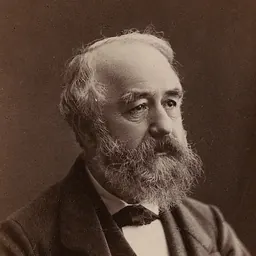
Lived 1854 – 1930 (aged 76). Webster Marble was an inventor and outdoorsman, known for Marble Arms.
Webster L. Marble (1854–1930) was an inventor, early outdoorsman, and prolific patent-holder who spent the majority of his life in Michigan's Upper Peninsula. His manufacturing company, now known as simply as Marble Arms, has operated in the town of Gladstone, Michigan since 1898.
Biography
Early life Webster Lansing Marble was born on March 23, 1854, in Milwaukee, Wisconsin, the third of six children born to Mary Chipman Marble and her husband Lansing Marble, a trapper and basketmaker. The family moved to Vassar, Michigan in 1858, where they would live until Webster was 15. He spent the majority of his childhood outdoors: hunting, fishing, and trapping alongside his siblings. Webster's family moved again in 1868, this time to Frankfort, Michigan, where his parents would remain for the rest of their lives. His father, Lansing Marble, operated a bushel basket-making business that used proprietary machines to increase stave basket-making capacity from one-a-day to over one hundred. He owned a basket factory back in Milwaukee from 1863 until 1867, when he sold the business to devote more time to the outdoor interests he shared with his son. It has been said that his both his father's entrepreneurial spirit and his passion for the outdoors likely heavily influenced Webster.
Timber cruiser For two decades, Webster Marble worked as a timber cruiser and surveyor throughout Northern Michigan's white pine forests. Timber cruisers played a vital role in the logging industry, traveling ahead alone to hike into the forests, take measurements, and report data back to the lumber companies for months at a time. During his time as a cruiser the Upper Peninsula was largely unsettled, viewed primarily as a deposit of resources like copper, iron, and lumber rather than a residential location. Demand for wood in the area had skyrocketed following the Great Chicago Fire of 1871, providing Webster with more than enough work for many years.
Marble was widely admired amongst his fellow cruisers for his uncanny ability to calculate the amount of useable lumber produced from a given acreage of forest just by looking at it. Not known for being a large man, Webster had to carry more than 50 pounds of heavy cruising and surveying equipment through the woods every day, including a large, razor-sharp hatchet. When his fellow surveyors settled down at the fire after a long day's work, Webster was known for pulling out his sketchbook and working on ideas for new tools that could improve work in the woods.
Webster married Rosa M. Derry, a former resident of New York, in Frankfort, Michigan in 1878. The pair would have two sons, William Lansing (1880–1977) and Floyd Webster (1891–1937).
Webster became heavily involved in the local Gladstone community as it began to form, joining both the local Republican Party and the Gladstone branch of the Freemasons, and winning a seat on the Gladstone School board. He also became heavily involved in the local Episcopal church, serving on the church board for many years as a treasurer and trustee.
Marble Arms and Manufacturing Co.
At the beginning of the 20th-century, Americans began to view the outdoors as more than just a place to source resources. Until the early 1900s, fishing, hunting, camping, and other outdoor activities were done to survive, not have fun. Webster Marble, an avid outdoorsman who had grown up trapping, fishing, and hunting alongside his father, sensed the public's rapidly growing interest in the outdoors and jumped to capitalize on it.
History
In the early 1890s, Webster Marble created the first Marble Universal Gunsight from his garage in Gladstone, patenting his invention under the name Gladstone Manufacturing Company. The gunsight would eventually be manufactured in 37 sizes to accommodate a number of popular gun models, including those made by Winchester, Marlin, Remington and Colt, though the Financial Panic of 1893 delayed their wider release (and thus the start of the company) by over a decade.
Marble continued working on his inventions in his garage at odd hours, while returning to timber cruising to support his family, until 1898. He had a brand-new invention that gave his company a new name, the Marble Safety Axe Company, so he extended his workshop to include 640 sq. ft. of floor space. For a year, the company would only produce the Marble Safety Axe – until the wealthy founder of Gladstone itself, Frank H. Van Cleve, became a partner in the business. In 1899, Webster travelled to New York City to showcase his products at the national Sports Expo at Madison Square Garden. At the height of his marketing ideas, Marble distributed more than 1 million copies of Marble's Message monthly magazine, and his advertising had been seen by more than 20 million people by 1912. The present Marble Arms manufacturing facility was built in 1966 in Gladstone and is still in operation today. As of 2022, Marble Arms employs dozens of workers who primarily manufacture Marble gunsights that are distributed by an exclusive number of firearms businesses in the United States, Canada, Australia, and Germany. Two successful Delta County businesses, Bark River Knives and Rapid River Knifeworks, were founded by former Marble Arms employees in the early 2000s.
In 1966, a man in Iowa named Dennis Hoegh invented a vacuum-formed plastic, hard-shell gun case. Hoegh soon made a deal with Marble Arms that included a generous relocation package, opening a brand new vacuum-formed plastic factory in Gladstone later that year. Marble's deal ended soon after, leaving Hoegh with a factory full of expensive machinery specifically built for manufacturing small plastic boxes. In 1971 Hoegh received a $50,000 small business loan and used it to create the world's first pet casket manufacturing company. The Hoegh Pet Casket factory remained in Gladstone as the world leader in pet casket production for decades, generating a reported $5 million a year in revenue. The company was purchased and rebranded to simply Hoegh Caskets in 2019 as a sign of respect and acknowledgement of the human need for such products.
Notable inventions Over the course of his lifetime, Webster Marble registered official patents for more than 60 of his best inventions. Today, Marble Arms is largely known for producing quality all-steel gunsights, though they were best known for crafting hunting knives, safety axes, fishing gaffs, match safes, and waterproof compasses during Webster's time. Webster Marble's inventions set the standard for outdoor tools in the 20th-century, with many of them still in use by people looking to safely enjoy the outdoors today.
Hunting knives Prior to Marble's inventions, the only knives available for outdoorsmen were either flimsy kitchen-style knives or Bowie-style fighting knives. The Marble Ideal knife introduced in 1900 was built for the outdoors, featuring a sturdy handle that made it practical to use for a host of tasks and reliable enough to be easily carried by anyone. The Ideal could be customized by the purchaser, with options available for the handle, guards and sheaths, and blade lengths ranging from 4–8 inches. Marble Waterproof Compasses, Webster Marble: Inventing the Outdoors.
Marble Waterproof Compass Very familiar with navigating in the woods under a plethora of conditions, Webster invented a compass that could be easily viewed from any angl under any weather conditions. Marble crafted the compass with a pin-back, reasoning that it would be significantly harder to lose a compass attached to your shirt than it would be to lose one that was just thrown in your pocket. Marble's compass was the first-ever to use a "compass card," a Webster invention that caused the entire compass-face to rotate instead of just the compass needle, resulting in a new compass that was easy to read in any lighting conditions. The Marble Waterproof Compass was a gamechanger for personal navigation, as it was easy to read if you were unfamiliar with orienteering and it was small enough to pin to your jacket and carry every day. Notably, 26th-President Teddy Roosevelt is said to have enjoyed using both the Game Getter and Marble products in general, going as far as to carry Marble knives, compasses, and matchboxes on his expeditions to Africa in 1909 and to the Amazon in 1914. Marble Match Safe Marble Match Safes, Webster Marble: Inventing the Outdoors.After falling into the Sturgeon River while camping, thus soaking the matches he needed to light a fire and dry himself, Webster Marble set out to invent a waterproof matchbox. Webster created the first prototype by sliding an empty 12 gauge shotgun shell into an empty 10 gauge shotgun shell, creating a small waterproof pocket. The official Marble's Match Safe was a small metal cylinder with a striking surface on the outside and an attached lid that formed a waterproof seal to protect the matches stored inside, first patented in 1900. The first Marble Match Safe was manufactured until 1903 and featured a small screw that attached the lid to the container, which was subsequently removed from the match safes manufactured from 1903 to 1928. In 1928 the model was once again updated to feature a ribbed metal striking surface, this time produced by Marble Arms until production ended in the 1940s.
On May 21, 1927, aviator Charles Lindbergh successfully completed the first non-stop, solo, from New York City to Paris across the Atlantic Ocean. He relied on a Marble Match Safe to keep his matches dry for that 33-hour flight, and kept a small Marble Compass pinned to his coat. Lindbergh would eventually carry numerous Marble products on future continental flights and tours, several of which are now preserved by the Smithsonian. In 2010, Marble Arms was recognized as one of "Michigan's Top 50 Companies to Watch."
Webster Marble was an early inductee to the Sporting Goods Industry Hall of Fame, created by the National Sporting Goods Association in 1955. Marble's legacy in the industry was solidified with his induction to the Hall of Fame in 1965 alongside Fred Bowman, creator of Wilson Sporting Goods, and Howard Head, inventor of laminated skis.
Collections Items invented by Webster Marble and manufactured by his company are held in the permanent collections of numerous institutions, including the Smithsonian, National Museum of American History, National Air and Space Museum, Pritzker Military Museum & Library, Canadian War Museum,
Webster Marble: Inventing the Outdoors Museum In 2015, the Michigan History Center in Lansing (operated by the Michigan Department of Natural Resources) curated the first solo exhibition of Webster Marble's products and influence following a large donation of Marble Arms memorabilia from collector Dennis Pace. Pace had acquired more than 300-pieces of Marble related material over 40 years, including marketing material, literature, and Marble Arms products. He donated his collection to the history center for use in a future exhibit and was ultimately named curator of such exhibit shortly after in recognition of his vast knowledge on the topic. Pace worked with Marble's great-grandchildren to find photos and information in their family archives to accompany his donation in the exhibit. It was on display there until 2017, when it was placed in storage while a permanent facility was constructed.
In 2019, the Webster Marble: Inventing the Outdoors Museum opened in the newly-built Delta County Multi-Use Complex at the U.P. State Fairgrounds in Escanaba, Michigan. The permanent building is shared by several local organizations and is located just a ten-minute drive from the Marble Arms manufacturing facility. The 4,000 sq. ft. exhibit offers free admission and features a Ford Model T touring vehicle, Marble Game Getters, marketing material, and many of Marble's safety axes, hunting knives, gun sights, and match boxes. The Webster Marble exhibit marks the first time the Michigan History Center has ever permanently loaned a portion of its collection to another facility.
Casperson's campaign was successful, and the state government accepted his resolution to declare November 15 Michigan's annual "Webster L. Marble Day." Marble Day is celebrated locally in Gladstone and Escanaba, with the Marble Museum hosting special events and promotions every year.
Don’t just read it —
keep it.
Full-length biographies made to live with: read them, listen on the way to work, watch them tonight.
- E-book
- Audio
- Video
Instant download · yours to keep · every purchase keeps this site free
Important facts
People in Webster Marble's life
Named in this biography and alive at the same time

Related people
Same field, nearest in time


Contemporaries
People whose lives overlapped Webster Marble's




Frequently asked questions
Who was Webster Marble?
20th-century outdoorsman and inventor
When was Webster Marble born?
Webster Marble was born on 23 April 1854 in Milwaukee, Wisconsin.
When did Webster Marble die?
Webster Marble died on 22 September 1930 in Gladstone, Michigan.
What was Webster Marble's occupation?
Webster Marble was an inventor and outdoorsman.
What was Webster Marble known for?
Webster Marble was known for Marble Arms.
Sources & further reading
Cite this page
APA: Biography.guide. (2026). Webster Marble. https://biography.guide/webster-marble/
MLA: "Webster Marble." Biography.guide, https://biography.guide/webster-marble/.
Chicago: "Webster Marble." Biography.guide. https://biography.guide/webster-marble/.
Data last updated: 2026-09-22 · Spot an error? Report a correction.
Page generated 2026-09-27 05:32 UTC