
Wapasha II
Dakota chief
About Wapasha II
Lived 1773 – 1836 (aged 62–63).
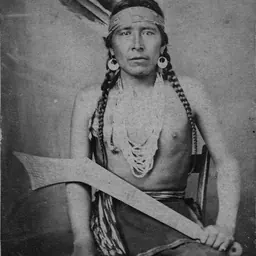
Wabasha II (c. 1773–1836), also known as Wapahasha, Wapasha, or "The Leaf," succeeded his father as head chief of the Mdewakanton Dakota tribe in the early 1800s. He led the Dakota forces fighting with the British in the War of 1812, but sided with the United States in the Black Hawk War of 1832. Chief Wabasha II signed the Treaties of Prairie du Chien in 1825 and 1830.
In 1843, the settlers of Rocque's Landing changed the name of their town to "Wabasha" in honor of the chief. A statue of Wapahasha II stands next to a fountain in present-day Wabasha, Minnesota, on the west bank of the Mississippi River.
Changes among the Dakota For a time in the late 1700s, the Mdewakanton Dakota were said to have united into a large village called Titankatanni (meaning "great old village") on the lower Minnesota River, with as many as 400 lodges.
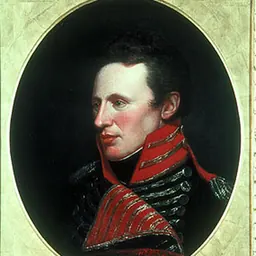
Early encounters with Americans Explorer Zebulon Pike visited Chief Wabasha in 1805 and again in 1806.
Pike expedition In the fall of 1805, Lieutenant Zebulon Pike stopped at the mouth of the Upper Iowa River to meet with Chief Wabasha, "son of the great Wapashaw," before proceeding north on his first expedition. to negotiate the purchase of 100,000 acres of land so that the United States could build a fort at the mouth of the Minnesota River. The Treaty of St. Peters, also known as Pike's Purchase, was signed by only two of the seven Mdewakanton leaders present, including Chief Little Crow I and Penichon.
In April 1806, after spending the winter with the Ojibwe and with fur traders in the north, Pike returned to the mouth of the Minnesota River (to what is now known as Pike Island) and held another council with the Dakota. This time, more than forty chiefs from the Sisseton, Wahpeton and Mdewakanton Dakota bands attended, together with 500 tribesmen.
Following the council, Pike went downriver and stopped in Kaposia, and again in the villages of Tatankamani and Wabasha, on his way back to St. Louis. Wabasha II and Little Crow I rejected their gifts and made speeches expressing anger at the British for failing to protect the interests of the Indians. As a result, McDouall wrote many letters to his superiors arguing in favor of British intervention against the military outposts that the United States was planning to build in Green Bay and Prairie du Chien. The Indians considered this an intrusion on their territory; they had never given permission for the Americans to build forts there. McDouall argued that the forts would be in violation of the Treaty of Ghent and that the British risked losing support from the Indians if they failed to stand up to the Americans. The next day, Long reported meeting "the nephew of La Fieulle" [sic], whom he was told would succeed Wabasha as chief. Wabasha's nephew was out on a hunting expedition.
Treaties Indian agent Lawrence Taliaferro organized the first Dakota Sioux delegation to Washington in 1824. In the spring of 1824, Chief Wabasha II departed Kiyuksa village as part of the "first Sioux Indian delegation to Washington" organized by Indian agent Lawrence Taliaferro. Other notable Dakota leaders in the delegation included Mdewakanton Chief Little Crow I and Yanktonai Chief Wanata I (The Charger). They were accompanied on the journey by a delegation of the Ojibwe (Chippewa).
1830 Treaty of Prairie du Chien
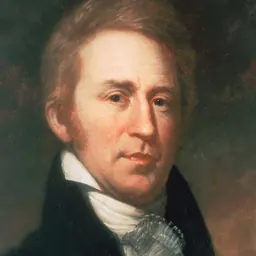
In the summer of 1830, a second conference of the northwestern tribes was held at Prairie du Chien, with United States treaty commissioners William Clark, superintendent of Indian affairs based in St. Louis, and Colonel Willoughby Morgan of the 1st Infantry Regiment at Fort Crawford.
The main purpose of the treaty was to stop various tribes, including the Dakota (Sioux] and the Sauk and Meskwaki (Fox), from raiding each other's territories. Notable signatories included Chiefs Wabasha II, Little Crow I and Big Eagle (grandfather of the later Big Eagle), as well as Wacouta I (who had succeeded Red Wing II), Big Thunder (who would later become Little Crow II), and Good Road (successor of Penichon). or as the Wabasha or Pepin Reservation, Wabasha's band owed considerable debt to "mixed-blood" fur trader Alexis Bailly,
Black Hawk War
Chief Wabasha II and his band were recruited by the United States to fight against Chief Black Hawk and the "British band" of Sauks during the Black Hawk War of 1832.
Peace talks with the Meskwaki On May 21, 1832, Chief Wabasha held peace talks with the Dubuque Meskwaki (Fox) in the presence of Colonel Willoughby Morgan at Prairie du Chien. The Dakota had complained that a war party of Sauks and Meskwakis had entered their territory as defined by the 1830 treaty and killed three or more of their men. The Meskwaki denied that anyone from their tribe had gone against the Dakota since signing the treaty, and said that they wished for peace. In doing so, they stipulated that they could only speak for themselves and not for other members of their brethren. The Dakota and Meskwaki "smoked and danced together and parted in apparent friendship and harmony"
Desertions and reprimand Following "a fortnight of inconspicuous service," the Dakota were marching with Colonel Hamilton to join General Atkinson's army in fighting Black Hawk's men, when all but six of them had a change of heart, turned around, and fled. others went to Prairie du Chien, where they were met by Indian agent Street, who reprimanded them for their "cowardice". Mixed-blood hunter Jack Frazer alone took seven scalps. On September 10, 1836, Wabasha's band signed a treaty with Colonel Zachary Taylor, acting Indian agent at Prairie du Chien. The treaty relinquished any Sioux claim to present-day northwest Missouri for $400 and was signed not by Chief Wabasha II, but by his son who succeeded him as Chief Wabasha III.
Don’t just read it —
keep it.
Full-length biographies made to live with: read them, listen on the way to work, watch them tonight.
- E-book
- Audio
- Video
Instant download · yours to keep · every purchase keeps this site free
Important facts
People in Wapasha II's life
Named in this biography and alive at the same time




Contemporaries
People whose lives overlapped Wapasha II's



Frequently asked questions
Who was Wapasha II?
Dakota chief
When was Wapasha II born?
Wapasha II was born in 1773.
When did Wapasha II die?
Wapasha II died in 1836.
Sources & further reading
Cite this page
APA: Biography.guide. (2026). Wapasha II. https://biography.guide/wapasha-ii/
MLA: "Wapasha II." Biography.guide, https://biography.guide/wapasha-ii/.
Chicago: "Wapasha II." Biography.guide. https://biography.guide/wapasha-ii/.
Data last updated: 2026-09-27 · Spot an error? Report a correction.
Page generated 2026-09-27 05:17 UTC