
Big Eagle
Native American leader
About Big Eagle
Lived 1827 – 1906 (aged 78–79). Big Eagle was an American traditional leader or chief.
Big Eagle (Dakota: Waŋbdí Táŋka, c. 1827–1906) was the chief of a band of Mdewakanton Dakota in Minnesota. He played an important role as a military leader in the Dakota War of 1862. Big Eagle surrendered soon after the Battle of Wood Lake and was sentenced to death and imprisoned, but was pardoned by President Abraham Lincoln in 1864. Big Eagle's narrative, "A Sioux Story of the War" was first published in 1894, and is one of the most widely cited first-person accounts of the 1862 war in Minnesota from a Dakota point of view.
Chief Big Eagle is featured in the "Two Men, One War" marker and the "Battle of Birch Coulee – Big Eagle" marker erected by the Minnesota Historical Society at the Birch Coulee Battlefield; he is also quoted in many of the other markers posted along the self-guided trail.
Life before the war Big Eagle was born in 1827 at Black Dog's village near Mendota, in present-day Eagan, Minnesota. He was a cousin of Little Crow's half-brother, White Spider. Due to the modest size of his band, he was considered a "sub-chief" but "may be termed one of the Sioux generals, since he had a band or division of his own."
As a young man, he often went on war parties against the Ojibwe and other enemies of the Mdewakanton. The six feathers he wore in his headdress symbolized the six scalps he had taken on the war path. but became increasingly critical of the farming movement in the years leading up to the Dakota War of 1862. left
1858 Dakota treaty delegation Big Eagle went to Washington, D.C., in 1858 as part of the Mdewakanton and Wahpekute Dakota treaty delegation led by Little Crow, when he was Little Crow's head warrior (akacita).
During the lengthy negotiations, the Dakota leaders were pressured to sign a treaty relinquishing half of their holdings – the land north and east of the Minnesota River – to the United States, leaving the Dakota with title to a 10-by-150 mile strip of land. According to Big Eagle:"In 1858 the ten miles of this strip belonging to the Medawakanton and Wacouta bands and lying north of the river was sold, mainly through the influence of Little Crow. That year, with some other chiefs, I went to Washington on business connected with the treaty. The selling of that strip north of the Minnesota caused great dissatisfaction among the Sioux, and Little Crow was always blamed for the part he took in the sale. It caused us all to move to the south side of the river, where there was but very little game, and many of our people, under the treaty, were induced to give up the old life and go to work like white men, which was very distasteful to many." Following his death, Big Eagle's brother Grizzly Bear took their uncle's name and became known as Medicine Bottle II (Wakanozanan).
Chief Big Eagle took part in all major battles during the Dakota War of 1862, except for the Battle of Redwood Ferry, After the war, Spencer credited Wakinyatawa (His Own Thunder) for intervening to save his life, but had no recollection of the role that Big Eagle had played:"But I did save the life of George H. Spencer at the time of the massacre. I know that his friend, Chaska, has always had the credit of that, but Spencer would have been a dead man in spite of Chaska if it had not been for me. I asked Spencer about this once, but he said he was wounded at the time and so excited that he could not remember what I did. Once after that I kept a half-breed family from being murdered; these are all the people whose lives I claim to have saved. I was never present when the white people were willfully murdered. I saw all the dead bodies at the agency." On the other hand, Big Eagle described the second battle at Fort Ridgely as a "grand affair," including Little Crow and Good Thunder, who had counted 800 soldiers on the march to the attack. According to Big Eagle, the chief leaders at the battle included The Thief, who was the head soldier of Mankato's band, and Mankato himself, "a very brave man and a good leader":
Battle of Birch Coulee
War council In a war council held on August 31, leaders in Little Crow's camp were divided about what course to follow. After much debate, the decision was made to split into two groups. Big Eagle decided to join Gray Bird, Mankato and Red Legs in leading more than 200 warriors, accompanied by women and wagons, south along the river to collect plunder left behind in Little Crow's village and in New Ulm, which had been abandoned. Meanwhile, Little Crow (Taoyateduta) and Walker Among Stones (Tukanmani) led over 100 men east into the Big Woods. Four or five of their best scouts were sent to follow the movements of Captain Joseph Anderson's detachment, which was part of a burial expedition sent from Fort Ridgely; Big Eagle described the scouts tracking their movements as "creeping across the prairie like so many ants." The Dakota commenced their ambush immediately, killing at least a dozen men, wounding dozens more, and killing most of their horses within the first few minutes. However, the soldiers in the burial party had gone to sleep with their muskets loaded, and many were able to return fire, crouching behind the fallen horses they used as barricades, and driving back the Dakota warriors who approached the wagons. According to Big Eagle:"Just at dawn the fight began. It continued all day and the following night until late the next morning. Both sides fought well. Owing to the white men's way of fighting they lost many men. Owing to the Indians' way of fighting they lost but few. The white men stood up and exposed themselves at first, but at last they learned to keep quiet. The Indians always took care of themselves. We had an easy time of it. We could crawl through the grass and into the coulee and get water when we wanted it, and after a few hours our women crossed the river and came up near the bluff and cooked for us, and we could go back and eat and then return to the fight. We did not lose many men. Indeed, I only saw two dead Indians, and I never heard that any more were killed."
Big Eagle's brother, Medicine Bottle II (Wakanozanzan), was captured with Little Six (Shakopee III) in Manitoba in 1864 and executed in 1865.
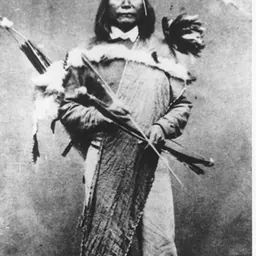
Story behind the portrait The famous portrait of Big Eagle was taken during the summer of 1864 when he was in prison at Camp Kearney (the Native American Stockade at Camp McClellen, Davenport). W. W. Hathaway, then the assistant commissary, had persuaded Big Eagle, the highest ranking Dakota in the prison, to sit for a photograph in a studio that had opened nearby.
"Everything went well until we neared the place, when Big Eagle began to remove his finery," said Hathaway. "We asked him what the trouble was and he said he would not pose unless we paid him $15."
"A Sioux Story of the War"
In June 1894, Big Eagle was interviewed by historian and journalist Robert Ira Holcombe through two interpreters. The narrative, "A Sioux Story of the War: Chief Big Eagle's Story of the Sioux Outbreak of 1862," first appeared in the St. Paul Pioneer Press on July 1, 1894, and was reprinted in Collections of the Minnesota Historical Society later that year.
In his introduction, Holcombe explained the terms under which Big Eagle granted the interview:Mr. Big Eagle was first informed that his statements were wanted solely in order that a correct knowledge of the military movements of the Indians during the war might be learned. It was suggested to him that no harm there from could come to him or any of his people; that neither the war banner nor the "bloody shirt" waved any longer in Minnesota; that it was well known that he was a prominent character in the war, but that he was now and had been for many years a quiet, industrious Christian citizen, respected by all who knew him, and he was assured that he would be correctly reported. He readily consented to tell his story, and gave full permission to use his name.
Return I. Holcombe himself was uniquely well-qualified to conduct the interview of Big Eagle. A Union Army veteran of the American Civil War who was also an avid reader of the Confederate Veteran, Holcombe had been employed for a year at the Minnesota Historical Society where he "arranged and examined the large collection of letters and other papers received from General Sibley, who had died two years before."
One early critic of Big Eagle's narrative was Samuel J. Brown, son of Joseph R. Brown, who wrote a letter to Holcombe on February 6, 1896, expressing skepticism about Big Eagle's version of events. Regarding Holcombe, historian William E. Lass writes, "His work displayed factual accuracy, critical evaluation of sources – including eyewitness accounts – and a dispassionate style free of inflammatory language."
On the continuing significance of Big Eagle's narrative of the Dakota War of 1862, historian Kenneth Carley wrote in 1962, "Regardless of Brown's estimate, or of any imperfections the narrative may have, it has been widely used – and of necessity will continue to be used – by writers interested in telling the Indian as well as the white side of the outbreak. There simply is no other major Indian account to compare with it."
Don’t just read it —
keep it.
Full-length biographies made to live with: read them, listen on the way to work, watch them tonight.
- E-book
- Audio
- Video
Instant download · yours to keep · every purchase keeps this site free
Important facts
People in Big Eagle's life
Named in this biography and alive at the same time

Related people
Same field, nearest in time



Contemporaries
People whose lives overlapped Big Eagle's





Frequently asked questions
Who was Big Eagle?
Native American leader (1827–1906)
When was Big Eagle born?
Big Eagle was born in 1827 in Eagan.
When did Big Eagle die?
Big Eagle died on 5 January 1906 in Granite Falls, Minnesota.
What was Big Eagle's occupation?
Big Eagle was a traditional leader or chief.
What nationality was Big Eagle?
Big Eagle was American.
Sources & further reading
Cite this page
APA: Biography.guide. (2026). Big Eagle. https://biography.guide/big-eagle/
MLA: "Big Eagle." Biography.guide, https://biography.guide/big-eagle/.
Chicago: "Big Eagle." Biography.guide. https://biography.guide/big-eagle/.
Data last updated: 2026-09-24 · Spot an error? Report a correction.
Page generated 2026-09-27 05:00 UTC