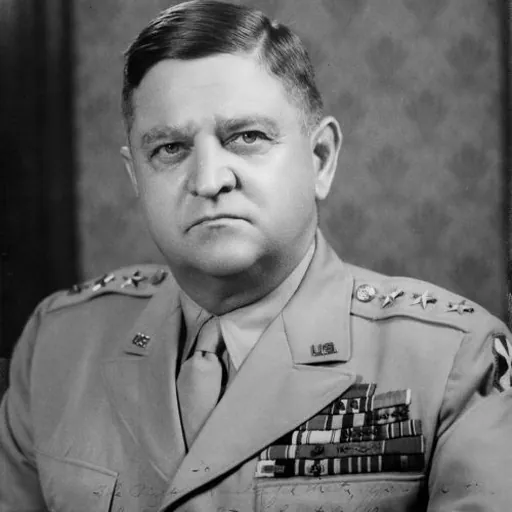
About Walton H. Walker
Lived 1889 – 1950 (aged 61). Walton H. Walker was an American military personnel and soldier.
Walton Harris Walker (3 December 1889 – 23 December 1950) was a United States Army four-star general who served with distinction in World War I, World War II, and the Korean War, where he commanded the Eighth United States Army before dying in a jeep accident. He received two Distinguished Service Crosses for extraordinary heroism in World War II and the Korean War.
Early life Walker was born in Belton, Texas, on 3 December 1889. His parents, Sam and Lydia Walker were both college graduates whose fathers had been officers in the Confederate Army. His father, a merchant, taught him how to ride a horse and to hunt and shoot. He graduated from the Wedemeyer Academy, a school which operated in Belton from 1886 to 1911. From a young age, he desired to go to United States Military Academy (USMA) at West Point, New York, and he hoped to be a general one day.
Early military career
Walker attended the Virginia Military Institute in preparation for his education at the USMA. He entered the Academy on 15 June 1907, but resigned on 7 October 1907. He reentered the Academy on March 3, 1908, and was commissioned a second lieutenant of Infantry on 12 June 1912.
As a lieutenant, Walker served at Fort Sheridan, Illinois; Fort Crockett, Texas; Veracruz, Mexico; Galveston, Texas; and Fort Sam Houston, Texas, from June 1912 to May 1917. He was a member of the 1914 Veracruz expedition under Brigadier General Frederick Funston; patrolling on the U.S.-Mexican border in 1916, he developed a close friendship with Dwight D. Eisenhower. He was promoted to captain on 15 May 1917, a few weeks after the American entry into World War I. He was awarded two Silver Stars for gallantry in action.
Interwar period After the war, Walker rotated through a variety of assignments at Camp Benning, Georgia, and Fort Sill, Oklahoma, and served as a company commander and instructor at West Point from August 1923 to June 1925. He attended the Command and General Staff School at Fort Leavenworth, Kansas, from September 1925 to June 1926. He then served at Fort Monroe, Virginia, from June 1926 to July 1930. He next commanded the 2nd Battalion, 15th Infantry at Camp Burrowes, Qinhuangdao and American Barracks, Tianjin, China, from September 1930 to March 1933.
He was promoted to lieutenant colonel on 1 August 1935, and, after attending the United States Army War College from August 1935 until June 1936, he served as post executive officer and then brigade executive officer with the 5th Infantry Brigade, 3rd Division, from August 1936 to June 1937; the brigade was commanded by George C. Marshall, the future Army Chief of Staff.
General Patton with members of his staff. Walker is standing on the right
When Marshall (now Chief of Staff) assigned George S. Patton to organize America's armored forces, Walker successfully lobbied Marshall for a post as one of Patton's subordinate commanders, gaining promotion to brigadier general in the process. Promoted to major general in 1942; he commanded the 3rd Armored Division from August 1941 to August 1942. After being succeeded by Leroy H. Watson, Walker became commanding general of IV Corps and then XX Corps (IV Armored Corps became XX Corps), taking the latter to England in February 1944 and leading it into combat in Normandy in July as part of Patton's Third Army. He was awarded a Silver Star for gallantry in action on 7 July 1944. The citation for the medal read:
The President of the United States of America, authorized by Act of Congress, 9 July 1918, takes pleasure in presenting a Second Bronze Oak Leaf Cluster in lieu of a Third Award of the Silver Star Medal to Major General Walton Harris Walker (ASN: 0-3405), United States Army, for gallantry in action against the enemy. When Infantry troops of the XX Corps launched an attack across the Vire River in the vicinity of Airel, 7 July 1944, and came under intensive enemy fire, General Walker made repeated visits to the disputed sector and exposed himself to mortar and artillery concentrations at the front in order to encourage the officers and men making the crossing. By his personal gallantry, he expedited the vital assault and contributed to the establishment of the bridgehead. General Walker's conduct reflects credit upon himself and the military service. becoming a communist state after 1946, known as the Democratic People's Republic of Korea, followed by South Korea becoming the Republic of Korea (ROK). China became the communist People's Republic of China in 1949. In 1950, the Soviet Union backed North Korea while the United States backed South Korea, and China allied with the Soviet Union in what was to become the first military action of the Cold War.
Shortly after 75,000 North Korean troops with tanks invaded South Korea on 25 June 1950, The U.S. Eighth Army was ordered to intervene and drive the invaders back across the 38th parallel, the border between the two countries. With only four lightly equipped and poorly trained divisions, Walker began landing troops on the southeast side of the Korean peninsula in July. After his lead units, elements of the 24th Infantry Division (including the ill-fated Task Force Smith), were virtually destroyed in a few days of furious fighting between Osan and Taejon, Walker realized his assigned mission was impossible and went on the defensive. Pushed steadily back towards the southeast by the North Korean advance, Walker's forces suffered heavy losses and for a time were unable to form a defensible front, even after bringing the 1st Cavalry Division and 25th Infantry Division into the fight.
Walker's situation was not helped by MacArthur's unrealistic demands from Tokyo for him not to retreat an inch. Attempting to obey, Walker gave a bombastic "not a step back" speech to his staff and subordinate commanders which did not go over well. Nor did it stop the North Korean troops from pushing back American and South Korea troops, which had been badly mauled in the opening days of the invasion, even further. As American and South Korean forces retreated further east and south, they finally arrived at a defensible line on the Nakdong River. They took advantage of shortened supply routes and a relatively good road network to exploit the advantages of interior lines. Walker was able to quickly shift his units from point to point, stopping North Korean attacks before they could be reinforced.
A critical advantage Walker had was signals intelligence produced by the U.S. Armed Forces Security Agency (now the National Security Agency). This data enabled Walker to gain an indication of North Korean Army movements prior to attacks. Walker kept his main units deployed on the front lines, while retaining other U.S. Army and Marine Corps forces as a mobile reserve. His ability to better interpret North Korean intentions allowed him and his staff to better position his forces along the perimeter. It also allowed him to employ artillery and airpower more effectively.
American military forces gradually solidified this defensive position on the southeast side of the Korean peninsula, dubbed the "Pusan Perimeter". Walker received reinforcements, including the Provisional Marine Brigade, which he used along with the Army's 27th Infantry Regiment as "fire brigades," reliable troops who specialized in counterattacking and wiping out enemy penetrations. As more reinforcements arrived, the combat advantage shifted toward the United Nations forces. North Korean forces had suffered terribly and their supply lines were under constant aerial bombardment. Almost all of their Russian-made T-34 tanks, which had spearheaded the invasion, had been destroyed. Walker ordered local counterattacks, while planning for a large-scale breakout in conjunction with MacArthur's Inchon landing in September.
With MacArthur's amphibious flanking move, the North Koreans seemed trapped, but Walker's rapid advance northwest towards Inchon and Seoul emphasized speed over maneuver and made no attempt to encircle and destroy the North Koreans after punching through their lines. Although thousands of prisoners were taken, many North Korean units successfully disengaged from the fighting, melting away into the interior of South Korea, where they would conduct a guerrilla war for two years. Others escaped all the way back to North Korea. Walker was awarded the Distinguished Service Cross for extraordinary heroism from 14 July to 28 September 1950. The medal's citation read:
The President of the United States of America, under the provisions of the Act of Congress approved 9 July 1918, takes pleasure in presenting a Bronze Oak Leaf Cluster in lieu of a Second Award of the Distinguished Service Cross to Lieutenant General Walton Harris Walker (ASN: 0-3405), United States Army, for extraordinary heroism in connection with military operations against an armed enemy of the United Nations while serving as Commanding General of the 8th United States Army. Lieutenant General Walker distinguished himself by extraordinary heroism in action against enemy aggressor forces in the Republic of Korea from 14 July to 28 September 1950. During this campaign General Walker personally, and at great risk to his own life from enemy ground fire, performed repeated aerial reconnaissance flights in unarmed plane deep into enemy territory. The knowledge gained by General Walker from these flights was of inestimable value to him in making tactical decisions, and contributed greatly to the accomplishment of his mission in spite of the preponderance of force possessed by the enemy. In addition to the above and with personal disregard not only of health of but life itself, he spent hour after hour and day after day on the battlefield, inspiring the United Nations forces with his own courage and his will to fight. Where acts of personal courage were common, General Walker's fearlessness and courageous leadership were outstanding. taking advantage of the American failure to take basic security measures, and the large gaps between American and South Korean units and between the Eighth Army and the X Corps. From late October until the beginning of December in 1950, the Chinese killed or captured thousands of American and ROK soldiers, decimating the 2nd Infantry Division and forcing Walker into a desperate retreat.
By early December, using his superior mobility, Walker successfully broke contact with the Chinese, withdrawing south to a position around Pyongyang, the capital of North Korea. Without instructions from MacArthur's headquarters, Walker decided that the Eighth Army was too battered to defend Pyongyang and ordered the retreat to resume to below the 38th parallel, saving most of the Eighth Army. Seoul (near Uijeongbu), South Korea, when his north-bound command jeep collided with a south-bound weapons carrier from a South Korean army division that had swung out of its lane. His body was escorted back to the United States by his son Sam Sims Walker, then a Company commander with the 19th Infantry Regiment, who was also serving in Korea. On 2 January 1951, he was posthumously promoted to full general
Military awards and badges Walker's decorations and awards, and badges, include:
Badges
Military promotions Source – Official Register of the United States Army. 1946. pg. 713
Cadet, United States Military Academy: 15 June 1907
Second Lieutenant, Regular Army: 12 June 1912
First Lieutenant, Regular Army: 1 July 1916
Captain, Regular Army: 17 May 1917
Major, National Army: 7 June 1918
Lieutenant Colonel, National Army: 6 May 1919
Captain, Regular Army: 12 February 1920
Major, Regular Army: 1 July 1920
Lieutenant Colonel, Regular Army: 1 August 1935
Colonel, Army of the United States: 14 February 1941
Brigadier General, Army of the United States: 10 July 1941
Major General, Army of the United States: 16 February 1942
Colonel, Regular Army: 1 May 1942
Lieutenant General, Army of the United States: 15 April 1945
Major General, Regular Army: 1 August 1947
General, Regular Army (posthumous): 2 January 1951 His picture hangs in the school lobby. A biography of Walker was published in 2008 titled General Walton H. Walker: Forgotten Hero-The Man Who Saved Korea, by Charles M. Province.
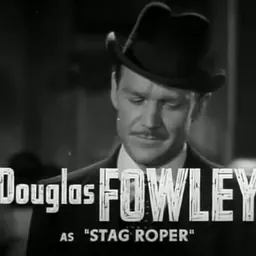
In popular culture Walker was portrayed by Douglas Fowley in the 1963 film Miracle of the White Stallions, and by Garry Walberg in the 1977 film MacArthur.
Don’t just read it —
keep it.
Full-length biographies made to live with: read them, listen on the way to work, watch them tonight.
- E-book
- Audio
- Video
Instant download · yours to keep · every purchase keeps this site free
Important facts
People in Walton H. Walker's life
Named in this biography and alive at the same time


Related people
Same field, nearest in time




Contemporaries
People whose lives overlapped Walton H. Walker's

Frequently asked questions
Who was Walton H. Walker?
United States Army general (1889-1950)
When was Walton H. Walker born?
Walton H. Walker was born on 3 December 1889 in Belton.
When did Walton H. Walker die?
Walton H. Walker died on 23 December 1950 in Seoul.
What was Walton H. Walker's occupation?
Walton H. Walker was a military personnel and soldier.
What nationality was Walton H. Walker?
Walton H. Walker was American.
Sources & further reading
Cite this page
APA: Biography.guide. (2026). Walton H. Walker. https://biography.guide/walton-h-walker/
MLA: "Walton H. Walker." Biography.guide, https://biography.guide/walton-h-walker/.
Chicago: "Walton H. Walker." Biography.guide. https://biography.guide/walton-h-walker/.
Data last updated: 2026-09-23 · Spot an error? Report a correction.
Portrait: Wikimedia Commons · author & licence
Page generated 2026-09-27 05:08 UTC