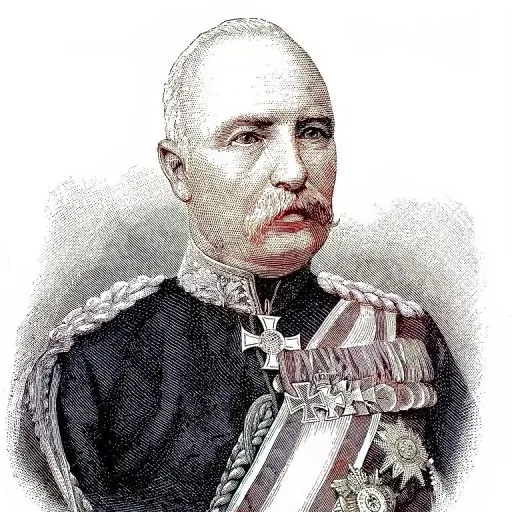
About Walter von Loë
Lived 1828 – 1908 (aged 79). Walter von Loë was a German military personnel, politician, soldier and general field marshal.
Friedrich Karl Walter Degenhard Freiherr von Loë (9 September 1828 – 6 July 1908) was a Prussian soldier and aristocrat. Loë had the distinction of being one of the few Roman Catholics to reach the rank of Generalfeldmarschall (field marshal) in the Prussian and imperial German armies.
Biography Walter was born on 9 September 1828 in Schloss Allner, Hennef, to Baron Maximilian von Loë (1801–1850), a chamberlain in the Prussian royal court and chief administrator of the Sieg district in the Rhine Province, and his first wife, Countess Helene von Hatzfeldt-Werther-Schönstein (1801–1838). The House of Loë was an ancient Catholic noble family of Westphalian origin, who was raised to the status of baron of the Holy Roman Empire in 1629. Walter had two younger brothers: Engelbert (1833–1904), and Otto (1835–1892), who would later become a member of the Reichstag.
Military career In his youth, Loë was educated at the Ritterakademie in Bedburg until 1845, when he served his required year in the military and was transferred to the reserves. After graduating from the academy, he studied at Bonn University. Loë was not to stay at the university for long, however, as war with Denmark broke out over a border dispute known as the Schleswig-Holstein Question. The duchies of Schleswig and Holstein, located along the Danish border, were claimed by both Prussia and Denmark. When German Schleswig-Holsteiners rebelled, Prussia and other German states sent forces to intervene. Loë served as a lieutenant of German cavalry during the conflict, eventually transferring to the Prussian 3rd Hussars.
In 1851, the war with Denmark concluded with an agreement, the 1852 London Protocol, which allowed the Danes to retain Schleswig-Holstein. Loë remained in the military, however, fighting rebels in Baden before becoming adjutant of Prussia's Army Riding School. A major by 1861, Loë became an aide-de-camp to King William I of Prussia, serving in this capacity for one year, upon which he accompanied the King's brother, Prince Albert, to the Caucasus. In 1863, Loë was appointed military attaché to the French army in Algeria; whilst in North Africa, he participated in a French campaign against Arab rebels.
Returning to Prussia, Loë was transferred to the army's Grand Headquarters, seeing action in the Battle of Königgrätz. He was promoted firstly to lieutenant colonel (1867) and then to full colonel (1868), and commanded the Seventh Hussars during the Franco-Prussian War, after which Germany was unified under William, now Emperor of the entire German nation. Loë's forces performed satisfactorily during the war, and he advanced to the level of brigade commander. Serving in both command and staff roles, Loë—having succeeded to his father's title of baron—rose to major general and then to lieutenant general. He became the commander of the 5th Division in 1879, and served from 1880 to 1884 as Prussian adjutant general, after which he was given command of the VIII Army Corps.
In February 1893, Loë was sent to Rome as Germany's liaison to the Holy See, meeting with Pope Leo XIII. Upon his successful completion of this diplomatic mission, Loë was made colonel general of the cavalry. After spending two years in charge of the cavalry branch, he was promoted to field marshal on 1 January 1905, becoming one of the few Catholics to receive this highest rank after service in the Protestant-dominated Prussian army. Additionally, Loë was made Commander-in-chief of the Marches and Governor of Berlin.
Catholic faith Loë's promotion to field marshal was exceptional in that this honour was rarely given to Catholics. Traditionally a Protestant state, Prussia allowed few Catholics to rise that high in rank. Despite his beliefs, Loë supported practices such as dueling, often embracing the traditions of Prussian Protestant officers.
Loë's faith, as well as his connection to the House of Hatzfeldt, would also bring him into conflict with Imperial Chancellor Otto von Bismarck, who spearheaded the anti-Catholic Kulturkampf during the 1870s. Bismarck was among those involved in the affair between his son Herbert and Princess Elisabeth von Carolath-Beuthen, the latter of whom was Loë's sister-in-law.
Honours and awards The Loestraße in Südstadt, Bonn, is named in his honour.
Orders and decorations
Military appointments À la suite of the 7th (1st Rhenish) Hussars "King William I" Honorary Doctorate from the Rheinische Friedrich-Wilhelms University, 8 July 1908
Don’t just read it —
keep it.
Full-length biographies made to live with: read them, listen on the way to work, watch them tonight.
- E-book
- Audio
- Video
Instant download · yours to keep · every purchase keeps this site free
Important facts
People in Walter von Loë's life
Named in this biography and alive at the same time
Related people
Same field, nearest in time

Contemporaries
People whose lives overlapped Walter von Loë's





Frequently asked questions
Who was Walter von Loë?
Prussian general (1828-1908)
When was Walter von Loë born?
Walter von Loë was born on 9 September 1828 in Schloss Allner.
When did Walter von Loë die?
Walter von Loë died on 6 July 1908 in Bonn.
What was Walter von Loë's occupation?
Walter von Loë was a military personnel, politician, soldier and general field marshal.
What nationality was Walter von Loë?
Walter von Loë was German.
Sources & further reading
Cite this page
APA: Biography.guide. (2026). Walter von Loë. https://biography.guide/walter-von-loe/
MLA: "Walter von Loë." Biography.guide, https://biography.guide/walter-von-loe/.
Chicago: "Walter von Loë." Biography.guide. https://biography.guide/walter-von-loe/.
Data last updated: 2026-09-23 · Spot an error? Report a correction.
Portrait: Wikimedia Commons · author & licence
Page generated 2026-09-27 05:07 UTC