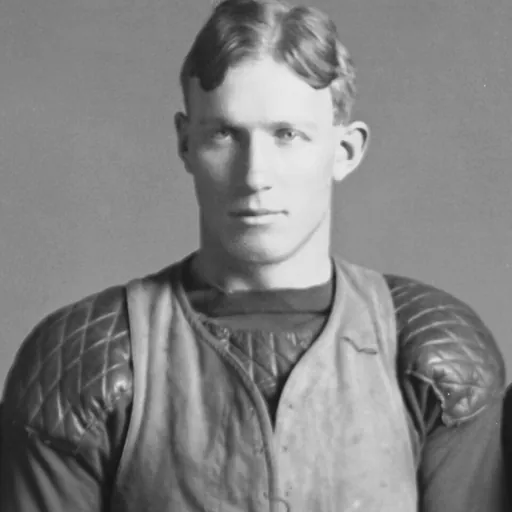
Walter Rheinschild
American football player and coach
About Walter Rheinschild
Lived 1884 – 1960 (aged 76). Walter Rheinschild was an American head coach, athletics competitor and american football player.
Walter Meadowfield Rheinschild (September 26, 1884 – October 3, 1960), known also by the nicknames "Rheiny" and "Rhino", was an American football player and coach. He played for the University of Michigan in 1904, 1905, and 1907, and was once "rated as the highest salaried amateur athlete in the business." In the 1890s, Rheinschild began playing football for the Boyle Heights Stars in the Boyle Heights section of Los Angeles. With Rheinschild playing fullback, the Stars won what the Los Angeles Times called "the 'scrub' championship of this city."
In 1900, Rheinschild enrolled at Los Angeles High School, where he became "a gridiron hero."
Bidding for Rheinschild's services Rheinschild and Michigan athletic director Charles A. Baird (pictured) denied that any money was paid to Rheinschild for playing football. Rheinschild was one of the most heavily recruited high school football players in the United States in 1904. USC coach Harvey Holmes recruited him strenuously, and Rheinschild later said that Holmes had offered him $75 a month for his services.
Rheinschild was also visited by "a delegation" from Dartmouth College seeking "to do business with the California lad." However, when he rejected Dartmouth's offer of $2,200, eastern newspapers insinuated that Rheinschild had signed for "a Ty Cobb salary at Ann Arbor."
In late 1905 and early 1906, charges of professionalism were leveled at the major college football programs, including Michigan, leading to calls for reform or even elimination of the sport from college campuses. In response to the controversy, the faculty at Michigan ruled Rheinschild and two other football players, Germany Schulz and Henry Schulte, academically ineligible. As a result, Rheinschild missed the 1906 season. Rheinschild's hometown newspaper, the Los Angeles Times described the action as follows: "In 1906 a wave of athletic purity swept over the country and the faculty refused to allow Rheinschild to play, for appearance sake. ... 'Rhiney' assisted Yost with the coaching and did some classroom work for a change." At the end of the 1907 season, Rheinschild was one of two Michigan players selected by Fielding H. Yost for the All-American team he selected for the North American Press Syndicate. He was also selected as an All-Western tackle by Walter Eckersall, who wrote that Rheinschild "has no equal at tackle." Eckersall continued:
Rheinschild of Michigan played close to the top this year, and his work in the Pennsylvania game would have given him even without his work in the other games. It was the best of any tackle on the field, and clearly indicated his caliber. One of his points is getting down the field under kicks. He often beat his ends down, and was sure and deadly in his tackle. He was not made use of sufficiently in offense to get his value in that respect. He was able to lunge from his position with extreme rapidity, to assist either the offense or defense. His play was, if anything less showy than in former years, but fully as effective, and this was clearly demonstrated all year.
Rheinschild graduated from the University of Michigan in 1908 with a law degree. In his first and only season as coach at Washington State, his football team compiled a record of 4 wins, 0 losses, and 2 ties. When the University of Washington claimed to be the football champions of the Northwest, Rheinschild, whose team played Washington to a tie, disputed the claim and challenged them to a rematch in Pullman. Rheinschild added, "Can Washington lay claim to the championship over W.S.C. when we played them to a standstill on their own grounds, held them to a 6 to 6 score and were outplaying them in the last 10 minutes of the game, so that nothing but the expiration of time prevented us from scoring a touchdown?" Image of Rheinschild from 1909 newspaper article announcing his hiring by St. Vincent's College In 1909, Rheinschild returned to Los Angeles to become head football coach at St. Vincent's College (now known as Loyola Marymount University). He led St. Vincent's to an undefeated season and the football championship of Southern California in his one year as head coach. The Los Angeles Times praised Rheinschild's efforts in turning the St. Vincent's team into champions:
Rheinschild has accomplished wonders with a squad which at the outset of the season appeared to be mediocre to an unusual degree. The Saints' athletic authorities are more than pleased with the success of 'Rheiny.' They expected the coach to clean up the Saint athletics and get a start for next year. 'Rheiny' did considerably more. He developed the strongest team the Saints ever had. And the eleven played clean ball too.
In 1913, Rheinschild was hired as the football coach at Throop College (now known as California Institute of Technology) in Pasadena, California, where he was paid $40 per game—the largest salary ever paid to a football coach in Southern California. He continued coaching in the 1910s as the football coach of the Los Angeles Athletic Club.
In 1915, Rheinschild was offered coaching positions at both the University of Michigan and the University of Washington. In April 1916 Rheinschild was endorsed to serve as the football coach at Occidental College, replacing Joseph Pipal. Occidental football records show that Fox Stanton served as the team's head coach in 1916. Rheinschild coached at Occidental during the 1917 season.
On Christmas Day 1917, Rheinschild coached and played for a college all-star football team in a match against athletes from the San Pedro Submarine Base.
Family, legal and business careers Rheinschild was married in February 1909 to Enid Daniels at the Scottish Rite Cathedral in Los Angeles; following the ceremony, they couple was given a box at the Orpheum Theatre where a spot light was thrown on them between acts as "the orchestra struck up a wedding march" for the embarrassed couple.
After stepping down as the coach at St. Vincent's College in 1910, Rheinschild established a law practice in the Security Building, then the tallest building in Los Angeles, located in the heart of the city's Spring Street Financial District. The old "Orpheum Theater" where Rheinschild and his bride were in the spotlight in 1909. In April 1919, Rheinschild was tried and found not guilty of complicity in an automobile theft; Rheinschild had been accused of hiding the automobile after it was stolen by another person. In September 1919, Rheinschild was suspended from the practice of law for 18 months after being accused of unethical conduct in representing both parties in a loan transaction. The Los Angeles Times reported that "tears of mortification" came into his eyes when the suspension was announced, and "his young and attractive wife ran up to him and threw her arms around his neck and tenderly kissed him." The following month, a different judge ordered Rheinschild disbarred, stating that the action was needed to set an example for other lawyers to restrain from similar conflicts of interest.
As of 1934, Rheinschild was the president of Corona Oil Company, Ltd., which was then drilling for oil in "the old Rancho LaSierra" in Riverside County, California.
In 1942, Rheinschild was a prosecution witness against Bugsy Siegel on charges of murdering Harry "Big Greenie" Greenberg; Rheinschild testified he had seen Siegel near Greenberg's house on many occasions in the weeks prior to the murder.
Head coaching record
Don’t just read it —
keep it.
Full-length biographies made to live with: read them, listen on the way to work, watch them tonight.
- E-book
- Audio
- Video
Instant download · yours to keep · every purchase keeps this site free
Important facts
People in Walter Rheinschild's life
Named in this biography and alive at the same time

Related people
Same field, nearest in time


Contemporaries
People whose lives overlapped Walter Rheinschild's
Frequently asked questions
Who was Walter Rheinschild?
American football player and coach (1884-1960)
When was Walter Rheinschild born?
Walter Rheinschild was born on 26 September 1884 in Lawrence.
When did Walter Rheinschild die?
Walter Rheinschild died on 3 October 1960 in Los Angeles.
What was Walter Rheinschild's occupation?
Walter Rheinschild was a head coach, athletics competitor and american football player.
What nationality was Walter Rheinschild?
Walter Rheinschild was American.
Sources & further reading
· Wikipedia: Walter Rheinschild
Cite this page
APA: Biography.guide. (2026). Walter Rheinschild. https://biography.guide/walter-rheinschild/
MLA: "Walter Rheinschild." Biography.guide, https://biography.guide/walter-rheinschild/.
Chicago: "Walter Rheinschild." Biography.guide. https://biography.guide/walter-rheinschild/.
Data last updated: 2026-09-20 · Spot an error? Report a correction.
Page generated 2026-09-27 05:10 UTC