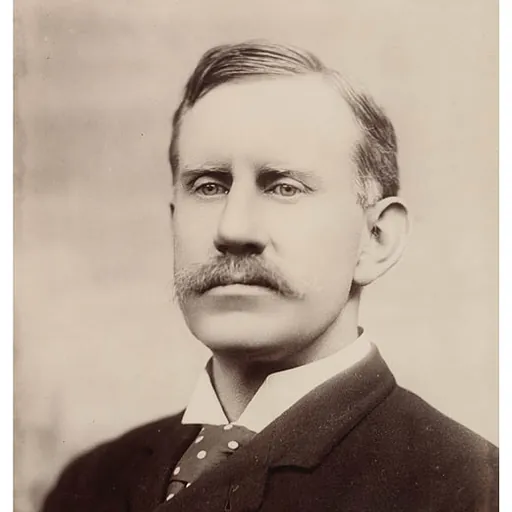
About Walter Liberty Vernon
Lived 1846 – 1914 (aged 67). Walter Liberty Vernon was an Australian architect.
Colonel Walter Liberty Vernon, (11 August 1846 – 17 January 1914) was an English architect who migrated to Australia and pursued his career as an architect in Sydney, New South Wales. In his role as the New South Wales Government Architect he is noted for designing multiple government buildings, many of which are extant with listings on national and state heritage registers.
Early life Vernon was born 11 August 1846 in High Wycombe, Buckinghamshire, England, the son of a banker's clerk, Robert Vernon and Margaret Liberty. He was articled in 1862 to a London architect, W. G. Habershon, and studied at the Royal Academy of Arts and South Kensington School of Art. After completing his studies, he pursued a practice as an architect in London and married Margaret Anne Jones in 1870 at Newport, Wales. His London practice was successful, but he suffered from bronchial asthma and received medical advice to leave England. He migrated to Australia and arrived in Sydney in November 1883. When the Borough of East St Leonards amalgamated to form the Municipality of North Sydney on 29 July 1890, Vernon was an Alderman of the new council, but did not seek re-election when his term expired in February 1891. Elected a fellow of the Royal Institute of British Architects in 1885, he joined the (Royal) Art Society of New South Wales in 1884, (Sir) John Sulman's Palladian Club and the Institute of Architects of New South Wales in 1887, and the Sydney Architectural Association in 1891. Vernon showed that the system of design competitions were twice as expensive and the activities of this office were boosted in 1894 when extra funding was committed as a way of creating relief work during the Depression of the 1890s.
As an architect practising in Australia, Vernon favoured what were later known as the Federation styles, such as the Free Classical, Arts and Crafts, and Free Style.
Examples of the former were his fire station in St Johns Road, Glebe, Jenolan Caves House in the Blue Mountains and the Public School, Military Road, Mosman. Examples of the latter were his fire stations in The Avenue, Randwick; Darlinghurst Road, Darlinghurst; and Pyrmont Street, Pyrmont. Another example of Federation Free Style is the former police station, Taylor Square, Darlinghurst.
He retired as New South Wales Government Architect in 1911 and returned to private practice, establishing a partnership with Howard Joseland. The latter, also born in England, was a practitioner of the Federation Arts and Crafts and Federation Bungalow styles.
Death and funeral Following the amputation of a leg, Vernon died of septicaemia and gangrene on 17 January 1914 in Darlinghurst and his "impressive funeral" at St James' Church, Sydney on 19 January was attended by "a large and representative gathering of mourners". He is buried in the Anglican section of the Gore Hill Cemetery.
Legacy Vernon had an outstanding career as an architect, with many of his buildings being listed on various national and/or state heritage registers.
Partial list of works The following buildings and structures were designed either in part or in full by Vernon, that are listed on active Commonwealth or State heritage registers include:
Other places where Vernon had involvement, either in part or in full, that are not listed on active Commonwealth or State heritage registers include the Anderson Stuart building, The University of Sydney, the former Balranald Post Office (since demolished), Bowral Court House, the former Braidwood Courthouse, Charles Sturt University, Original Farm and Farm School Buildings, Bathurst, Cootamundra Court House, Condobolin Court House, Cowra Court House, Crows Nest Fire Station, Darlinghurst Fire Station, Darlinghurst Police Station (former), Dubbo Lands Board Office, Forbes Lands Board Office, Hay Court House, Hay Lands Board Office, Hunters Hill Post Office, Kogarah Post Office (former), Lismore Post Office, Narrandera Court House, Newtown Post Office, Orange Lands Board Office, Parkes Court House, Pyrmont Fire Station, Randwick Police Station, Redfern Court House, Sargood & Co Warehouse (former), Summer Hill Post Office (former), Surry Hills Police Station (former), Wagga Wagga Court House, Western Sydney University Stable Square, Richmond and Wyalong Court House.
Gallery
Don’t just read it —
keep it.
Full-length biographies made to live with: read them, listen on the way to work, watch them tonight.
- E-book
- Audio
- Video
Instant download · yours to keep · every purchase keeps this site free
Important facts
People in Walter Liberty Vernon's life
Named in this biography and alive at the same time



Related people
Same field, nearest in time


Contemporaries
People whose lives overlapped Walter Liberty Vernon's

Frequently asked questions
Who was Walter Liberty Vernon?
English architect (1846–1914)
When was Walter Liberty Vernon born?
Walter Liberty Vernon was born on 11 August 1846 in High Wycombe.
When did Walter Liberty Vernon die?
Walter Liberty Vernon died on 17 January 1914 in Darlinghurst.
What was Walter Liberty Vernon's occupation?
Walter Liberty Vernon was an architect.
What nationality was Walter Liberty Vernon?
Walter Liberty Vernon was Australian.
Sources & further reading
· Wikipedia: Walter Liberty Vernon
· DBpedia: Walter Liberty Vernon
Cite this page
APA: Biography.guide. (2026). Walter Liberty Vernon. https://biography.guide/walter-liberty-vernon/
MLA: "Walter Liberty Vernon." Biography.guide, https://biography.guide/walter-liberty-vernon/.
Chicago: "Walter Liberty Vernon." Biography.guide. https://biography.guide/walter-liberty-vernon/.
Data last updated: 2026-09-21 · Spot an error? Report a correction.
Portrait: Wikimedia Commons · author & licence
Page generated 2026-09-27 05:01 UTC