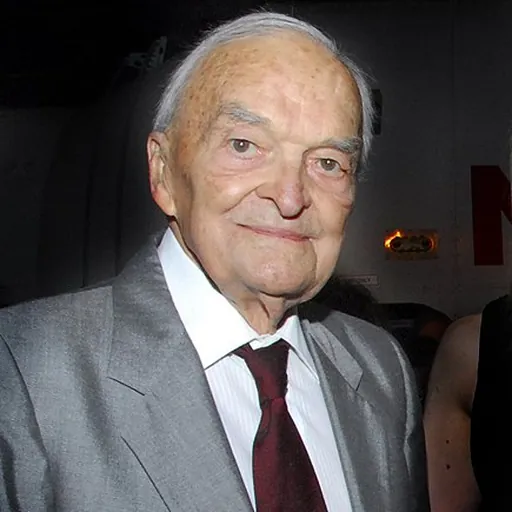
Walter Haeussermann
German-American aerospace engineer
About Walter Haeussermann
Lived 1914 – 2010 (aged 96). Walter Haeussermann was a German and American military flight engineer, engineer, university teacher and scientist.
Walter Haeussermann (also spelled Häussermann; March 2, 1914 – December 8, 2010) was a German-American aerospace engineer and member of the "von Braun rocket group", both at Peenemünde and later at Marshall Space Flight Center, where he was the director of the guidance and control laboratory. He was awarded the Department of the Army Decoration for Exceptional Civilian Service in 1959 for his contributions to the US rocket program. In a 2008 interview, he recalled seeing a rocket engine test upon his arrival there, saying, "I was flabbergasted, because on the first day I was shown a rocket test ... I was astonished that something like this was already existing." Asked about meeting von Braun, he enthusiastically replied, "I met him the second day. I was very interested about him." He worked on the V-2 guidance and simulations by means of analog computers.
Work in guidance and control Haeussermann's main area of work was in automatic guidance and control for missiles. For example, he was instrumental in the design of the Saturn V system. He also conducted research more broadly, for instance in 3-axis attitude control and the use of Hall devices in aerospace control devices. In his late career, he examined control issues related to experiments on board the Space Shuttle.
Arthur Rudolph Haeussermann was a colleague of Arthur Rudolph, who in the 1980s was investigated by the OSI and Eli Rosenbaum for alleged Nazi war crimes. Haeussermann was part of Rudolph's defense team.
Works Haeussermann, W. (1965) Guidance and control of saturn launch vehicles, AIAA #65-304. Haeussermann, W. (1970) Description and performance of the Saturn launch vehicle's navigation, guidance, and control system , NASA TN D-5869. Haeussermann, W. (1971) Saturn launch vehicle's navigation guidance, and control system, Automatica 7(5), 537-556. Haeussermann, W. (1959) The Spherical Control Motor for Three-Axis Attitude Control of Space Vehicles, NASA TM X-50071 Haeussermann, W. (1979) Hall devices improve electric motor efficiency, NASA MFS-23828. Haeussermann, W. (1976) Control requirements of the Shuttle experiments, In: Symposium on Automatic Control in Space, 7th, Rottach-Egern, West Germany, May 17–21, 1976, Volume 1. (A77-24777 10-12) Düsseldorf, VDI/VDE-Gesellschaft Mess- und Regelungstechnik, 1976, p. 97-111.
Don’t just read it —
keep it.
Full-length biographies made to live with: read them, listen on the way to work, watch them tonight.
- E-book
- Audio
- Video
Instant download · yours to keep · every purchase keeps this site free
Important facts
People in Walter Haeussermann's life
Named in this biography and alive at the same time


Related people
Same field, nearest in time
Contemporaries
People whose lives overlapped Walter Haeussermann's


Frequently asked questions
Who was Walter Haeussermann?
German-American aerospace engineer (1914-2010)
When was Walter Haeussermann born?
Walter Haeussermann was born on 2 March 1914 in Künzelsau.
When did Walter Haeussermann die?
Walter Haeussermann died on 8 December 2010 in Huntsville.
What was Walter Haeussermann's occupation?
Walter Haeussermann was a military flight engineer, engineer, university teacher and scientist.
What nationality was Walter Haeussermann?
Walter Haeussermann was German and American.
Sources & further reading
· Wikipedia: Walter Haeussermann
· DBpedia: Walter Haeussermann
Cite this page
APA: Biography.guide. (2026). Walter Haeussermann. https://biography.guide/walter-haeussermann/
MLA: "Walter Haeussermann." Biography.guide, https://biography.guide/walter-haeussermann/.
Chicago: "Walter Haeussermann." Biography.guide. https://biography.guide/walter-haeussermann/.
Data last updated: 2026-09-23 · Spot an error? Report a correction.
Portrait: Wikimedia Commons · author & licence
Page generated 2026-09-27 05:06 UTC