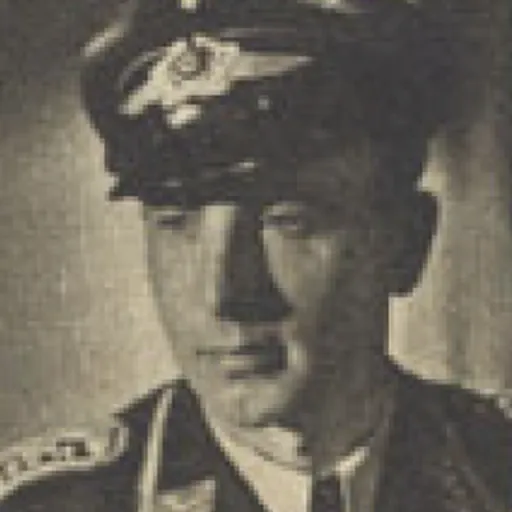
Walter Brandt
German fighter ace and Knight's Cross recipient
About Walter Brandt
Lived 1917 – 1977 (aged 59). Walter Brandt was a German.
Walter Brandt (24 March 1917 – 18 January 1977) was a German Luftwaffe ace and recipient of the Knight's Cross of the Iron Cross during World War II. The Knight's Cross of the Iron Cross, and its variants were the highest awards in the military and paramilitary forces of Nazi Germany during World War II. Brandt was credited with 43 aerial victories in 527 missions.
Career Brandt was born on 24 March 1917 in Bad Salzuflen in the Principality of Lippe within the German Empire. Following flight training, he was transferred to the 2. Staffel (2nd squadron) of Lehrgeschwader 2 (LG 2—2nd Demonstration Wing), a fighter squadron within the I. (Jäger) Gruppe (I.(J)—1st fighter group). Brandt claimed his first aerial victory on 13 March 1941 against the Royal Air Force (RAF) during aerial combat with Supermarine Spitfire fighters north of Cap Gris-Nez.
Eastern Front On 18 June 1941, I.(J)/LG 2 was moved to Bucharest and placed under the command of Jagdgeschwader 77 (JG 77—77th Fighter Wing). The Geschwader was located in the sector of Heeresgruppe Süd (Army Group South). Three days later, I.(J)/LG 2 moved to Roman. That evening, the pilots and ground crews were briefed of the upcoming invasion of the Soviet Union, which opened the Eastern Front.
On 6 January 1942, I.(J)/LG 2 was officially redesignated and became the I. Gruppe of JG 77. On 27 June, I. Gruppe received new orders and began preparations for transfer to Sicily.
Malta and North Africa On 29 June 1942, I. Gruppe under the command of Hauptmann Heinrich Bär relocated from the Eastern Front to the Mediterranean theatre of operations. The Gruppe moved from Baherove, via Odessa, Băneasa, Sofia, Thessaloniki to Eleusis, where they arrived on 1 July. The unit was then ordered to Sicily where it arrived at the Comiso airfield on 5 July and was subordinated to the command of Jagdgeschwader 53 Pik-As (JG 53—53rd Fighter Wing). Three days later, Brandt claimed a Spitfire fighter shot down. This was his first aerial victory during the Siege of Malta on a fighter escort mission for Junkers Ju 88 bombers attacking the RAF Luqa airfield. On 10 July, on another Ju 88 escort mission, he yet again claimed a Spitfire shot down. On 13 July, I. Gruppe flew three combat air patrol missions over Malta, during one of which Brandt claimed a further Spitfire destroyed.
On 25 October, I. Gruppe of JG 77 was ordered to trans to the North African theater, arriving at an airfield named Bir el Abd, located southwest of El Alamein, on 27 October. In December, Brandt was awarded the German Cross in Gold .
On 14 January 1943, Brandt was shot down in his Messerschmitt Bf 109 G-2 trop (Werknummer 10744—factory number) southwest of Buerat, Libya. A Spitfire projectile had nearly severed his right leg prior to him bailing out. Brandt landed in an Italian position and was immediately taken to a nearby field hospital where his right leg had to be amputated. Bär, the commander of I. Gruppe, nominated him for the Knight's Cross of the Iron Cross which was presented to him while hospitalized in Bavaria on 24 March.
Squadron leader and German surrender In August 1944, Brandt was appointed Staffelkapitän (squadron leader) of 2. Staffel of Jagdgeschwader 3 "Udet" (JG 3—3rd Fighter Wing), replacing Oberleutnant Walter Bohatsch in this capacity. On 26 November, he was injured in a takeoff accident at Paderborn when he crashed his Bf 109 G. On 26 November, I. Gruppe, along with other Luftwaffe units, were ordered to participate in a Defense of the Reich mission. The Gruppe, led by Hauptmann Horst Haase, took off from Paderborn and flew into a heavy cloud cover over the airfield. Due to poor visibility conditions, Haase and his wingman, Leutnant Hans Fritz, were killed in a mid-air collision near Erkelenz. Three further aircraft also crashed due to adverse weather conditions. Brandt then took command of the Gruppe, and without sustaining further losses, he safely led the formation back to Paderborn. Following these events, Brandt was arrested and charged with cowardice before the enemy for not continuing the missions. Later, all charges against him were dropped. On 12 December, Brandt claimed a RAF Avro Lancaster heavy bomber shot down. That day, 140 Lancaster bombers attacked the steel works at Witten in the Ruhr. I. Gruppe was scrambled at 12:30 and were vectored to a point of intercept near Dortmund. The Gruppe attacked the bombers, which were unescorted, just prior to their bomb run. The Luftwaffe pilots claimed thirteen bombers shot down, including one by Brandt, for the loss of five of their own.
On 22 January 1945, I. Gruppe relocated to the Eastern Front where they initially occupied an airfield at Stettin-Altdamm, present-day Dąbie in Poland. Here, the Gruppe primarily supported the Army Group Vistula fighting in the Vistula–Oder offensive. On 10 February, the Gruppe was ordered to Pinnow airfield, located approximately south-southwest of Kolberg, present-day Kołobrzeg. Here on 19 February, Brandt claimed a Lavochkin-Gorbunov-Gudkov LaGG-3 fighter shot down over Madüsee, present day Lake Miedwie. On 3 March, Brandt claimed he had destroyed three Soviet T-34 tanks with bombs, further twenty vehicles by strafing, and shot down three aircraft in aerial combat.This earned him a named reference in the Wehrmachtbericht, a propaganda bulletin. Following these events, Brandt was again injured when his Bf 109 G-14 (Werknummer 464278) was hit, resulting in an emergency landing near Augustwalde, present-day Rębusz in Poland. On 23 March, I. Gruppe was ordered to seize all operations. By 10 April, the Gruppe was fully disbanded and its pilots reassigned to other units. In consequence, Brandt was transferred to II. Gruppe of JG 3 where he was given command of 7. Staffel. He replaced Oberleutnant Herbert Mielke who had been killed in action on 3 April. At the time, II. Gruppe was based at Garz Airfield on the island of Usedom. Here, the Gruppe flew several ground attack missions against Soviet bridges crossing the lower Oder. On 30 April, the Gruppe relocated to Pütnitz and to Leck Airfield on 5 May where the remnants of the Luftwaffe surrendered to British forces.
Later life Brandt died from complications of his wartime injuries on 28 January 1977 in Bottrop.
Summary of career
Aerial victory claims According to US historian David T. Zabecki, Brandt was credited with 57 aerial victories. According to Heaton, Lewis, Olds and Schulze however, Brandt was credited with 42 aerial victories. Dixon also lists him 42 aerial victories claimed in 527 combat missions. Mathews and Foreman, authors of Luftwaffe Aces — Biographies and Victory Claims, researched the German Federal Archives and found records for 42 aerial victory claims. This figure includes 23 aerial victories on the Eastern Front and 19 over the Western Allies, including one four-engined heavy bomber.
Victory claims were logged to a map-reference (PQ = Planquadrat), for example "PQ 66642". The Luftwaffe grid map covered all of Europe, western Russia and North Africa and was composed of rectangles measuring 15 minutes of latitude by 30 minutes of longitude, an area of about . These sectors were then subdivided into 36 smaller units to give a location area in size.
Chronicle of aerial victories Claim Date Time Type Location Claim Date Time Type Location – 2.(Jagd) Staffel of Lehrgeschwader 2 –At the Channel and over England — 26 June 1940 – 30 March 1941 1 13 March 1941 15:20 Spitfire north of Cap Gris-Nez – 2.(Jagd) Staffel of Lehrgeschwader 2 –Operation Barbarossa — 22 June – 5 December 1941 2 24 June 1941 13:10 SB-2 5 23 October 1941 16:10 MiG-3 3 16 October 1941 14:00? SB-2 6 1 November 1941 12:07 I-15 4 19 October 1941 15:10 I-15 7 1 November 1941 12:08 I-15 – 2. Staffel of Jagdgeschwader 77 –Winter War — 6 January – 30 April 1942 8? 15 January 1942 R-5 10 20 February 1942 14:37 Pe-2 9 9 February 1942 13:45 I-15 11 3 March 1942 13:17 I-301 (LaGG-3) – 2. Staffel of Jagdgeschwader 77 –Eastern Front — 1 May – 30 June 1942 12 8 May 1942 07:05? I-153 18 13 June 1942 16:15 Il-2 vicinity of Taman 13 28 May 1942 05:21? I-16 PQ 66642 19 14 June 1942 18:48 I-16 PQ 66623 14 28 May 1942 05:23? I-16 PQ 66654 20? 15 June 1942 U-2 15 2 June 1942 12:33 Yak-1 21 26 June 1942 17:00 LaGG-3 16? 4 June 1942 12:45 Yak-1 22 28 June 1942 16:15 MiG-3 17 10 June 1942 10:42 Yak-1 Taman 23 28 June 1942 16:16? MiG-3 – 2. Staffel of Jagdgeschwader 77 –Mediterranean Theater, Sicily — 1 July – October 1942 24? 8 July 1942 Spitfire 33? 10 August 1942 Spitfire 25 10 July 1942 06:33? Spitfire vicinity of Malta 34? 13 August 1942 Spitfire 26 13 July 1942 08:22 Spitfire vicinity of Malta 35? 15 September 1942 10:17 Spitfire vicinity of Malta 27? 17 July 1942 Spitfire 36? 11 October 1942 08:25 Spitfire vicinity of Malta 28? 20 July 1942 Spitfire 37 14 October 1942 08:10 Spitfire vicinity of Malta 29? 26 July 1942 16:55 Spitfire vicinity of Malta 38 14 October 1942 17:50 Spitfire vicinity of Malta 30? 28 July 1942 Spitfire 39 16 October 1942 17:40 Spitfire vicinity of Malta 31? 30 July 1942 18:20 Spitfire vicinity of Malta 40? 17 October 1942 Spitfire 32? 3 August 1942 Spitfire – 2. Staffel of Jagdgeschwader 77 –Mediterranean Theater, North Africa — October – 31 December 1942 41 7 December 1942 15:03 Spitfire 43? 10 December 1942 15:05 P-40 northwest of El Agheila 42 10 December 1942 11:20? P-40 northwest of El Agheila 44? 13 December 1942 15:37 P-40 – 2. Staffel of Jagdgeschwader 77 –Mediterranean Theater, North Africa — 1–14 January 1943 45? 12 January 1943 15:10 P-40 47 14 January 1943 10:20 P-40 vicinity of Buerat 46? 13 January 1943 08:37 P-40 – 2. Staffel of Jagdgeschwader 3 "Udet" –Action in the West — August – 31 December 1944 48 12 December 1944 13:54 Lancaster PQ 05 Ost KPBottrop-Recklinghausen – 2. Staffel of Jagdgeschwader 3 "Udet" –Eastern Front — January – March 1945 49 19 February 1945 16:07 LaGG-3 51 3 March 1945 17:12 Pe-2 50 3 March 1945 17:10 Pe-2 52 3 March 1945 17:13 LaGG-3
Awards Iron Cross (1939) 2nd and 1st Class Honour Goblet of the Luftwaffe on 13 September 1942 as Feldwebel and pilot German Cross in Gold on 12 December 1942 as Feldwebel in the 2./Jagdgeschwader 77 Knight's Cross of the Iron Cross on 24 March 1943 as Oberfeldwebel and pilot in the I./Jagdgeschwader 77
Don’t just read it —
keep it.
Full-length biographies made to live with: read them, listen on the way to work, watch them tonight.
- E-book
- Audio
- Video
Instant download · yours to keep · every purchase keeps this site free
Important facts
People in Walter Brandt's life
Named in this biography and alive at the same time
Contemporaries
People whose lives overlapped Walter Brandt's

Frequently asked questions
Who was Walter Brandt?
German fighter ace and Knight's Cross recipient
When was Walter Brandt born?
Walter Brandt was born on 24 March 1917 in Bad Salzuflen.
When did Walter Brandt die?
Walter Brandt died on 18 January 1977 in Bottrop.
What nationality was Walter Brandt?
Walter Brandt was German.
Sources & further reading
Cite this page
APA: Biography.guide. (2026). Walter Brandt. https://biography.guide/walter-brandt/
MLA: "Walter Brandt." Biography.guide, https://biography.guide/walter-brandt/.
Chicago: "Walter Brandt." Biography.guide. https://biography.guide/walter-brandt/.
Data last updated: 2026-09-22 · Spot an error? Report a correction.
Portrait: Wikimedia Commons · author & licence
Page generated 2026-09-27 05:02 UTC