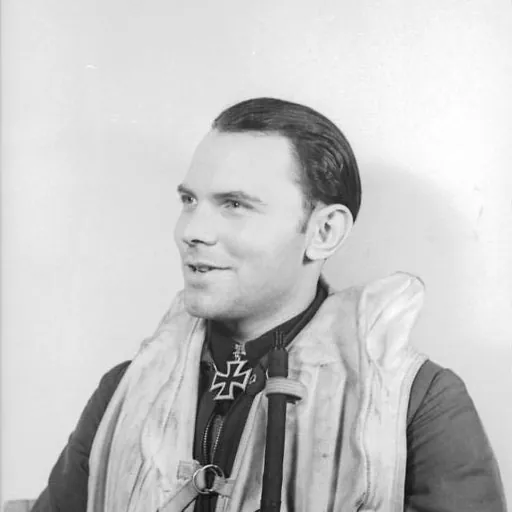
About Walter Borchers
Lived 1916 – 1945 (aged 29). Walter Borchers was a German flying ace.
Walter Borchers (22 January 1916 – 6 March 1945) was a German Luftwaffe military aviator and wing commander during World War II. As a flying ace, he was credited with 59 aerial victories, including 43 nocturnal victories, 10 as a destroyer pilot and 6 four-engined bombers at day time, claimed in roughly 300 combat missions. Prior to his death he held the position of wing commander of the 5th Night Fighter Wing.
Biography Walter Borchers was born on 22 January 1916 in Ofen in Ammerland, Duchy of Oldenburg as the third of three brothers, all of whom would be awarded the Knight's Cross of the Iron Cross during the course of World War II. His brother, Major Adolf Borchers received the Knight's Cross on 22 November 1944 as Staffelkapitän of 11./Jagdgeschwader 51 "Mölders". A second brother, SS-Hauptsturmführer Hermann Borchers received the Knight's Cross on 16 October 1944 as commander of the I. Battalion of the SS-Panzergrenadier-Regiment 19.
Borchers was a member of the 5th Staffel (squadron) of Zerstörergeschwader 76 (ZG 76—76th Destroyer Wing) at the outbreak of World War II on 1 September 1939. He became the Staffelkapitän of 5./ZG 76 in the fall of 1940. He claimed 10 aerial victories during the Battle of France and Battle of Britain.
Night fighter career A map of part of the Kammhuber Line. The 'belt' and night fighter 'boxes' are shown. Following the 1939 aerial Battle of the Heligoland Bight, RAF attacks shifted to the cover of darkness, initiating the Defence of the Reich campaign. By mid-1940, Generalmajor (Brigadier General) Josef Kammhuber had established a night air defense system dubbed the Kammhuber Line. It consisted of a series of control sectors equipped with radars and searchlights and an associated night fighter. Each sector named a Himmelbett (canopy bed) would direct the night fighter into visual range with target bombers. In 1941, the Luftwaffe started equipping night fighters with airborne radar such as the Lichtenstein radar. This airborne radar did not come into general use until early 1942.
Borchers' Staffel was transformed to the 8. Staffel of Nachtjagdgeschwader 3 (NJG 3—3rd Night Fighter Wing) in the fall of 1941, flying night fighter missions in Defence of the Reich. Borchers claimed his first nocturnal aerial victory on the night of 3 March 1943. He claimed his 12th and 15th against the United States Army Air Forces (USAAF) heavies—four-engined strategic bombers—in 1943. Still an Oberleutnant, he was made Gruppenkommandeur of the III./Nachtjagdgeschwader 5 (NJG 5—5th Night Fighter Wing) on 22 April 1943, leading the Gruppe (group) until 15 March 1944. In this position he claimed a further six nocturnal victories and four heavy USAAF bombers shot down.
Wing commander He was promoted to Major and took command of NJG 5 as Geschwaderkommodore (wing commander) on 15 March, succeeding Egmont Prinz zur Lippe-Weißenfeld. He received the Knight's Cross of the Iron Cross on 27 July 1944 by which time he had achieved 45 aerial victories in total.
Having claimed an Avro Lancaster, Borchers was shot down and killed in action on the night of 6 March 1945 by a long-range British night fighter north of Altenburg. Flying Junkers Ju 88 G-6 "C9+GA" (Werknummer 622 319—factory number) his air gunner parachuted to safety while his radio operator Leutnant Friedrich Reul was also killed. Borchers had been nominated for the Oak Leaves to the Knight's Cross which he never received. His victors were Wing Commander Walter Gibb and Flying Officer Kendall of No 239 Squadron, Royal Air Force (RAF), part of No. 100 Group RAF, flying a de Havilland Mosquito night fighter.
Summary of career Aerial victory claims According to US historian David T. Zabecki, Borchers was credited with 59 aerial victories. Foreman, Parry and Mathews, authors of Luftwaffe Night Fighter Claims 1939 – 1945, researched the German Federal Archives and found records for 32 nocturnal victory claims. Mathews and Foreman also published Luftwaffe Aces — Biographies and Victory Claims, listing Borchers with additional eleven aerial victories claimed as a Zerstörer pilot.
Victory claims were logged to a map-reference (PQ = Planquadrat), for example "PQ 4317". The Luftwaffe grid map covered all of Europe, western Russia and North Africa and was composed of rectangles measuring 15 minutes of latitude by 30 minutes of longitude, an area of about . These sectors were then subdivided into 36 smaller units to give a location area in size.
Chronicle of aerial victories Claim(total) Claim(nocturnal) Date Time Type Location Serial No./Squadron No. – 4. Staffel of Zerstörergeschwader 76 – 1 17 May 1940 12:40 M.S.406 2 29 May 1940 14:00 Spitfire 3 8 June 1940 17:40 Hawk 75 4 22 June 1940 17:50 M.S.406 5 15 August 1940 19:05 Spitfire south of Salisbury 6 30 August 1940 12:30 Hurricane 7 4 September 1940 14:05 Spitfire 8 4 September 1940 14:10 Spitfire south of London 9 4 September 1940 14:35 Hurricane south of London 10 11 September 1940 17:05 Hurricane south of Portsmouth – 5. Staffel of Zerstörergeschwader 76 – 11 20 August 1941 15:35 Spitfire PQ 4317 – 8. Staffel of Nachtjagdgeschwader 3 – 12 1 3 March 1943 22:30 Wellington east of Emden – Stab III. Gruppe of Nachtjagdgeschwader 3 – 13 2 18 March 1943 15:45 B-24 Jade Bight northwest of Jade Bight 14 3 5 April 1943 00:46 Wellington west of Terschelling Wellington HE432/428 Ghost Squadron 15 4 17 April 1943 13:45 B-17 PQ 05 Ost 7412 B-17 42-5337/91st Bombardment Group 16 5 24 August 1943 01:14 Stirling Helenau 17 6 1 September 1943 00:50 Stirling south of Berlin 18 7 4 September 1943 00:45 Lancaster south-southeast of Neuruppin 19 8 16 December 1943 20:08 Lancaster northeast of Berlin 20 9 4 January 1944 12:45 B-24 21 10 5 January 1944 11:50 B-24 – 7. Staffel of Nachtjagdgeschwader 5 – 22 11 25 May 1944 00:54 four-engined bomber west of Aachen – Stab of Nachtjagdgeschwader 5 – 23 12 8 June 1944 02:21 four-engined bomber west of Paris Lancaster LL864/No. 115 Squadron 24 13 8 June 1944 02:29 four-engined bomber west of Paris 25 14 8 June 1944 02:31 four-engined bomber west-southwest of Paris 26 15 25 June 1944 00:25 four-engined bomber PQ QD 27 16 25 June 1944 00:48 four-engined bomber PQ NB-3 28 17 5 July 1944 01:50 four-engined bomber Amiens 29 18 16 July 1944 01:35 four-engined bomber Châlons-sur-Marne 30 19 29 July 1944 01:58 four-engined bomber northwest of Stuttgart Lancaster PB172/No. 100 Squadron RAF 31 20 15 October 1944 19:23 PS-84 32 21 23 October 1944 18:09 DB-3 Eastern Front 33 22 14/15 January 1945 Lancaster Western Front 34 23 14/15 January 1945 Lancaster Western Front 35 24 14/15 January 1945 Lancaster Western Front 36 25 15/16 January 1945 Lancaster Western Front 37 26 15/16 January 1945 Lancaster Western Front 38 27 15/16 January 1945 Lancaster Western Front 39 28 8/9 February 1945 Lancaster Western Front 40 29 8/9 February 1945 Lancaster Western Front 41 30 8/9 February 1945 Lancaster Western Front 42 31 5/6 March 1945 four-engined bomber Western Front 43 32 5/6 March 1945 four-engined bomber Western Front
Awards Iron Cross (1939) 2nd and 1st Class German Cross in Gold on 12 July 1943 as Oberleutnant in the 8./Nachtjagdgeschwader 3 Knight's Cross of the Iron Cross on 27 July 1944 as Major and Gruppenkommandeur of the III./Nachtjagdgeschwader 5.
Don’t just read it —
keep it.
Full-length biographies made to live with: read them, listen on the way to work, watch them tonight.
- E-book
- Audio
- Video
Instant download · yours to keep · every purchase keeps this site free
Important facts
People in Walter Borchers's life
Named in this biography and alive at the same time



Related people
Same field, nearest in time

Contemporaries
People whose lives overlapped Walter Borchers's



Frequently asked questions
Who was Walter Borchers?
German World War II flying ace (1916-1945)
When was Walter Borchers born?
Walter Borchers was born on 22 January 1916 in Bad Zwischenahn.
When did Walter Borchers die?
Walter Borchers died on 6 March 1945 in Altenburg.
What was Walter Borchers's occupation?
Walter Borchers was a flying ace.
What nationality was Walter Borchers?
Walter Borchers was German.
Sources & further reading
Cite this page
APA: Biography.guide. (2026). Walter Borchers. https://biography.guide/walter-borchers/
MLA: "Walter Borchers." Biography.guide, https://biography.guide/walter-borchers/.
Chicago: "Walter Borchers." Biography.guide. https://biography.guide/walter-borchers/.
Data last updated: 2026-09-23 · Spot an error? Report a correction.
Portrait: Wikimedia Commons · author & licence
Page generated 2026-09-27 05:08 UTC