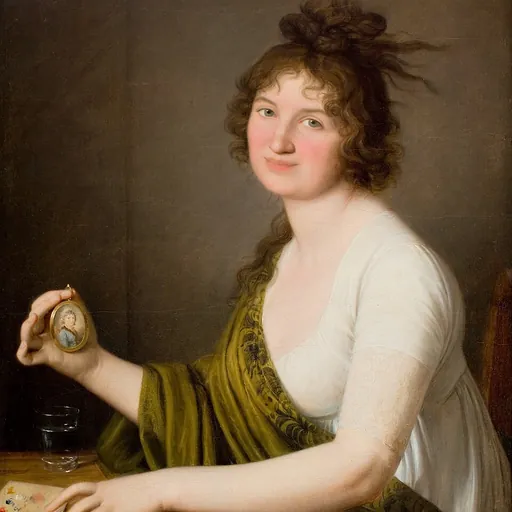
Waleria Tarnowska
Polish painter and art collector
About Waleria Tarnowska
Lived 1782 – 1849 (aged 66). Waleria Tarnowska was a Polish and Austrian art collector, painter and patron of the arts.
Waleria Tarnowska (December 9, 1782, – November 23, 1849) was a Polish painter and a patron of the arts. She is known for her miniatures, numerous portraits, religious paintings and drawings.
Personal life Waleria Tarnowska was a daughter of Walerian Stroynowski and Aleksandra Tarnowska. On 7 September 1800, Waleria married Jan Feliks Tarnowski. She was the mother of Kazimierz, Rozalia, Jan Bogdan, Maria Felicja, Walerian, Rozalia, Wiktoria, Anna and Tadeusz Antoni; and the grandmother of Jan Dzierżysław Tarnowski, Stanisław „Czarny”, Stanisław „Biały” and Władysław. Waleria was educated at home by governesses, and her teachers also included the archaeologist and historian Wawrzyniec Surowiecki, and the professor of chemistry and medicine Jędrzej Śniadecki, as well as her uncle, Hieronim Stroynowski, bishop and Rector of Vilnius University.
Waleria together with her husband Jan Felix created the collection of paintings, drawings, sculptures, books and antiquities at Dzików, which included paintings by Lorenzo Lotto, Guercino, Guido Reni, Rembrandt, Annibale Carracci, Salvator Rosa, Hans Holbein the Younger, Anthony van Dyck, Anton Raphael Mengs, Bernini, Antonio Canova.
Career First Waleria studied painting for three years in Horochów with Constantino Villani and the miniaturist de Hoflize, then with Wincenty de Lesseur 1800-1804 in Dzików and 1810 in Warsaw, at miniaturist Therese Maron and her husband, Antonio Cherubini in Rome, Domenico del Frate (who in 1806 depicted portraits of members of her family, and painted the Virgin Mary in the chapel in Dzików). Her next teacher was Filippo Giacomo Remondini; she then studied in Paris from 1824 to 1826.
Madonna w białym welonie (Madonna in white veil; She may be the artist of the copy of a lost painting by Giovanni Battista Salvi zw. the Sassoferrato) Madonna w błękitnej chuście (Madonna in blue scarf) Aleksandra z Tarnowskich Stroynowska (Waleria’s mother) Jan Bohdan Tarnowski (Waleria's son in children's age) Ks. Julian Antonowicz (father Antonowicz was Waleria’s husband's tutor and friend of both) Marianna z Tarnowskich hr. Scipio del Campo Rozalia Tarnowska (1803-1804, Waleria’s daughter) Portret Anny z Rakowskich hr. Bystry (c. 1805) Portret Joanny Grudzińskiej (portrait of wife of Grand Duke Konstantin Pavlovich) Portret Jana Feliksa Tarnowskiego (several miniatures with husband's effigy) Portret Waleryana Stroynowskiego (Waleria’s father portrait) Portret kobiety z książką (The woman's portrait with book (the copy of painting by painter from Netherlandic school in collection of Dzików Castle in Tarnobrzeg) Król Stefan Batory (King Stefan Batory) Konstanty Iwanowicz ks. Ostrogski (father-in-law of Zofia, daughter of hetman Jan Tarnowski) Napoleon I (as consul, miniature from 1804, on basis of the portrait by J. B. Isabey, lent by Letycja Buonaparte, which so pleased miniature, that she gave to medallion with her son's curl) Józefina de Beauhernais (Napoleon's wife) Magdalena pokutująca (Suffering Magdalene with skull and parchment) Maria Magdalena (with book and dish on balm) Zofia z Czartoryskich Zamoyska Izabela z Flemingów ks. Czartoryska Portret Jana Tarnowskiego (Hetman's portrait) Antonina Anna Krasińska (Zygmunt Krasiński grandmother) Portret Kryglerowej po hiszpańsku (Portrait Kryglerowej in Spanish) Józefa Czarnecka Czystość Józefa (Joseph's cleanness, the copy of painting by Carlo Cagnacci) Rysunek Proroka (Prophet, drawing) Stanisław Żółkiewski (drawing in yew frame) Święty Bernard (Saint Bernard) Chrystus (Christ, Salvator Mundi, the copy of painting by Guido Reni) Psyche i kupido (Psyche and cupid) Projekt monumentu zwieńczonego hełmem (The project of monument topped with helmet, 1824) Before World War II, Waleria's miniatures, paintings and drawings were in family collections in Dzików Castle, Chorzelów, Rudnik nad Sanem, and Wiśniowa (the residence of the Mycielski family). Post-war, her work can be found in collections at the Polish Museum, Rapperswil, the National Museum in Warsaw and Cracow, the Castle Museum in Pszczyna and the Jagiellonian Library (drawings). Mes journal (diary, 1804-1838)
Don’t just read it —
keep it.
Full-length biographies made to live with: read them, listen on the way to work, watch them tonight.
- E-book
- Audio
- Video
Instant download · yours to keep · every purchase keeps this site free
Important facts
People in Waleria Tarnowska's life
Named in this biography and alive at the same time



Related people
Same field, nearest in time



Contemporaries
People whose lives overlapped Waleria Tarnowska's

Frequently asked questions
Who was Waleria Tarnowska?
Polish painter and art collector (1782-1849)
When was Waleria Tarnowska born?
Waleria Tarnowska was born on 9 December 1782 in Horokhiv.
When did Waleria Tarnowska die?
Waleria Tarnowska died on 23 November 1849 in Tarnobrzeg.
What was Waleria Tarnowska's occupation?
Waleria Tarnowska was an art collector, painter and patron of the arts.
What nationality was Waleria Tarnowska?
Waleria Tarnowska was Polish and Austrian.
Sources & further reading
· Wikipedia: Waleria Tarnowska
Cite this page
APA: Biography.guide. (2026). Waleria Tarnowska. https://biography.guide/waleria-tarnowska/
MLA: "Waleria Tarnowska." Biography.guide, https://biography.guide/waleria-tarnowska/.
Chicago: "Waleria Tarnowska." Biography.guide. https://biography.guide/waleria-tarnowska/.
Data last updated: 2026-09-20 · Spot an error? Report a correction.
Portrait: Wikimedia Commons · author & licence
Page generated 2026-09-27 04:58 UTC