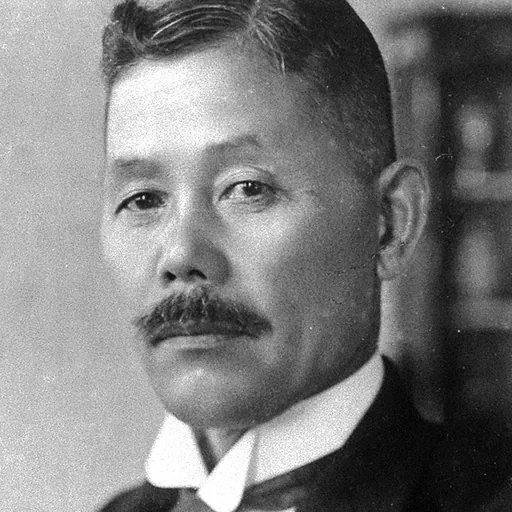
About Wakatsuki Reijirō
Lived 1866 – 1949 (aged 83). Wakatsuki Reijirō was a Japanese politician.
Baron was a Japanese politician who twice served as Prime Minister of Japan from 1926 to 1927, and again in 1931.
Early life and education Wakatsuki Reijirō, né Okumura, was born on 21 March 1866, in Matsue, Izumo Province (present day Shimane Prefecture), the second son of ashigaru Okumura Sensaburō and his wife Kura. The family was of the samurai status, but was of the lowest class and very poor, so they worked side jobs to support themselves. When Reijirō was three years old, his mother died. As the father and the eldest brother were ordered to work in Yamazaki, Kyoto by the Matsue Domain, the responsibilities of the house fell onto Reijirō's 11-year-old elder sister Iwa who took care of the three-year-old Reijirō while having a side job. The Okumura family were low-ranking, and the family could not have a residence near the center of Sakaimachi. For this reason, the family lived in a rented house on the outskirts of the town, but by the time Reijirō was born, his father had just constructed a small house in Nishitanaka.
At the time, samurai were required to wear their katana (typically two), and Reijirō commuted to temple school wearing only one wooden sword on his hip. After graduating from elementary school, he entered a Chinese literary school, but quit the following year entering a middle school in Matsue. However, he was forced to quit middle school in just eight months because his family could not afford the tuition fees. After quitting school, he collected firewood in the mountains and helped with house chores.
At the age of 16, he began working as an elementary school substitute teacher. In 1883, he decided to enter the Imperial Japanese Army Academy as the tuition fees were government expensed, but failed the physical examination. The next year, he heard about student recruitment by the Law School of the Ministry of Justice, which also had its tuition fees covered by the government. However, the examination took place in Tokyo, and the travel fees were not covered. He consulted his uncle, Wakatsuki Kei, who was the head of Nogi District, and was able to borrow 30 yen from him. In 1884, Reijirō left Matsue at the age of 19.
Wakatsuki was awarded the Order of the Paulownia Flowers on 10 November 1928. After serving as chief delegate plenipotentiary to the London Naval Conference 1930, Wakatsuki pushed strongly for speedy ratification of the disarmament treaty, thus earning the wrath of the Japanese military and various ultranationalist groups.
Second premiership (1931)
After Prime Minister Hamaguchi was forced out of office by the severe injuries incurred in an assassination attempt, Wakatsuki assumed the leadership of the Rikken Minseitō, the successor to the Kenseikai. He was elevated to the rank of baron (danshaku) in the kazoku peerage system in April 1931. Wakatsuki once again became Prime Minister from 14 April 1931 to 13 December 1931. During Wakatsuki's second term, he failed to control the Imperial Japanese Army. He was unable either to prevent the Manchurian Incident from occurring, or to rein in the Army from further escalation in China afterwards despite orders to cease hostilities. This frustration culminated in his resignation, which finally allowed for the unleashing of the full force of the Kwantung Army's northern operation.
Later life After his retirement as Prime Minister, Wakatsuki became president of the Rikken Minseitō in July 1934. Despite the growing militarism in Japanese society, he continued to oppose the Second Sino-Japanese War, and was adamantly opposed to extending the war to include the United States and other western powers. Even after the declaration of hostilities in World War II, he publicly stated the war should end as quickly as possible. In May 1945, on hearing of the collapse of Nazi Germany, he emerged from retirement to urge Prime Minister Kantarō Suzuki to open negotiations with the United States as soon as possible. In August, he participated in the government panel recommending unconditional acceptance of the Potsdam Declaration.
After the surrender of Japan, Wakatsuki was subpoenaed by the Supreme Commander of the Allied Powers in June 1946 as a prosecution witness at The International Military Tribunal for the Far East. Wakatsuki died of Angina pectoris at his summer home in Itō, Shizuoka on 20 November 1949. His grave is at the Somei Cemetery in downtown Tokyo.
Honours From the corresponding article in the Japanese Wikipedia Grand Cordon of the Order of the Sacred Treasure (24 August 1911; Fifth Class: 28 December 1902) Grand Cordon of the Order of the Rising Sun (14 July 1916; Second Class: 1 April 1906) Grand Cordon of the Order of the Rising Sun with Paulownia Flowers (10 November 1928) Baron (11 April 1931)
Don’t just read it —
keep it.
Full-length biographies made to live with: read them, listen on the way to work, watch them tonight.
- E-book
- Audio
- Video
Instant download · yours to keep · every purchase keeps this site free
Important facts
People in Wakatsuki Reijirō's life
Named in this biography and alive at the same time
Related people
Same field, nearest in time





Contemporaries
People whose lives overlapped Wakatsuki Reijirō's



Frequently asked questions
Who was Wakatsuki Reijirō?
Japanese politician (1866–1949)
When was Wakatsuki Reijirō born?
Wakatsuki Reijirō was born on 21 March 1866 in Matsue.
When did Wakatsuki Reijirō die?
Wakatsuki Reijirō died on 20 November 1949 in Ito.
What was Wakatsuki Reijirō's occupation?
Wakatsuki Reijirō was a politician.
What nationality was Wakatsuki Reijirō?
Wakatsuki Reijirō was Japanese.
Sources & further reading
· Wikipedia: Wakatsuki Reijirō
Cite this page
APA: Biography.guide. (2026). Wakatsuki Reijirō. https://biography.guide/wakatsuki-reijiro/
MLA: "Wakatsuki Reijirō." Biography.guide, https://biography.guide/wakatsuki-reijiro/.
Chicago: "Wakatsuki Reijirō." Biography.guide. https://biography.guide/wakatsuki-reijiro/.
Data last updated: 2026-09-22 · Spot an error? Report a correction.
Portrait: Wikimedia Commons · author & licence
Page generated 2026-09-27 05:02 UTC