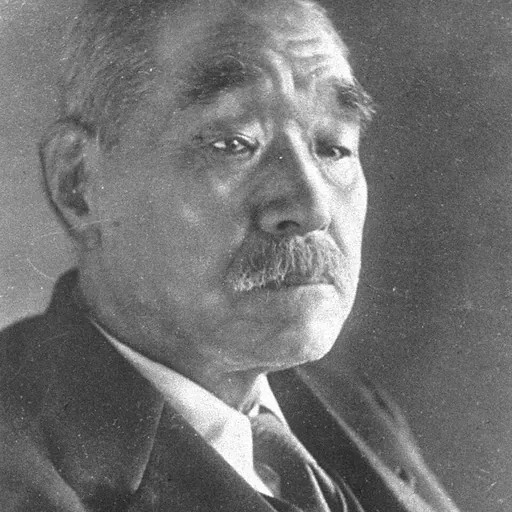
About Kantarō Suzuki
Lived 1868 – 1948 (aged 80). Kantarō Suzuki was a Japanese politician, diplomat and military personnel.
Naval career Suzuki entered the 14th class of the Imperial Japanese Naval Academy in 1884, graduating 13th of 45 cadets in 1887. Suzuki served on the corvettes , and cruiser as a midshipman. On being commissioned as ensign, he served on the corvette , cruiser Takao, corvette Jingei, ironclad , and gunboat . After his promotion to lieutenant on 21 December 1892, he served as chief navigator on the corvettes , , and .
Suzuki served in the First Sino-Japanese War, commanding a torpedo boat and participated in a night torpedo assault in the Battle of Weihaiwei in 1895. Afterwards, he was promoted to lieutenant commander on 28 June 1898 after graduation from the Naval Staff College and assigned to a number of staff positions including that of naval attaché to Germany from 1901 to 1903.
During the Russo-Japanese War, Suzuki commanded Destroyer Division 2 in 1904, which picked up survivors of the Port Arthur Blockade Squadron during the Battle of Port Arthur. He was appointed executive officer of the cruiser on 26 February 1904, aboard which he participated in the Battle of the Yellow Sea. During the pivotal Battle of Tsushima, Suzuki was commander of Destroyer Division 4 under the IJN 2nd Fleet, which assisted in sinking the Russian battleship .
After the surrender of Japan became public, Suzuki resigned and Prince Higashikuni became the next prime minister. Suzuki was the Chairman of the Privy Council from 7 August 1944 to 7 June 1945 and again after the surrender of Japan from 15 December 1945 to 13 June 1946.
Suzuki died of cancer on 17 April 1948. His grave is in his home town of Noda, Chiba. One of his two sons became director of Japan's immigration service, while the other was a successful lawyer.
Honours
From the corresponding Japanese Wikipedia article
Peerages Baron (20 November 1936)
Decorations Order of the Sacred Treasure, 2nd Class (28 August 1915; Fourth Class: 30 May 1905; Fifth Class: 30 November 1901; Sixth Class: 18 November 1895) Order of the Golden Kite, 3rd Class (1 April 1906; Fifth Class: 18 November 1895) Grand Cordon of the Order of the Rising Sun (1 April 1916; Second Class: 19 January 1916; Third Class: 1 April 1906) Grand Cordon of the Order of the Paulownia Flowers (April 29, 1934)
Don’t just read it —
keep it.
Full-length biographies made to live with: read them, listen on the way to work, watch them tonight.
- E-book
- Audio
- Video
Instant download · yours to keep · every purchase keeps this site free
Important facts
Related people
Same field, nearest in time




Contemporaries
People whose lives overlapped Kantarō Suzuki's




Frequently asked questions
Who was Kantarō Suzuki?
29th Prime Minister of Japan (1868-1948)
When was Kantarō Suzuki born?
Kantarō Suzuki was born on 18 January 1868 in Sakai.
When did Kantarō Suzuki die?
Kantarō Suzuki died on 17 April 1948 in Sekiyado.
What was Kantarō Suzuki's occupation?
Kantarō Suzuki was a politician, diplomat and military personnel.
What nationality was Kantarō Suzuki?
Kantarō Suzuki was Japanese.
Sources & further reading
Cite this page
APA: Biography.guide. (2026). Kantarō Suzuki. https://biography.guide/kantaro-suzuki/
MLA: "Kantarō Suzuki." Biography.guide, https://biography.guide/kantaro-suzuki/.
Chicago: "Kantarō Suzuki." Biography.guide. https://biography.guide/kantaro-suzuki/.
Data last updated: 2026-09-23 · Spot an error? Report a correction.
Portrait: Wikimedia Commons · author & licence
Page generated 2026-09-27 05:06 UTC