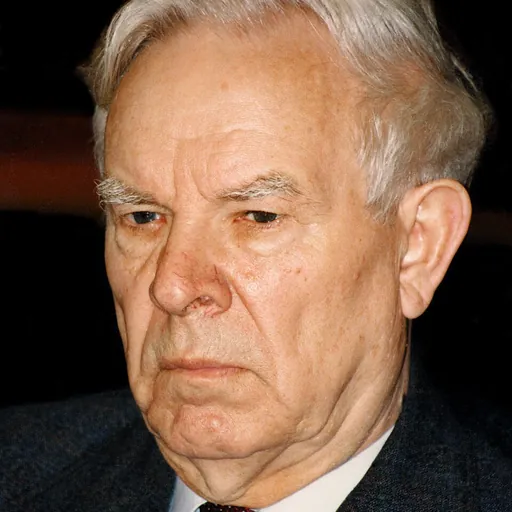
About Vladimir Semichastny
Lived 1924 – 2001 (aged 76). Vladimir Semichastny was a Russian politician.
Vladimir Yefimovich Semichastny (; ; 15 January 1924 – 12 January 2001) was a Soviet politician, who served as Chairman of the KGB from November 1961 to May 1967. A protégé of Alexander Shelepin, he rose through the ranks of the Communist Youth League (Komsomol).
Early life Semichastny was born in January 1924 in the village of Hryhorivka, near Grishino (today Pokrovsk), in the Yekaterinoslav Governorate (today Donetsk Oblast) of Soviet Ukraine, to a working-class Russian family originally from Tula Province. After finishing high school in 1941, he began studying Chemistry at the Institute of Chemical Technology in Kemerovo, but his studies were interrupted by World War II; his family back in Ukraine were evacuated to Astrakhan, due to the Nazi conquest of the region, and Semichastny himself was drafted to the Red Army. After the liberation of the Donbas by the Red Army in 1943, Semichastny returned home. Later, he received a degree in history from Kiev State University.
In the Communist Youth League After the end of the war, Semichastny became a full-time employee of the Communist Youth League (Komsomol), working in the fields of propaganda and administration. From 1947 to 1950 he was First Secretary of the Ukrainian Komsomol. 1958, speaking to an audience of thousands at a rally to celebrate the 40th anniversary of the founding of Komsomol, he attacked Boris Pasternak, who had just been awarded the Nobel Prize for his novel, Doctor Zhivago, which had been published abroad after being suppressed in the USSR. Comparing him with "a pig that shits in its own sty", he called for Pasternak to be deported. It was this threat that made Pasternak decide to renounce the prize.
In Azerbaijan In 1959, Semichastny was sent by the Soviet leadership to the politically sensitive and oil-rich Soviet Socialist Republic of Azerbaijan, as Second Secretary of the ruling Communist Party of Azerbaijan, a position he held for two years, until 1961, serving under the Republic's leader Vali Akhundov.
Chairman of the KGB
September 1964. Vladimir Semichastny, Chairman of the KGB (first from left), talking to Soviet intelligence officers Rudolf Abel (second from left) and Konon Molody (second from right) in 1964
Semichastny was appointed chairman of the KGB by Nikita Khrushchev in November 1961, again succeeding his friend and mentor Shelepin, who had been KGB Chairman since 1958. Appointed at the age of 37, he was the youngest Soviet security and intelligence chief of the Cold War. As KGB chief, he generally continued his predecessor's policies: support for national liberation movements worldwide, suppression of nationalism, separatism and the dissident movement within the Soviet Union, and recruitment of young university graduates to the KGB. He also put much emphasis on developing the security and intelligence services of the Soviet satellite states, and on assisting the communist forces in the Vietnam War.
Semichastny was surprised when Khrushchev informed him of his appointment as KGB Chairman, commenting that he did not have any experience in intelligence and counterintelligence; Khrushchev, however, told him that the KGB needed, above all, a deft political hand.
Despite Khrushchev's fondness and esteem, Semichastny never became part of the Soviet leader's inner circle.
Semichastny was the one who informed Khrushchev of his removal from power, "by order of the Politburo"; as Khrushchev was returning to Moscow from a holiday at the Black Sea, Semichastny waited for him at the airport flanked by KGB security guards, informed him of his ouster and told him not to resist. Khrushchev did not resist, and the hardliners' coup went off smoothly; Khrushchev felt betrayed by Semichastny, as he considered him a friend and ally until that very moment, not suspecting that he had joined his enemies within the Party.
In March 1967, Stalin's daughter, Svetlana Alliluyeva, defected to the USA; Semichastny ordered the KGB to kidnap her and bring her back. The attempt failed, and led to the exposure of several KGB agents, who were arrested. This gave Shelepin's enemies a pretext to sack Semichastny. Shelepin was able to protect him for a few weeks, but in May, he was hospitalised for eight days after an operation, and in his absence, on 18 May 1967, the Politburo held a ten-minute discussion in which they decided to appoint Yuri Andropov, who was ten years older than Semichastny, as his replacement. Shelepin was removed from positions of influence soon afterwards.
Later career From 1967 until 1981 Semichastny was a Deputy Prime Minister of the Ukrainian Soviet Socialist Republic, although he did not have any significant influence in the political affairs of the Republic, which was tightly controlled by Brezhnevists. In 1981 he was removed from that position as well, and retired to private life.
Semichastny died in Moscow at the age of 76, on January 12, 2001, after suffering a stroke.
Assessment Markus Wolf, the intelligence chief of East Germany, who worked closely with Semichastny, described him as follows:
Don’t just read it —
keep it.
Full-length biographies made to live with: read them, listen on the way to work, watch them tonight.
- E-book
- Audio
- Video
Instant download · yours to keep · every purchase keeps this site free
Important facts
People in Vladimir Semichastny's life
Named in this biography and alive at the same time


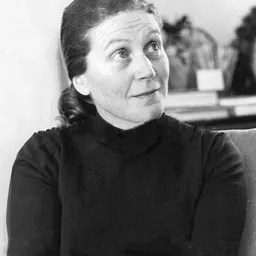




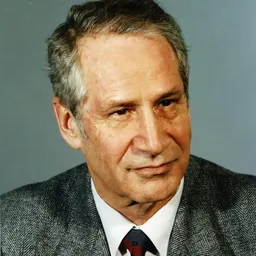
Related people
Same field, nearest in time


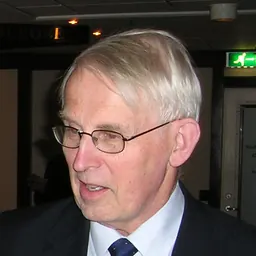

Contemporaries
People whose lives overlapped Vladimir Semichastny's


Frequently asked questions
Who was Vladimir Semichastny?
KGB Chairman (1924-2001)
When was Vladimir Semichastny born?
Vladimir Semichastny was born on 15 January 1924 in Mezhova.
When did Vladimir Semichastny die?
Vladimir Semichastny died on 12 January 2001 in Moscow.
What was Vladimir Semichastny's occupation?
Vladimir Semichastny was a politician.
What nationality was Vladimir Semichastny?
Vladimir Semichastny was Russian.
Sources & further reading
· Wikipedia: Vladimir Semichastny
· DBpedia: Vladimir Semichastny
Cite this page
APA: Biography.guide. (2026). Vladimir Semichastny. https://biography.guide/vladimir-semichastny/
MLA: "Vladimir Semichastny." Biography.guide, https://biography.guide/vladimir-semichastny/.
Chicago: "Vladimir Semichastny." Biography.guide. https://biography.guide/vladimir-semichastny/.
Data last updated: 2026-09-24 · Spot an error? Report a correction.
Portrait: Wikimedia Commons · author & licence
Page generated 2026-09-27 05:08 UTC