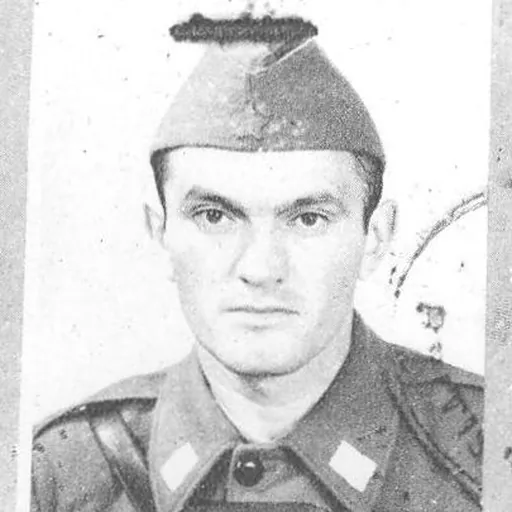
Vladimir Dedijer
Serbian politician and partisan fighter
About Vladimir Dedijer
Lived 1914 – 1990 (aged 76). Vladimir Dedijer was a Yugoslav historian, journalist, university teacher, writer, politician and partisan.
Vladimir Dedijer (; 4 February 1914 – 30 November 1990) was a Yugoslav partisan fighter during World War II who became known as a politician, human rights activist, and historian. In the early postwar years, he represented Yugoslavia at the United Nations and was a senior government official.
Later, after being at cross purposes with the government, he concentrated on his academic career as a historian. He taught at the University of Belgrade and also served as a visiting professor at several universities in the United States and Europe. He participated in the Russell Tribunal in 1967, reviewing United States forces activities in Vietnam, and in later tribunals.
Origins and family Vladimir Dedijer was born to a Serbian family in Belgrade, in the Kingdom of Serbia, which later was absorbed into Yugoslavia. His family originated from Čepelica, Bileća in Bosnia and Herzegovina and were Orthodox Christians. His father, Jevto Dedijer, was a professor of geography at Belgrade University and his mother, Milica, was a social worker. He was the middle of three sons: Borivoje, Vladimir, and Stevan.
Before World War II, Dedijer married Olga Popović. Their daughter, Milica, was named for his mother. After Olga died in 1943, her widower married again the next year to Vera Križman, an actress and fellow Yugoslav Partisan. He and Vera had four children together: daughter Bojana and three sons, Borivoje (Boro), Branimir (Branko), and Marko Dedijer. Branko committed suicide at 13, after being interrogated by police about his father's political activities. After he returned home, he hanged himself. Boro committed suicide in 1966 by jumping off a cliff near his father's house. But Dedijer believed that Boro was killed by Slovenian police.
Political and revolutionary activity In his youth Dedijer attended the Conference for Reconciliation in Poland in 1929 as a delegate of Yugoslav high school youth. In 1931, he attended the XX World Congress of the Young Men's Christian Association in Cleveland, Ohio in the United States.
After finishing high school, Dedijer worked for the daily newspaper Politika while studying law. As a journalist, he became a foreign correspondent in Poland, Denmark, Norway (1935), England (1935–1936), and Spain (1936) in the years before the outbreak of World War II. For his support of the Republican government in Spain during the Spanish Civil War, Dedijer was fired from Politika in 1937 by order of the Yugoslav government.
During the 1930s, Dedijer collaborated with the Communist Party of Yugoslavia (CPY). Dedijer considered himself an independent thinker like Serbian ancestors. "It is hard to be a Serb," he said once, "But how beautiful!"
Dedijer joined Yugoslav partisans in 1941 in their struggle against the Nazi Germany occupiers. He served as Lieutenant Colonel in Tito's headquarters.
After the war, Dedijer served as a member of the Yugoslav delegation on 1946 Paris peace conference and in several sessions of United Nations General Assembly (1945–1952). He also became a history professor at the University of Belgrade.
In 1978, he was admitted as a full member to the Serbian Academy of Sciences and Arts.
Dedijer is known for his book, The Yugoslav Auschwitz and the Vatican: The Croatian Massacre of the Serbs During World War II, which was translated into several languages. He wrote about the violent repression and genocide committed by Ustashe Catholics in Croatia against ethnicities and religions that they considered heretics. He estimated a total of 750,000 Orthodox Serbs; 60,000 Jews; and 26,000 Sinti and Roma were massacred by the Ustashe.
The preface of the 1992 book edition reads, »...in Catholic Croatia, the 'Kingdom of God', everyone who did not belong to the Catholic faith - for the most part Orthodox Serbs - was compelled to convert to Catholicism. Those who refused - as well as many who had already converted - were murdered, usually after prolonged torture in which the order of the day was the cutting off of noses, ears, or other body parts, or poking out eyes. Children were cut out of the bodies of pregnant women and subsequently beheaded; people were chopped to pieces before the eyes of loved ones, who were even forced to catch the spurting blood in a bowl, etc., to list only a few horrors as examples. These atrocities assumed such an extent that even German Nazis, who were not exactly sensitive in such matters, protested. If this historical fact is little known where we are, another fact completely escapes our knowledge: the decisive involvement of the Vatican in these massacres.«
His history, The Road to Sarajevo (1966), discusses the origins of World War I. His book Tito (1953), was translated into twenty languages. Dedijer donated all his income from that book ($530,000) to charities. Together with French philosopher and activist Jean-Paul Sartre, he chaired the Bertrand Russell International Tribunal on War Crimes, organized in 1966, in the role of the first vice-president.
The First International Russell Tribunal was set up in 1966 to adjudicate the war crimes committed by the US in Vietnam and conducted hearings in 1967. The Tribunal was due to sit in Paris, but the French authorities refused to grant an entry visa to Dedijer. For that reason, the Tribunal held its first session in Stockholm, Sweden (2-10 May 1967) and the second session in Roskilde, Denmark (20 November-1 December 1967). Both sessions were presided by Dedijer. The sessions condemned the US for war crimes, aggression, and genocide in the Vietnam War.
Dedijer presided over the Third International Russell Tribunal, which was constituted in Darmstadt and held on 16 October 1977. The Tribunal dealt with the denial of the right of individuals to practice their chosen profession in West Germany because of their political convictions, after the government had issued a discriminatory decree against radicals at a time of great social unrest in the nation. legislature had passed laws against in West Germany.
Soon after Tito's death, Dedijer published a three-volume work titled Novi prilozi za biografiju Josipa Broza Tita ("New Contributions to the Biography of Josip Broz Tito") in 1980-1984. This book marked Dedijer's change of opinion towards Tito. The book was full of unverified claims and unreliable rumours presented as historical facts.
Dedijer died in Boston, Massachusetts on 30 November 1990. He was subsequently cremated. His ashes were returned for interment at Žale Central Cemetery in Ljubljana, Slovenia.
Dedijer's bibliography , Borba, Ljubljana, 1949 (in Slovenian) Tito speaks: his self-portrait and struggle with Stalin, London : Weidenfeld and Nicolson, 1953. On military conventions; an essay on the evolution of international law, Lund, Gleerup 1961 The Beloved Land, MacGibbon & Kee, 1961 Tito, Simon and Schuster, 1963 The Road to Sarajevo, Simon and Schuster, 1966 - World War, 1914-1918 History of Yugoslavia, McGraw-Hill Book Co., 1974 The Battle Stalin Lost: Memoirs of Yugoslavia 1948-1953, Viking Press, Jan 1, 1971 (Serbian) , Mladost, Zagreb 1980 (Serbian) , Prosveta, Beograd 1980 (Serbian) , Rad Beograd 1987 (Serbian) , Rad Beograd 1987 (Bosnian) , Svjetlost, Sarajevo 1990 The War Diaries of Vladimir Dedijer, Volume 1: From April 6, 1941, to November 27, 1942, University of Michigan Press, Ann Arbor, 1990 The War Diaries of Vladimir Dedijer, Volume 2: From November 28, 1942, to September 10, 1943, University of Michigan Press, Ann Arbor, May 1, 1990 The War Diaries of Vladimir Dedijer, Volume 3:From September 11, 1943, to November 7, 1944, University of Michigan Press, Ann Arbor, Sep 1, 1990 The Yugoslav Auschwitz and the Vatican: the Croatian Massacre of the Serbs during World War II, Buffalo, N.Y. : Prometheus Books; Freiburg, Germany : Ahriman-Verlag, 1992.
Don’t just read it —
keep it.
Full-length biographies made to live with: read them, listen on the way to work, watch them tonight.
- E-book
- Audio
- Video
Instant download · yours to keep · every purchase keeps this site free
Important facts
People in Vladimir Dedijer's life
Named in this biography and alive at the same time



Related people
Same field, nearest in time


Contemporaries
People whose lives overlapped Vladimir Dedijer's

Frequently asked questions
Who was Vladimir Dedijer?
Serbian politician and partisan fighter (1914-1990)
When was Vladimir Dedijer born?
Vladimir Dedijer was born on 4 February 1914 in Belgrade.
When did Vladimir Dedijer die?
Vladimir Dedijer died on 30 November 1990 in Boston.
What was Vladimir Dedijer's occupation?
Vladimir Dedijer was a historian, journalist, university teacher, writer, politician and partisan.
What nationality was Vladimir Dedijer?
Vladimir Dedijer was Yugoslav.
Sources & further reading
Cite this page
APA: Biography.guide. (2026). Vladimir Dedijer. https://biography.guide/vladimir-dedijer/
MLA: "Vladimir Dedijer." Biography.guide, https://biography.guide/vladimir-dedijer/.
Chicago: "Vladimir Dedijer." Biography.guide. https://biography.guide/vladimir-dedijer/.
Data last updated: 2026-09-24 · Spot an error? Report a correction.
Portrait: Wikimedia Commons · author & licence
Page generated 2026-09-27 05:08 UTC