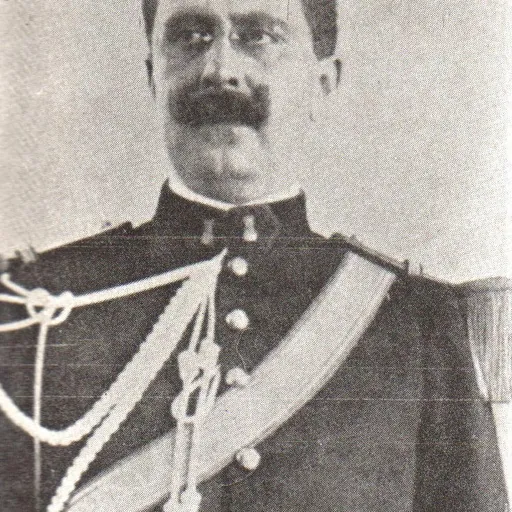
Vito Alessio Robles
Mexican military officer, engineer, writer, journalist, diplomat, and academic
About Vito Alessio Robles
Lived 1879 – 1957 (aged 77). Vito Alessio Robles was a Mexican historian, journalist, politician, writer, diplomat and engineer.
General Vito Alessio Robles (August 14, 1879 – June 11, 1957) was a Mexican military officer, engineer, writer, journalist, diplomat, and academic who participated in the Mexican Revolution. He was one of the country's leading historians, as well as a politician, serving as a senator and opposition party leader. His work on the history of Coahuila y Tejas, in three volumes, is notable. He was temperamentally a public prosecutor and as a critic he spoke and wrote with total frankness. He is credited as the first generation of romantic revolutionaries of Mexico who dreamed and put to action the civic movement which would ensure better opportunities open to the people of Mexico.
Early years He was born in 1879 in Saltillo, Coahuila, (baptized 30 August 1879 – San Esteban protomártir), the eldest of the seven sons of Dominic Alessio Bello, a merchant from Salerno, Italy, and Crisanta Robles Rivas. His brothers, José Alessio Robles and Miguel Alessio Robles, were also military generals; his other siblings included Domingo Alessio Robles (1884–), María Catarina Alessio Robles (1886–), Ricardo Alessio Robles (1889), and María Alessio Robles (1890). In the fight against Madero in Chihuahua, he was injured at Malpaso.
Career After his scholastic career, he was assigned the task of building Monterrey Square, barracks and Pótam Toros in the Yaqui region. He was also responsible for building the national dockyard at the Guaymas Port in Sonora. He was then given the war duty to fight the Yaqui Indians from 1905 to 1908. On his return from the military operations, in 1908, he was assigned the task of building the headquarters of La Piedad in the capital. In 1908 itself, he was made the Professor of Communications at the Military School. His campaign as an army officer covered México city, Jalapa, Monterrey and Sonora. He met his future wife, Espinosa Como Cuevas Trinidad at the río Yaqui, Sonora. In the fight against Madero in Chihuahua, he was injured at Malpaso. for one year from 1 January 1915.
After 1920, he led a deputation by the Federal District V District and was a senator of Coahuila in 1922. As senator he was an exemplary parliamentarian in the same category as Belisario Dominguez. Some of his other notable books are Saltillo, en la Historia y en la Leyenda, Coahuila y Texas, desde la consumación de la independencia hasta el tratado de paz de Guadalupe Hidalgo, and Coahuila y Texas en la época colonial.
Publications (in Spanish) Comunicaciones de campaña (1910–1912) [Campaign Communications (1910–1912)] Francisco de Urdiñola y el norte de la Nueva España (1931) [Urdiñola Francisco and northern New Spain (1931)] Coahuila y Texas en la época colonial (1938) [Coahuila and Texas in colonial times (1938)] Cómo se ha escrito la historia de Coahuila (1931) [The history of Coahuila (1931)] Unas páginas traspapeladas de la historia de Coahuila y Texas. El derrotero de la entrada a Texas del gobernador de Coahuila, sargento mayor Martín de Alarcón (1932) [A misplaced page of history of Coahuila and Texas: The course of the entrance to the Governor of Coahuila Texas, Sergeant Major Martin de Alarcón (1932)] La primera imprenta en Coahuila (1932) [The first printing in Coahuila (1932)] El derrotero de Martín Alarcón en Texas (1933) [The course of Martin Alarcon in Texas (1933)] Etimologías bastardeadas (1934) [Bastardized etymologies (1934)] Saltillo en la historia y en la leyenda (1934) [Saltillo in history and legend (1934)] Fray Agustín de Morfi y su obra (1935) [Fray Agustin de Morfi and his work (1935)] Monterrey en la historia y en la leyenda (1936) [Monterrey in history and legend (1936)] Acapulco en la historia y en la leyenda (1936) [Acapulco in history and legend (1936)] Desfile sangriento (1936) [Bloody Parade (1936)] Ramos Arizpe (1937) [Ramos Arizpe (1937)] Los tratados de Bucareli (1937) [Bucareli treaties (1937)] Bosquejos históricos (1938) [Historic Sketches (1938)] Mis andanzas con nuestro Ulises (1938) [My adventures with our Ulysses (1938)] La primera imprenta en las Provincias Internas de Oriente, Texas, Tamaulipas, Nuevo León y Coahuila (1939) [The first printing press in the Eastern Provinces, Texas, Tamaulipas, Nuevo León and Coahuila (1939)] Heráldica coahuilense (1943) [Coahuilense Heraldry (1943)] Alejandro de Humboldt: su vida y su obra (1940) [Alejandro de Humboldt: his life and work (1940)] Las condiciones sociales en el norte de la Nueva España (1945–46) [Society in northern New Spain (1945–46)] Coahuila y Texas desde la consumación de la Independencia hasta el tratado de paz de Guadalupe Hidalgo (1945–1946) [Coahuila and Texas from the consummation of Independence until the peace treaty of Guadalupe Hidalgo (1945–1946)] Diuscurso pronunciado en la apertura de la IV Convención del Partido Nacional Antirreeleccionista [Diuscurso delivered at the opening of the National Party Convention IV Antirreeleccionista] La convención revolucionaria de Aguascalientes [The revolutionary convention of Aguascalientes]
Don’t just read it —
keep it.
Full-length biographies made to live with: read them, listen on the way to work, watch them tonight.
- E-book
- Audio
- Video
Instant download · yours to keep · every purchase keeps this site free
Important facts
People in Vito Alessio Robles's life
Named in this biography and alive at the same time

Related people
Same field, nearest in time

Contemporaries
People whose lives overlapped Vito Alessio Robles's



Frequently asked questions
Who was Vito Alessio Robles?
Mexican military officer, engineer, writer, journalist, diplomat, and academic (1879–1957)
When was Vito Alessio Robles born?
Vito Alessio Robles was born on 14 August 1879 in Saltillo.
When did Vito Alessio Robles die?
Vito Alessio Robles died on 11 June 1957 in Mexico.
What was Vito Alessio Robles's occupation?
Vito Alessio Robles was a historian, journalist, politician, writer, diplomat and engineer.
What nationality was Vito Alessio Robles?
Vito Alessio Robles was Mexican.
Sources & further reading
· Wikipedia: Vito Alessio Robles
· DBpedia: Vito Alessio Robles
Cite this page
APA: Biography.guide. (2026). Vito Alessio Robles. https://biography.guide/vito-alessio-robles/
MLA: "Vito Alessio Robles." Biography.guide, https://biography.guide/vito-alessio-robles/.
Chicago: "Vito Alessio Robles." Biography.guide. https://biography.guide/vito-alessio-robles/.
Data last updated: 2026-09-23 · Spot an error? Report a correction.
Portrait: Wikimedia Commons · author & licence
Page generated 2026-09-27 05:06 UTC