
About Vishnu Narayan Bhatkhande
Lived 1860 – 1936 (aged 76). Vishnu Narayan Bhatkhande was an Indian actor, musicologist, composer and music educator.
Early life Pandit Vishnu Narayan Bhatkhande was born on 10 August 1860 in Walkeshwar, Bombay. While not a professional musician himself, his father, who worked for an affluent businessman, ensured that Vishnu Narayan and his siblings received an education in classical music. After turning fifteen, Bhatkhande became a student of the sitar and subsequently began studying Sanskrit texts that dealt with music theory. He completed a BA degree at Deccan College in Pune in 1885. In 1887, Bhatkhande graduated with a degree in law from Elphinstone College, affiliated with Bombay University and briefly pursued a career in criminal law.
After the death of his wife and his daughter, Bhatkhande abandoned his legal practice and devoted the rest of his life to systematising the prevailing forms of Hindustani music and building a coordinated theory and practice of music. During his travels in India, he spent time in the then-princely states of Baroda, Gwalior, and Rampur. In Rampur he was the disciple of veena player Ustad Wazir Khan, a descendant of Miyan Tansen.
Bhatkhande travelled to South India, arriving in Madras (now Chennai) in 1904. With the help of local contacts, he began to familiarise himself with the world of Carnatic music. He established contact with stalwarts such as Tiruvottriyur Tyagayyar and Tachur Singaracharya in Madras, Poochi Srinivasa Iyengar in Ramanathapuram and Subbarama Dikshitar in Ettayapuram but the language barrier made these interactions less fruitful than he expected. Notes from a journal maintained of his time there were later published as Meri Dakshin Bharat Ki Sangeet Yatra (My Musical Journey in Southern India).
Bhatkhande's first published work, Swar Malika, was a booklet containing detailed descriptions of all prevalent ragas. In 1909, he published Shri Mallakshaya Sangeetam, in Sanskrit, under the pseudonym 'Chatur-pandit'. To make this cultural heritage accessible to the common man, he published commentary on his own Sanskrit grantha in Marathi over a span of several years; it was published over four volumes bearing the title: Hindustani Sangeet Paddhati. Today, these volumes form the standard text on Hindustani music, an indispensable starting point for any student of Hindustani classical music. His disciple S N Ratanjankar, famous musician Dilipkumar Roy, Ratanjankar's disciple K. G. Ginde, S.C.R. Bhatt, Ram Ashrey Jha 'Ramrang', Sumati Mutatkar and Krishna Kumar Kapoor are among the notable scholars who were influenced by Bhatkhande. His notation system became standard, and though later scholars like Pandit V. D. Paluskar, Pandit Vinayakrao Patwardhan and Pandit Omkarnath Thakur introduced their improved versions, it remained a publisher's favorite. It suffered a setback with the onset of desktop publishing, which found inserting marks above and below Devanagari text cumbersome; as a result, books carrying compositions yielded to theoretical texts. A recently developed notation system, Ome Swarlipi, follows the logical structure introduced by Bhatkhande but uses symbols instead of Devanagari alphabets.
After traveling widely and having discussions with practitioners of various schools, Bhatkhande arranged all the ragas of Hindustani classical music across 10 musical scales, called thaats. Though the thaats do not encompass all possible ragas, they do cover the vast majority and are a key contribution to Indian musical theory. The thaat structure corresponds to the melakarta system of raga arrangement in Carnatic music, the south Indian variety of Indian classical music.
Bhatkhande wrote all of his works under one of the two pseudonyms, Vishnu Sharma and Chaturpandit.
Institutions
Bhatkhande started schools and colleges in India for systematic teaching of Hindustani music. In 1916, he reorganized the Baroda state music school, and later, with the help of the Maharaja of Gwalior, established the Madhav Music College in Gwalior.
In 1926, Rai Umanath Bali and his nephew Dr. Rai Rajeshwar Bali, then education minister of United Provinces, established Marris College of Music in Lucknow with Bhatkhande preparing the course material. The college was later renamed Bhatkhande College of Hindustani Music and is now known as Bhatkhande Music Institute (Deemed University). Preparation of that course material was a landmark achievement of Bhatkhande since musical knowledge used to be passed on orally in earlier times from Gurus and Ustads to their disciples.
Bhatkhande prepared the Hindustani Sangeet Kramik Pustak Maalika as a series of textbooks. He also started the tradition of the All-India Music Conferences to provide a common platform for discussion between Hindustani and Carnatic classical musicians.
Death Bhatkhande suffered paralysis and a thigh fracture in 1933. He died on 19 September 1936, during Ganeshotsav in Mumbai.
Don’t just read it —
keep it.
Full-length biographies made to live with: read them, listen on the way to work, watch them tonight.
- E-book
- Audio
- Video
Instant download · yours to keep · every purchase keeps this site free
Important facts
People in Vishnu Narayan Bhatkhande's life
Named in this biography and alive at the same time
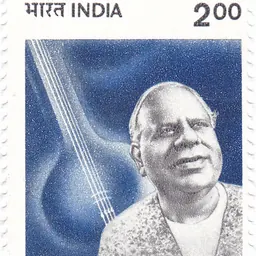





Related people
Same field, nearest in time

Contemporaries
People whose lives overlapped Vishnu Narayan Bhatkhande's



Frequently asked questions
Who was Vishnu Narayan Bhatkhande?
Indian musicologist (1860-1936)
When was Vishnu Narayan Bhatkhande born?
Vishnu Narayan Bhatkhande was born on 10 August 1860 in Mumbai.
When did Vishnu Narayan Bhatkhande die?
Vishnu Narayan Bhatkhande died on 19 September 1936 in Bombay.
What was Vishnu Narayan Bhatkhande's occupation?
Vishnu Narayan Bhatkhande was an actor, musicologist, composer and music educator.
What nationality was Vishnu Narayan Bhatkhande?
Vishnu Narayan Bhatkhande was Indian.
Sources & further reading
· Wikipedia: Vishnu Narayan Bhatkhande
· DBpedia: Vishnu Narayan Bhatkhande
Cite this page
APA: Biography.guide. (2026). Vishnu Narayan Bhatkhande. https://biography.guide/vishnu-narayan-bhatkhande/
MLA: "Vishnu Narayan Bhatkhande." Biography.guide, https://biography.guide/vishnu-narayan-bhatkhande/.
Chicago: "Vishnu Narayan Bhatkhande." Biography.guide. https://biography.guide/vishnu-narayan-bhatkhande/.
Data last updated: 2026-09-26 · Spot an error? Report a correction.
Page generated 2026-09-27 05:14 UTC