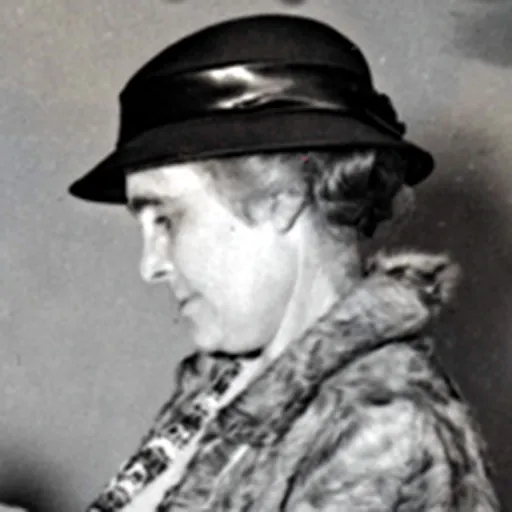
About Virginia E. Jenckes
Lived 1877 – 1975 (aged 97). Virginia E. Jenckes was an American politician.
Virginia Jenckes (née Ellis; November 6, 1877 – January 9, 1975) served three terms as a U.S. Representative (March 4, 1933 – January 3, 1939) from Indiana's Sixth Congressional District. The Terre Haute, Indiana, native was the first woman from Indiana to be elected to the U.S. House of Representatives. Alongside Kathryn O'Loughlin McCarthy, she was the second woman Representative from the Midwest and the first who was not succeeding a male relative. In 1937 she became the first American woman appointed as a U.S. delegate to the Inter-Parliamentary Union in Paris, France. The outspoken, independent-minded farmer from Vigo County was an advocate for women and became known for her support of flood control measures and repeal of Prohibition, as well as her opposition to communism. Jenckes's most significant accomplishment for her Indiana constituents was obtaining an $18 million appropriation for the Wabash River basin that eventually became law.
While Jenckes broadly supported New Deal initiatives in general and voted with the majority of the Democrats in the U.S. Congress, she did not always follow the Democratic majority. During her later years, Jenckes became especially concerned about thwarting what she believed to be communist propaganda and its perceived threats, despite the public ridicule she received. After retiring from Congress in 1939, Jenckes served as an American Red Cross volunteer for more than twenty years. During the Hungarian uprising of 1956, she gained national attention for her efforts to assist five Catholic priests in their escape to the United States from Hungarian prisons. In 1969 Jenckes returned to Indiana, where she spent the final years of her life.
Early life Virginia Ellis Somes, the daughter of James Ellis Somes, a pharmacist, and Mary Oliver Somes, was born in Terre Haute, Indiana, on November 6, 1877. She attended public schools in Terre Haute, including Wiley High School, where she enrolled at the age of eleven and became the youngest student in the school's history. She left high school early to complete her formal education by taking two years of courses at Coates College for Women.
In 1912, when Jencks was thirty-four, she married sixty-eight-year old Ray Greene Jenckes, a Terre Haute farmer and grain dealer. Together, they managed a farm along the Wabash River in western Indiana. After her husband's death in 1921, Jenckes inherited the farm along with his grain business and assumed sole responsibility for their management. Their only child, a daughter named Virginia, was born in 1913 and died of tuberculosis on September 18, 1936, at the age of twenty-two.
Career Early years Jenckes, who had been involved in farming in Vigo County, Indiana, since her marriage in 1912, was well aware of the damage that frequent river flooding could do to farms. Jenckes later reported that her farm had flooded nine times in fourteen months during the 1920s. Jenckes also attained national prominence in 1928 as secretary of the National Rivers and Harbors Congress.
U.S. Congresswoman In 1932 Jenckes became the first woman from Indiana to be elected to the U.S. House of Representatives. She was elected as a new Deal Democrat to represent Indiana's Sixth Congressional District in the Seventy-third Congress and was re-elected to the two succeeding Congresses. Jenckes served in the U.S. House of Representatives from March 4, 1933, to January 3, 1939. Jenckes, who was one of four women in the United States who ran for a seat in Congress in 1932, easily won election in the Democrats' landslide election of 1932. In her first vote in Congress she expressed her independent mindedness when she voted against the Economy Act of 1933 because its cuts in government expenses would reduce veterans benefits, a move that Jenckes had promised her constituents she would not allow. Jenckes's most significant accomplishment for her constituents was to successfully obtain an $18 million appropriation for the Wabash River basin that eventually became law.
Second term Jenckes won re-election to Congress in a close race in 1934, when she once again defeated Purnell, this time by a margin of 383 votes out of a total of 135,000 that were cast. Two themes characterized the remainder of her congressional career: Jenckes's "self-identification as a champion of women’s interests" and presenting herself as someone who could offer a feminine perspective on legislative issues. Endorsed by the National Woman's Party during her 1934 re-election campaign, Jenckes advocated for political equality for women, although she was not a radical feminist by later-defined standards. Jenckes emphasized "traditional gender distinctions" and supported policies that would benefit women as well as consumer and business interests. Jenckes was also a fervent supporter of J. Edgar Hoover and advocated congressional funding for the Federal Bureau of Investigation.
Jenckes was vocal in her opposition to communism and especially active in efforts to eliminate what she believed to be subversive activities in America. Jenckes's American patriotism and strong interest in national symbols also led her to introduce legislation that required the American flag to be flown atop federal buildings. Jenckes ran unopposed in the Democratic primary, but Noble J. Johnson, her Republican challenger, narrowly defeated her in the general election. Jenckes, who suggested her loss was the result of ballot tampering, was among the seventy Democrats in the U.S. House who were defeated for re-election that year.
Later years After retiring from the U.S. Congress in 1939, Jenckes remained in Washington, D.C., where she was a volunteer for the American Red Cross for nearly two decades
Don’t just read it —
keep it.
Full-length biographies made to live with: read them, listen on the way to work, watch them tonight.
- E-book
- Audio
- Video
Instant download · yours to keep · every purchase keeps this site free
Important facts
People in Virginia E. Jenckes's life
Named in this biography and alive at the same time




Related people
Same field, nearest in time




Contemporaries
People whose lives overlapped Virginia E. Jenckes's



Frequently asked questions
Who was Virginia E. Jenckes?
American politician (1877–1975)
When was Virginia E. Jenckes born?
Virginia E. Jenckes was born on 6 November 1877 in Terre Haute.
When did Virginia E. Jenckes die?
Virginia E. Jenckes died on 9 January 1975 in Indiana.
What was Virginia E. Jenckes's occupation?
Virginia E. Jenckes was a politician.
What nationality was Virginia E. Jenckes?
Virginia E. Jenckes was American.
Sources & further reading
· Wikipedia: Virginia E. Jenckes
· DBpedia: Virginia E. Jenckes
Cite this page
APA: Biography.guide. (2026). Virginia E. Jenckes. https://biography.guide/virginia-e-jenckes/
MLA: "Virginia E. Jenckes." Biography.guide, https://biography.guide/virginia-e-jenckes/.
Chicago: "Virginia E. Jenckes." Biography.guide. https://biography.guide/virginia-e-jenckes/.
Data last updated: 2026-09-23 · Spot an error? Report a correction.
Portrait: Wikimedia Commons · author & licence
Page generated 2026-09-27 05:06 UTC