
Vincent Sarich
American paleo-anthropologist
About Vincent Sarich
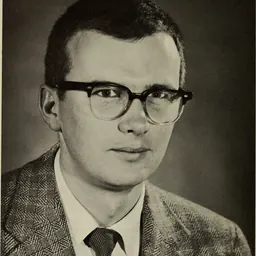
Lived 1934 – 2012 (aged 77). Vincent Sarich was an American paleontologist, anthropologist, university teacher and paleoanthropologist, known for Human evolution.
Vincent Matthew Sarich (December 13, 1934 – October 27, 2012) was an American anthropologist and biochemist. He was Professor Emeritus in anthropology at University of California, Berkeley.
Sarich and his PhD advisor, Allan Wilson, used molecular data to estimate that humans and chimpanzees have a common ancestor just four to five million years ago. Their paper on their finding was published in 1967. At the time, scientists considered the common ancestor to live ten to 30 million years ago, and their revised estimate has become well accepted. Sarich generated controversy with his support for analyzing human behavior and populations in evolutionary terms.
Early life and education Born in Chicago, he received a bachelor of science in chemistry from Illinois Institute of Technology and his masters and doctorate in anthropology from University of California, Berkeley, where he was supervised by Sherwood Washburn. He was a member of the Department of Anthropology at Stanford from 1967 to 1981, and taught at UC Berkeley from 1966 through 1994.
As a doctoral student, and along with his PhD supervisor Allan Wilson, Sarich measured the strength of immunological cross-reactions of blood serum albumin between pairs of creatures, including humans and African apes (chimpanzees and gorillas). The strength of the reaction could be expressed numerically as an Immunological Distance, which was in turn proportional to the number of amino acid differences between homologous proteins in different species. Sarich and Wilson showed that the pattern of differences between modern species could only be explained if the molecular change along different lineages had in fact accumulated approximately equally (i.e., were a type of 'molecular clock'). This method they called the relative rate test, and it showed that one could empirically test whether the molecular change was constant simply by looking at the pattern of differences between modern forms of the molecule. By constructing a calibration curve of the I.D. of species' pairs with best-attested divergence times in the fossil record, the data could be used as a molecular clock to estimate the times of divergence of pairs with poorer or unknown fossil records.
Career In their 1967 paper Immunological time scale for hominid evolution in Science, Sarich and Wilson estimated the divergence time of humans and apes as four to five million years ago,
Sarich's later work on race strengthened his reputation as a controversial figure. He applied his earlier work to racial differentiation, which he saw as subgroupings below the level of species. He also argued that the smaller the amount of time required to create a given number of morphological difference, the more selectively significant the differences would necessarily be.
Sarich was a proponent of sociobiology, evolutionary psychology, and that racial differences were real and represented evolved geographic populational differences (on average), which often caused him to be the subject of controversy by activists at Berkeley. written by Linda Gottfredson and published in the Wall Street Journal. Sarich also wrote a defense of The Bell Curve.
After retirement from Berkeley, he occasionally lectured in anthropology at the University of Auckland, New Zealand for a number of years. At the time of his death he was living in Seattle with his daughter, her partner, and his grandson.
Criticism Some of Sarich's teachings were criticized by some students and faculty, who argued they believed they were not based in science, and his critics said some of his statements were demeaning to women, nonwhites and homosexuals. Other students defended him against these charges, however, and defended his teaching.
Don’t just read it —
keep it.
Full-length biographies made to live with: read them, listen on the way to work, watch them tonight.
- E-book
- Audio
- Video
Instant download · yours to keep · every purchase keeps this site free
Important facts
People in Vincent Sarich's life
Named in this biography and alive at the same time




Related people
Same field, nearest in time




Contemporaries
People whose lives overlapped Vincent Sarich's





Frequently asked questions
Who was Vincent Sarich?
American paleo-anthropologist (1934–2012)
When was Vincent Sarich born?
Vincent Sarich was born on 13 December 1934 in Chicago.
When did Vincent Sarich die?
Vincent Sarich died on 27 October 2012 in Seattle.
What was Vincent Sarich's occupation?
Vincent Sarich was a paleontologist, anthropologist, university teacher and paleoanthropologist.
What was Vincent Sarich known for?
Vincent Sarich was known for Human evolution.
What nationality was Vincent Sarich?
Vincent Sarich was American.
Sources & further reading
Cite this page
APA: Biography.guide. (2026). Vincent Sarich. https://biography.guide/vincent-sarich/
MLA: "Vincent Sarich." Biography.guide, https://biography.guide/vincent-sarich/.
Chicago: "Vincent Sarich." Biography.guide. https://biography.guide/vincent-sarich/.
Data last updated: 2026-09-20 · Spot an error? Report a correction.
Page generated 2026-09-27 05:31 UTC