
About Vincent F. Harrington
Lived 1903 – 1943 (aged 40). Vincent F. Harrington was an American politician, basketball coach and university teacher.
Vincent Francis Harrington (May 16, 1903 – November 29, 1943) was a Democratic U.S. Representative from Iowa. Harrington was commissioned in the United States Army Air Forces after the Pearl Harbor attack, resigned from Congress when President Franklin D. Roosevelt disallowed members of Congress from serving in the military at the same time, and died of natural causes while on active duty in England. A Liberty Ship was named in his honor.
Personal background Born in Sioux City, Iowa to Thomas F. and Maria Harrington, Vincent Harrington attended Cathedral Grammar School in Sioux City. He then attended Trinity College Academy, a school in Sioux City built on land purchased from Harrington's parents by the Order of St. Francis.
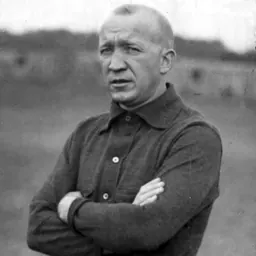
He attended the University of Notre Dame in South Bend, Indiana, where he played football for Knute Rockne, as a second-stringer on the legendary "Four Horsemen" team that dominated all opponents in the 1924 season.
After graduating from Notre Dame in 1925, he served as an instructor and athletic director at Columbia University (now named as the University of Portland) in Portland, Oregon, from 1926 to 1927, where he taught economics and history.
Election to the U.S. House (1936) In June 1936, Harrington won the Democratic nomination for Lieutenant Governor of Iowa. However, the following month, Iowa electoral politics was thrown into disarray when Democratic U.S. Senator Richard Louis Murphy was killed in a car accident. Democratic Congressman Guy M. Gillette of Cherokee, Iowa, a candidate for re-election in Iowa's 9th congressional district, ran instead in the special election to serve out the remainder of Murphy's Senate term. This prompted Harrington, a 9th district resident, to withdraw from the race for Lieutenant Governor to accept the Democratic nomination to replace Gillette on the ballot for the U.S. House of Representatives. In the general election, Harrington defeated Republican Fred B. Wolf by over 10,000 votes.
Re-elections Harrington was re-elected in 1938 and 1940. However, his re-election wins (both over Republican Albert F. Swanson) were much closer than his original victory. In 1938, he won by only 269 votes out of over 94,000 cast (down from 339 after Swanson challenged Harrington's election and the House disallowed 70 Harrington votes), and in 1940 he won by only 2,140 votes out of over 130,000 cast.
1941 reapportionment Iowa lost one of its nine congressional seats following the 1940 census, requiring the Republican-controlled 1941 Iowa General Assembly to divide the state into eight congressional districts. The old 9th congressional district, minus one county, became the new 8th congressional district. The exception was Monona County, which Harrington had carried in 1940 by a thousand-vote margin. When Monona County was placed in the reconfigured 7th congressional district, it was considered a blow to Harrington's chances for re-election in 1942. At the time, his support for strict neutrality and split with Roosevelt, whose popularity in Iowa had declined after 1936, likely matched the views of many of his constituents. However, after the Pearl Harbor attack, congressmen with such a voting record would have difficulty keeping their seats.
Resignation from the House In the 1940 race, he had promised that, if he ever voted for war, he would himself go to war. Thus, after he voted to declare war following the Pearl Harbor attack, he entered in May 1942 in the Army Air Forces, where he was commissioned as a captain, and took a leave of absence from Congress while becoming a candidate for re-election. He declared that "the decision as to my congressional status after January 3, 1943 is entirely up to the people of the district."
However, before the 1942 general election, President Roosevelt issued an order as commander-in-chief that forced members of Congress serving in the military to resign from one position or the other. To abide by his promise to go to war, Harrington resigned from Congress on September 5, 1942.
Don’t just read it —
keep it.
Full-length biographies made to live with: read them, listen on the way to work, watch them tonight.
- E-book
- Audio
- Video
Instant download · yours to keep · every purchase keeps this site free
Important facts
People in Vincent F. Harrington's life
Named in this biography and alive at the same time

Related people
Same field, nearest in time






Contemporaries
People whose lives overlapped Vincent F. Harrington's
Frequently asked questions
Who was Vincent F. Harrington?
American politician (1903-1943)
When was Vincent F. Harrington born?
Vincent F. Harrington was born on 16 May 1903 in Sioux City.
When did Vincent F. Harrington die?
Vincent F. Harrington died on 29 November 1943 in Rutland.
What was Vincent F. Harrington's occupation?
Vincent F. Harrington was a politician, basketball coach and university teacher.
What nationality was Vincent F. Harrington?
Vincent F. Harrington was American.
Sources & further reading
· Wikipedia: Vincent F. Harrington
· DBpedia: Vincent F. Harrington
Cite this page
APA: Biography.guide. (2026). Vincent F. Harrington. https://biography.guide/vincent-f-harrington/
MLA: "Vincent F. Harrington." Biography.guide, https://biography.guide/vincent-f-harrington/.
Chicago: "Vincent F. Harrington." Biography.guide. https://biography.guide/vincent-f-harrington/.
Data last updated: 2026-09-25 · Spot an error? Report a correction.
Page generated 2026-09-27 05:11 UTC