
About Viktor Bunyakovsky
Lived 1804 – 1889 (aged 84). Viktor Bunyakovsky was a Russian mathematician and teacher, known for Bunyakovsky conjecture, Cauchy–Schwarz inequality and Condensed matter physics.
Viktor Yakovlevich Bunyakovsky (; ; – ) was a Russian mathematician, member and later vice president of the Petersburg Academy of Sciences.
Bunyakovsky was a mathematician, noted for his work in theoretical mechanics and number theory (see: Bunyakovsky conjecture), and is credited with an early discovery of the Cauchy–Schwarz inequality, proving it for the infinite dimensional case as well as for definite integrals of real-valued functions in 1859, many years prior to Hermann Schwarz's works on the subject.
Biography Viktor Yakovlevich Bunyakovsky was born in Bar, Podolia Governorate, Russian Empire (now Vinnytsia Oblast, Ukraine) in 1804. Bunyakovsky was a son of Colonel Yakov Vasilievich Bunyakovsky of a cavalry regiment, who was killed in Finland in 1809.
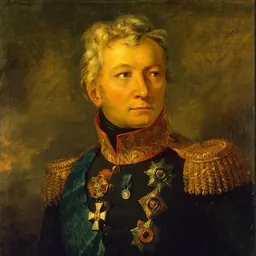
Education Bunyakovsky obtained his initial mathematical education at the home of his father's friend, Count Alexander Tormasov, in St. Petersburg. In 1820, he traveled with the count's son to a university in Coburg and subsequently to the Sorbonne in Paris to study mathematics. At the Sorbonne, Bunyakovsky had opportunity to attend lectures from Laplace and Poisson. He focused his study and research on mathematics and physics. The determination of the radius vector in elliptical motion of planets; and The propagation of heat in solids.
He successfully completed his dissertation on theoretical physics, theoretical mechanics and mathematical physics, and obtained his doctorate under Cauchy's supervision.
Scientific and pedagogical work After the seven years abroad, Bunyakovsky returned to St. Petersburg in 1826 and took up teaching and research, which he pursued for much of his life. In addition to the university courses in analytical mathematics, differential equations, and probability theory, he was also active in preparing syllabi and teaching manuals for Russian schools and military academies.
He lectured on mathematics and mechanics at the First Cadet Corps (later the Naval Academy) from 1826 to 1831 and at the Communications Institute in St. Petersburg.
From 1828 to 1864, Bunyakovsky was attached to the officer classes at the Naval Academy in St. Petersburg.
From 1846 to 1880, Bunyakovsky was a professor at St. Petersburg University in St. Petersburg, Russia. mathematical physics, condensed matter physics, mathematical analysis, differential equations, actuarial mathematics, and mathematics education with a focus on mathematical terminology.
He worked on theoretical mechanics and number theory (see: Bunyakovsky conjecture). He is credited with an early discovery of the Cauchy–Schwarz inequality, proving it for the infinite dimensional case in 1859, many years prior to Hermann Schwarz's research on the subject.
Bunyakovsky is an author of Foundations of the mathematical theory of probability (1846). Bunyakovsky published around 150 research papers.
Bunyakovsky published his first volume: Lexicon of fundamental and applied mathematics, which was written until letter "D" in Russia in 1839. Bunyakovsky became a world famous scientist after this publication.
Bunyakovsky wrote a research article titled: "On possibility of introduction of certain measures of trust to results of some sciences and statistics mainly", which was published in Sovremennik in Russia in 1848.
Bunyakovsky published his monograph: "The parallel lines" in which he provided the scientific evidences to the problems in the parallel lines theory in Russia in 1853.
Bunyakovsky wrote a research article titled: "Biological researches and their application to man's population in Russia", which was published in "Zapiski Academii Nauk" in Russia in 1873 or 1874.
Bunyakovsky printed a research article titled: "On the probability of number of divisions of Russian army in 1883–1885", which was published in Zapiski Academii Nauk in Russia in 1885.
Bunyakovsky developed a number of practical applications as far as the probability theory is concerned, publishing his research articles in the Russian magazines Sovremennik and Zhurnal Ministerstava Narodnogo Prosvesheniya.
Bunyakovsky made a significant scientific contribution to the problem of the naval department pension fund creation, publishing his research articles in Morskoi Sbornik magazine in 1858.
Bunyakovsky formulated an empirical law of deaths in 1869, making it possible to solve the problems on the calculation of both capital insurance and life-time incomes in finances.
Legacy A street in Bar, Ukraine, is named after Bunyakovsky.
The Bunyakovsky International Conference honoring Bunyakovsky's scientific achievements was organized in 2004 in Kyiv, Ukraine.
Don’t just read it —
keep it.
Full-length biographies made to live with: read them, listen on the way to work, watch them tonight.
- E-book
- Audio
- Video
Instant download · yours to keep · every purchase keeps this site free
Important facts
more
Theoretical mechanicsPeople in Viktor Bunyakovsky's life
Named in this biography and alive at the same time
Related people
Same field, nearest in time




Contemporaries
People whose lives overlapped Viktor Bunyakovsky's





Frequently asked questions
Who was Viktor Bunyakovsky?
Russian mathematician (1804-1889)
When was Viktor Bunyakovsky born?
Viktor Bunyakovsky was born on 16 December 1804 in Bar.
When did Viktor Bunyakovsky die?
Viktor Bunyakovsky died on 30 November 1889 in Saint Petersburg.
What was Viktor Bunyakovsky's occupation?
Viktor Bunyakovsky was a mathematician and teacher.
What was Viktor Bunyakovsky known for?
Viktor Bunyakovsky was known for Bunyakovsky conjecture, Cauchy–Schwarz inequality, Condensed matter physics, Finances, Number theory and Probability theory.
What nationality was Viktor Bunyakovsky?
Viktor Bunyakovsky was Russian.
Sources & further reading
· Wikipedia: Viktor Bunyakovsky
Cite this page
APA: Biography.guide. (2026). Viktor Bunyakovsky. https://biography.guide/viktor-bunyakovsky/
MLA: "Viktor Bunyakovsky." Biography.guide, https://biography.guide/viktor-bunyakovsky/.
Chicago: "Viktor Bunyakovsky." Biography.guide. https://biography.guide/viktor-bunyakovsky/.
Data last updated: 2026-09-20 · Spot an error? Report a correction.
Page generated 2026-09-27 05:24 UTC