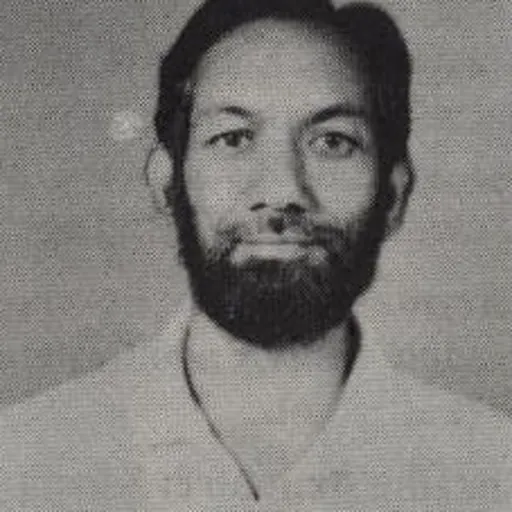
About Vijay Kumar Kapahi
Lived 1944 – 1999 (aged 55). Vijay Kumar Kapahi was an Indian astrophysicist, known for Observational cosmology, Quasars and Radio galaxies.
Vijay Kumar Kapahi (21 January 1944 – 16 March 1999) was an Indian astrophysicist and the director of the National Centre for Radio Astrophysics, an autonomous division of Tata Institute of Fundamental Research. Known for his research on radio galaxies, quasars and observational cosmology, Kapahi was an elected fellow of all the three major Indian science academies – Indian Academy of Sciences, Indian National Science Academy and National Academy of Sciences, India – as well as of the Maharashtra Academy of Sciences. The Council of Scientific and Industrial Research, the apex agency of the Government of India for scientific research, awarded him the Shanti Swarup Bhatnagar Prize for Science and Technology for his contributions to physical sciences in 1987.
Biography
Vijay Kumar Kapahi was born on 21 January 1944 at Quetta in British India. His pre-graduate and graduate studies were completed at St. Joseph's College, Bangalore (then under Mysore University) in 1959 and 1962 respectively before his move to Mumbai where he did a one-year course at BARC Training School. In 1963, he joined the Radio Astronomy Group of Tata Institute of Fundamental Research (TIFR) and this gave him the opportunity to work with Govind Swarup, who would later design the Ooty Radio Telescope. During his service at TIFR, he simultaneously pursued his doctoral studies mentored by Swarup and secured a PhD from Bombay University in 1975 for his thesis, Angular structures of extragalactic radio sources and cosmology. The Radio Astronomy Group meanwhile developed into an autonomous division of TIFR, with a new name, National Centre for Radio Astrophysics, and he served as the director of the institution since 1994. He was holding the position and simultaneously serving as a professor at TIFR at the time of his death at the age of 55 on 16 March 1999. During his doctoral studies under the guidance of Govind Swarup, together they developed an imaging technique for capturing rapid images of solar radio bursts Through his studies with the help of Ooty Radio Telescope, he discovered for the first time in 1975 that radio galaxies were smaller in linear sizes during earlier cosmic epochs. These studies assisted in the later-day development of a paradigm known as unifying scheme of radio galaxies and quasers and in integrating the properties of lobe-dominated and core-dominated types of quasars. and ResearchGate, an online article repository of scientific articles, has listed 101 of them. Besides, he edited five books Lectures on Observational Cosmology, Proceedings of the Workshop Diffuse Thermal and Relativistic Plasma in Galaxy Clusters and Asian-Pacific Astronomy: Proceedings of the 6th Asian- Pacific Regional Meeting on Astronomy of the International Astronomical Union. He also contributed chapters to books published by others and his work has drawn citations from other scientists.
Kapahi was directly involved in the establishment of the Ooty Radio Telescope, especially in the development of phase-shifter array. His contributions were reported in the initiation of the Joint Astronomy Programme of the Indian Institute of Science and he was associated with the Astronomical Society of India which he presided from 1997 until his death in 1999. He was also a member of the Indian Physics Association and International Astronomical Union He received two more honors in 1987; the Physical Research Laboratory selected him for Hari Om Ashram Prerit Vikram Sarabhai Research Award He received the Henri Chretien Research Grant Award of the American Astronomical Society in 1991 and became an elected fellow of the Indian National Science Academy in 1997. He was also an elected fellow of the National Academy of Sciences, India and the Maharashtra Academy of Sciences.
Selected bibliography Books
Chapters
Articles
Don’t just read it —
keep it.
Full-length biographies made to live with: read them, listen on the way to work, watch them tonight.
- E-book
- Audio
- Video
Instant download · yours to keep · every purchase keeps this site free
Important facts
People in Vijay Kumar Kapahi's life
Named in this biography and alive at the same time



Related people
Same field, nearest in time





Contemporaries
People whose lives overlapped Vijay Kumar Kapahi's


Frequently asked questions
Who was Vijay Kumar Kapahi?
Indian astrophysicist (1944–1999)
When was Vijay Kumar Kapahi born?
Vijay Kumar Kapahi was born on 21 January 1944 in Quetta.
When did Vijay Kumar Kapahi die?
Vijay Kumar Kapahi died on 16 March 1999 in Mumbai.
What was Vijay Kumar Kapahi's occupation?
Vijay Kumar Kapahi was an astrophysicist.
What was Vijay Kumar Kapahi known for?
Vijay Kumar Kapahi was known for Observational cosmology, Quasars and Radio galaxies.
What nationality was Vijay Kumar Kapahi?
Vijay Kumar Kapahi was Indian.
Sources & further reading
· Wikipedia: Vijay Kumar Kapahi
Cite this page
APA: Biography.guide. (2026). Vijay Kumar Kapahi. https://biography.guide/vijay-kumar-kapahi/
MLA: "Vijay Kumar Kapahi." Biography.guide, https://biography.guide/vijay-kumar-kapahi/.
Chicago: "Vijay Kumar Kapahi." Biography.guide. https://biography.guide/vijay-kumar-kapahi/.
Data last updated: 2026-09-20 · Spot an error? Report a correction.
Portrait: Wikimedia Commons · author & licence
Page generated 2026-09-27 04:57 UTC