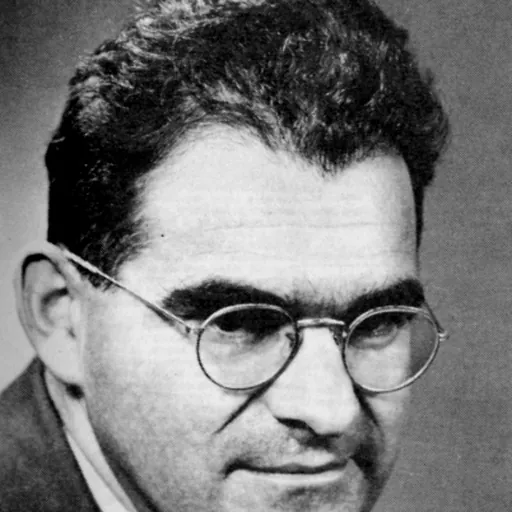
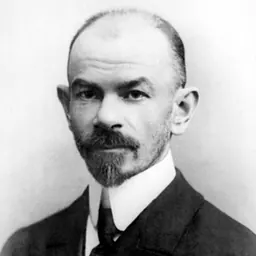
Victor Weisskopf
Austrian American theoretical physicist
About Victor Weisskopf
Lived 1908 – 2002 (aged 93). Victor Weisskopf was an Austrian and American physicist, nuclear physicist and university teacher.
Victor Frederick "Viki" Weisskopf (also spelled Viktor; September 19, 1908 – April 22, 2002) was an Austrian-born American theoretical physicist and Director-General of CERN from 1961 – 1965.
Biography Weisskopf was born in Vienna to Jewish parents and earned his doctorate in physics at the University of Göttingen in Germany in 1931. He did postdoctoral work with Werner Heisenberg, Erwin Schrödinger, Wolfgang Pauli, and Niels Bohr. Bohr mentored Weisskopf at his institute in Copenhagen. By the late 1930s, he realized that, as a Jew, he needed to get out of Europe. Bohr helped him find a position at University of Rochester in the United States.
During World War II he was Deputy Division Leader of the Theoretical Division of the Manhattan Project at Los Alamos, and he later campaigned against the proliferation of nuclear weapons.
After World War II, Weisskopf joined the physics faculty at MIT, ultimately becoming head of the department. In 1956, he became one of the founding members of the Physical Science Study Committee (PSSC), developing the curriculum for a revolutionary method of teaching physics at the high school level. As the Red Scare faded, in 1959 Weisskopf joined physicists George Gamow and Hans Bethe in supporting the return of exiled physicist Frank Oppenheimer to science teaching;
At MIT, he encouraged students to ask questions, and even in undergraduate physics courses, taught his students to think like physicists, not just to memorize the equations of physics. He was a memorable teacher, and delighted in posing "Fermi questions" and then helping students to work out approximate answers. For example, he would ask the maximum possible height of a mountain on the Earth, calculated from known basic physical constants. It took him about half an hour to work through an explanation of his computations, with the result being of the same order of magnitude as the known height of Mount Everest. For an encore, he would quickly work out the analogous answers for Mars and Jupiter (when the Mars Orbiter survey results later became available, they were consistent with his computed elevation). For his finale, he would compute the energy released by rolling a bowling ball down the highest theoretical mountain on Jupiter.
His first wife, Ellen Tvede, died in 1989. Weisskopf died on April 22, 2002, and was survived by his second wife Duscha, daughter of accidental Night of the Long Knives victim Willi Schmid.
Scientific achievements In the 1930s and 1940s, "Viki", as everyone called him, made major contributions to the development of quantum theory, especially in the area of quantum electrodynamics. One of his few regrets was that his insecurity about his mathematical abilities may have cost him a Nobel Prize when he did not publish results (which turned out to be correct) about what became known as the Lamb shift. Nevertheless, he was nominated for the Nobel Prize in Physics numerous times later in his career.
From 1937 to 1943 he was a Professor of Physics at the University of Rochester. There, he met graduate student Esther Conwell, and together they formulated the Conwell–Weisskopf theory, which describes the movement of electrons through semiconductors and led to a better understanding of integrated circuits, knowledge that became essential for modern computing. Weisskopf was a co-founder and board member of the Union of Concerned Scientists. He served as director-general of CERN from 1961 to 1966 In 1966 a Festschrift was published in his honor.
Weisskopf was awarded the Max Planck Medal in 1956 and the Prix mondial Cino Del Duca in 1972, the National Medal of Science (1980), the Wolf Prize (1981) and the Public Welfare Medal from the National Academy of Sciences (1991).
Weisskopf was a co-founder and board member of the Union of Concerned Scientists. Weisskopf was a member of the National Academy of Sciences and the American Philosophical Society. He was president of the American Physical Society (1960–61) and the American Academy of Arts and Sciences (1976–1979). He was appointed by Pope Paul VI to the 70-member Pontifical Academy of Sciences in 1975, and in 1981 he led a team of four scientists sent by Pope John Paul II to talk to President Ronald Reagan about the need to prohibit the use of nuclear weapons.
Decorations and awards 1956: Max Planck Medal 1971: First recipient of the George Gamow Memorial Lectureship Award from the University of Colorado Boulder 1972: Prix mondial Cino Del Duca 1976: Oersted Medal 1977: Marian Smoluchowski Medal 1978: Pour le Mérite for Arts and Sciences 1980: National Medal of Science 1981: Wolf Prize 1982: Austrian Decoration for Science and Art 1983: J. Robert Oppenheimer Memorial Prize 1984: Albert Einstein Medal 1990: Ludwig Wittgenstein Prize of the Austrian Science Fund 1991: Public Welfare Medal (United States National Academy of Sciences) 2000: Grand Gold Medal with Star for Services to the Republic of Austria There is a street, Route Weisskopf, named after Weisskopf at CERN, Geneva, Switzerland.
Quotes
Citing initial teacher–student interactions, Noam Chomsky attributes to Victor the educational maxim,
Publications
Don’t just read it —
keep it.
Full-length biographies made to live with: read them, listen on the way to work, watch them tonight.
- E-book
- Audio
- Video
Instant download · yours to keep · every purchase keeps this site free
Important facts
People in Victor Weisskopf's life
Named in this biography and alive at the same time




Related people
Same field, nearest in time


Contemporaries
People whose lives overlapped Victor Weisskopf's

Frequently asked questions
Who was Victor Weisskopf?
Austrian American theoretical physicist (1908–2002)
When was Victor Weisskopf born?
Victor Weisskopf was born on 19 September 1908 in Vienna.
When did Victor Weisskopf die?
Victor Weisskopf died on 22 April 2002 in Newton.
What was Victor Weisskopf's occupation?
Victor Weisskopf was a physicist, nuclear physicist and university teacher.
What nationality was Victor Weisskopf?
Victor Weisskopf was Austrian and American.
Sources & further reading
Cite this page
APA: Biography.guide. (2026). Victor Weisskopf. https://biography.guide/victor-weisskopf/
MLA: "Victor Weisskopf." Biography.guide, https://biography.guide/victor-weisskopf/.
Chicago: "Victor Weisskopf." Biography.guide. https://biography.guide/victor-weisskopf/.
Data last updated: 2026-09-20 · Spot an error? Report a correction.
Portrait: Wikimedia Commons · author & licence
Page generated 2026-09-27 04:58 UTC