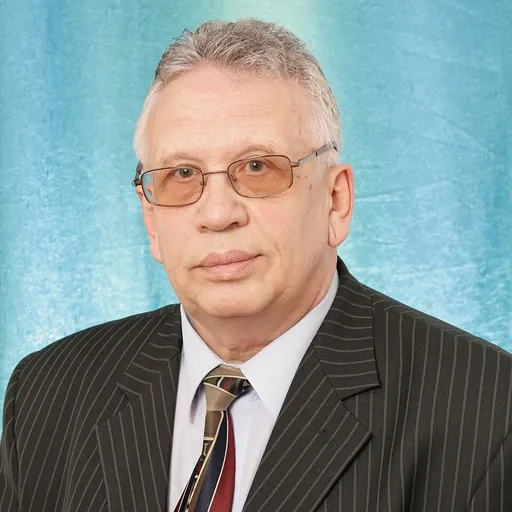
About Victor Kanke
Born 1944. Victor Kanke is a Russian philosopher, university teacher and physics teacher.
Victor Andreyevich Kanke (Russian: Виктор Андре́евич Ка́нке) (29 April 1944) is a Russian philosopher born in the village of Nekrasovo, Slavgorod District, Altai Territory to a German family. He taught physics at school (1966-1974) and philosophy at the Biysk State Teacher Training Institute (1976-1987) and the Obninsk Institute for Nuclear Power Engineering (since 1987).
Theories In his doctoral dissertation (1985), Kanke developed the concept of time forms, according to which the nature of time is always determined by the specifics of the processes in which it is inherent. Time is a measure of the process from its inception to its new state. It is a common mistake to give physical time universal features. But it is an adequate quantitative measure of solely physical processes.
In 1996–2011, Kanke developed the theory of conceptual transitions. According to this theory, philosophy in its modern form is divided into two parts, namely, substantial and metascientific philosophy. Substantial philosophy, unable to keep pace with science, inevitably takes on a metaphysical form, which is characteristic of post structuralism, critical hermeneutics and analytic philosophy. In its metascientific form, philosophy has to do with subsciences, examining and criticizing their contents. The metascientific approach is opposed to metaphysics in philosophy and substantialism in Science, according to which science does not need to study metascience. The metascientific approach gives priority to the conceptual structure of modern theories that implement some form of transition from one concept to another.
Kanke believes that the metascientific approach is an antidote to SPAM (syndrome of acquired antimetascientificity in sciences) and SPAN (syndrome of acquired antiscientificity in philosophy).
Ethics takes a prominent place in Kanke's theoretical constructions. He believes that modern ethics is built in a substantial manner, so it is dominated by the unscientific syndrome. Genuine ethics is the apex of the philosophy of axiological sciences, it aims at achieving the full potential of the transdisciplinary matrix of modern science, including scientific philosophy.
The theory of scientific transduction involves a comprehensive development of the philosophy of individual scientific disciplines. In this regard, Kanke is known for his monographs in the philosophy of mathematics, physics, chemistry, biology, engineering, computer science, economics, history, management, law, pedagogy.
In accordance with the theory of conceptual transitions, Kanke constructs relevant courses in philosophy. He believes that the general arguments about philosophy and the philosophy of science must necessarily be supplemented by a detailed excursion into the conceptual features of various sciences.
Selected books 2008. Philosophy of Science. A Short Encyclopedia. Moscow: Omega-L. . 2008 (2000). The Main Philosophical Trends and Conceptions of Science. Moscow: Logos. . 2012 (1984). Forms of Time. Moscow: URSS. 2008. General Philosophy of Science. Moscow: Omega-L. . 2007 (2003). History of Philosophy. Thinkers, Concepts and Discoveries. Moscow: Logos. . 2003. Ethics of Responsibility. A Theory of Morality of the Future. Moscow: Logos. . 2007. Modern Ethics. Moscow: Omega-L. . 2011. Modern Philosophy. Moscow: Omega-L. . 2007. The Philosophy of Textbooks. Moscow: University Book. . 2006 (2001). Conceptions of Modern Natural Sciences. Moscow: Logos. . 2011. The Philosophy of Mathematics, Physics, Chemistry and Biology. Moscow: Knorus. . 2007. The Philosophy of Economics. Moscow: Infra-M. . 2010. The Philosophy of Management. Moscow: Knorus. . 2009. The Philosophy of History. Moscow: Publishing House of Moscow State University Press. (Co-authored). . 2011. History and Philosophy of Chemistry. Moscow: Publishing House of National Nuclear Research University “MEPHI”. . 2011. The Philosophy of Pedagogy. Moscow. . 2013. The methodology of scientific knowledge. Moscow: Omega-L. . 2013. History, philosophy and methodology of engineering and computer science. Moscow: Yurayt. . 2014. History, philosophy and methodology of psychology and pedagogy. Moscow: Yurayt. . 2014. History, philosophy and methodology of natural sciences. Moscow: Yurayt. . 2014. History, philosophy and methodology of social sciences. Moscow: Yurayt. . 2021. Encyclopedia of Metascience and Special Philosophy of Science. Hong Kong/Tallinn: Eurasian Scientific Editions.. 2022. 50 critical essays on the philosophy of science. Geneva/Hong Kong/Tallinn: Eurasian Scientific Editions. .
Don’t just read it —
keep it.
Full-length biographies made to live with: read them, listen on the way to work, watch them tonight.
- E-book
- Audio
- Video
Instant download · yours to keep · every purchase keeps this site free
Important facts
People in Victor Kanke's life
Named in this biography and alive at the same time
Related people
Same field, nearest in time


Contemporaries
People whose lives overlapped Victor Kanke's



Frequently asked questions
Who is Victor Kanke?
philosopher
When was Victor Kanke born?
Victor Kanke was born on 29 April 1944 in Halbstadt.
What is Victor Kanke's occupation?
Victor Kanke is a philosopher, university teacher and physics teacher.
What nationality is Victor Kanke?
Victor Kanke is Russian.
Sources & further reading
Cite this page
APA: Biography.guide. (2026). Victor Kanke. https://biography.guide/victor-kanke/
MLA: "Victor Kanke." Biography.guide, https://biography.guide/victor-kanke/.
Chicago: "Victor Kanke." Biography.guide. https://biography.guide/victor-kanke/.
Data last updated: 2026-09-20 · Spot an error? Report a correction.
Portrait: Wikimedia Commons · author & licence
Page generated 2026-09-27 04:57 UTC