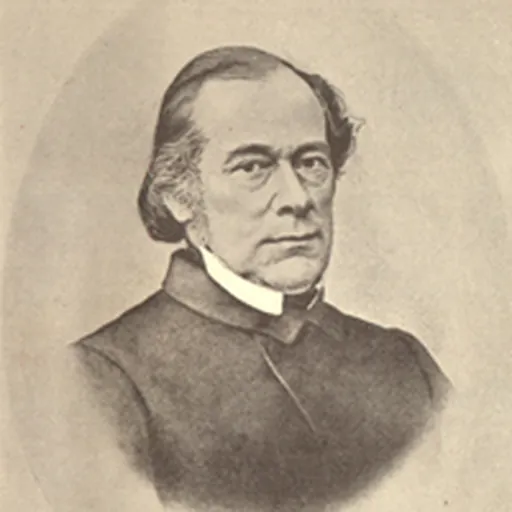
About Victor Aimé Huber
Lived 1800 – 1869 (aged 69). Victor Aimé Huber was a writer, university teacher, political economist, literary historian, social scientist and literary scholar.
Victor Aimé Huber (10 March 1800 – 19 July 1869) was a German social reformer, travel writer and a literature historian.
Huber was born in Stuttgart, Germany. His parents, Ludwig Ferdinand and Therese Huber, née Heyne, were both writers. After the early death of his father, Victor was sent to live with friends of his parents in Hofwil, Switzerland. Victor was just six years old at the time.
Huber graduated in medicine in 1820 and afterwards undertook several travels to France, Portugal, England, Spain and Italy. In 1828, Huber accepted a post as a teacher of history and modern languages at a gymnasium in Bremen, Germany. In 1832, he became a professor of modern and oriental languages in Rostock, in 1836 in Marburg and in 1843 professor for the history of literature in Berlin.
Huber took part in the establishment of a conservative party in Prussia, from which he, however, withdrew after a short time because of the interests of feudal landlords. His real aim was to help the reintegration of workers into civil society, and for this reason, he gave up his professorship in Berlin in order to dedicate himself to the social questions of the day.
Soon afterwards, Huber was able to propose a new social model to improve the life conditions of low-wage workers after visiting Manchester, in England, in 1844, where he acquainted himself with the housing and living conditions of factory workers. He named this model "internal occupation" (innere Ansiedlung).
Huber was one of the intellectual predecessors of the cooperative movement in Germany. He carried out his socio-political concepts in practice. From 1849 to 1852, Huber was active in the executive committee of the not-for-profit building firm of the 'Citizens of Berlin', which built six small houses for 15 families on a property at Schoenhauser Av. What was to become a showcase for his "internal occupation" model, however, had a short duration. In 1888/1889, the houses were demolished to make space for larger and denser buildings.
Huber died, aged 69, in Wernigerode.
Works De lingua et osse hyoi deo pici viridis, Dissertation Stuttgart 1821 Die Selbsthilfe der arbeitenden Klasse durch Wirtschaftsvereine und innere Ansiedlung, 1848 (anonym) Concordia. Bll. d. Berl. gemeinn. Baugesellschaft, Berlin 1849 Reisebriefe aus Belgien, Frankreich und England im Sommer 1854, 1855
Don’t just read it —
keep it.
Full-length biographies made to live with: read them, listen on the way to work, watch them tonight.
- E-book
- Audio
- Video
Instant download · yours to keep · every purchase keeps this site free
Important facts
People in Victor Aimé Huber's life
Named in this biography and alive at the same time

Related people
Same field, nearest in time




Contemporaries
People whose lives overlapped Victor Aimé Huber's





Frequently asked questions
Who was Victor Aimé Huber?
German writer (1800–1869)
When was Victor Aimé Huber born?
Victor Aimé Huber was born on 10 March 1800 in Stuttgart.
When did Victor Aimé Huber die?
Victor Aimé Huber died on 19 July 1869 in Wernigerode.
What was Victor Aimé Huber's occupation?
Victor Aimé Huber was a writer, university teacher, political economist, literary historian, social scientist and literary scholar.
What nationality was Victor Aimé Huber?
Victor Aimé Huber's recorded nationality: German Confederation.
Sources & further reading
· Wikipedia: Victor Aimé Huber
Cite this page
APA: Biography.guide. (2026). Victor Aimé Huber. https://biography.guide/victor-aime-huber/
MLA: "Victor Aimé Huber." Biography.guide, https://biography.guide/victor-aime-huber/.
Chicago: "Victor Aimé Huber." Biography.guide. https://biography.guide/victor-aime-huber/.
Data last updated: 2026-09-21 · Spot an error? Report a correction.
Portrait: Wikimedia Commons · author & licence
Page generated 2026-09-27 05:00 UTC