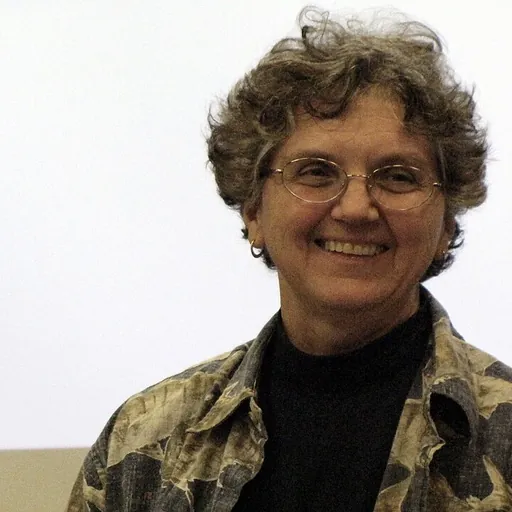
Vicki Ann Funk
American botanist for the National Museum of Natural History
About Vicki Ann Funk
Lived 1947 – 2019 (aged 71). Vicki Ann Funk was an American botanist, curator, botanical collector and scientific collector, known for Botany.
Vicki Ann Funk (November 26, 1947 – October 22, 2019) was an American botanist and curator at the Smithsonian's National Museum of Natural History, known for her work on members of the composite family (Asteraceae) including collecting plants in many parts of the world, as well as her synthetic work on phylogenetics and biogeography.
Biography Funk was born on November 26, 1947, in Owensboro, Kentucky, to Edwin Joseph and Betty Ann (née Massenburg) Funk. She had two brothers, Edwin Jr. and Jared Kirk. She grew up in Owensboro and at a few United States Air Force bases before she was in elementary school. Funk studied biology and history at Murray State University in Kentucky and received a Bachelor of Science (BS) degree in 1969. She had wanted to attend medical school, but decided against it after volunteering at a hospital one summer. After graduating, she lived and worked part-time in Germany for two years, then returned to the United States to teach high school for one year. She then spent a summer at the Hancock Biological Station on Kentucky Lake. There she discovered her passion for field work and research.
In 1975, she received an M.S. in biology at Murray State where her thesis was A Floristic and Geologic Survey of Selected Seeps of Calloway County, KY. Her advisor was Dr. Marian Fuller. She spent the summer of 1975 studying aquatic plants at Stone Lab at Lake Erie. In the fall she began doctoral studies at Ohio State University with Ron Stuckey as her advisor. She later changed her focus to Compositae with Tod Stuessy. She was an assistant curator at the Ohio State University from 1976 until 1977. where she studied Compositae with Arthur Cronquist She co-discovered the critically endangered Bidens meyeri in Rapa Iti, French Polynesia. Her work shows that this Bidens species may represent the end of a migration from North America through the Society Islands to the Austral Islands.
Beginning in 1988, she served as head of the Biological Diversity of the Guiana Shield Program (BDG), and in 2015 began the Global Genome Initiative for Gardens, both headquartered at the Smithsonian Institution. Both of these programs were passed on to others in 2018. She was also an adjunct professor at George Mason University and Duke University. In 2009, she received two awards: the Secretary's Award for Excellence in Collaboration and the National Museum of Natural History Science Achievement Award. In 2010, she was awarded the Stebbins' Medal for the best publication in Plant Systematics or Plant Evolution in the period 2007 to 2009 from the International Association for Plant Taxonomy. In 2012, she won the Smithsonian's Secretary's Award for Outstanding Publication and became a board member for the National Evolutionary Synthesis Center for two years. In 2014 she won the Rolf Dahlgren Prize for her major contributions to the understanding of the systematics and evolution of the angiosperms.
Funk has also been recognized for lifetime achievements in her field. In 2018, she won the Asa Gray Lifetime Achievement Award from the American Society of Plant Taxonomists. In 2019, the Linnean Society of London recognized Funk with its Linnean Medal for lifetime service to the natural sciences. In 2019, the American Society of Plant Taxonomists announced the new Vicki Funk Fund for Graduate Student Research in her honor.
In 2005, scientists named a new species of ant after Vicki Funk. This species, Pheidole funki, is known only from a single specimen collected in Guyana. Three genera, namely Vickia, Vickifunkia and Vickianthus, are named in honor of Vicki Funk's contribution towards systematics of Compositae. The species Xenophyllum funkianum J. Calvo from the Ecuadorian Andes was named after her in 2020 in a posthumous co-publication. Baccharis funkiae, a narrow endemic species of Compositae from Uruguay is named after Vicki Funk. Indian botanists named a new species of Gesneriaceae as Didymocarpus vickifunkiae to honor her contributions.
In November 2020, the Journal of Systematics and Evolution dedicated a special issue on collection-based systematics and biogeography as a tribute to Vicki Funk.
Don’t just read it —
keep it.
Full-length biographies made to live with: read them, listen on the way to work, watch them tonight.
- E-book
- Audio
- Video
Instant download · yours to keep · every purchase keeps this site free
Important facts
more
Victoria Ann Funk, Vicki A Funk, Vicki A. Funk, V Funk, Funk, V A Funk, Funk V, V. A. Funk, Funk V. A., V.A.Funk, Vicki FunkPeople in Vicki Ann Funk's life
Named in this biography and alive at the same time


Related people
Same field, nearest in time




Contemporaries
People whose lives overlapped Vicki Ann Funk's





Frequently asked questions
Who was Vicki Ann Funk?
American botanist for the National Museum of Natural History (1947-2019)
When was Vicki Ann Funk born?
Vicki Ann Funk was born on 26 November 1947 in Owensboro.
When did Vicki Ann Funk die?
Vicki Ann Funk died on 22 October 2019 in Arlington.
What was Vicki Ann Funk's occupation?
Vicki Ann Funk was a botanist, curator, botanical collector and scientific collector.
What was Vicki Ann Funk known for?
Vicki Ann Funk was known for Botany.
What nationality was Vicki Ann Funk?
Vicki Ann Funk was American.
Sources & further reading
Cite this page
APA: Biography.guide. (2026). Vicki Ann Funk. https://biography.guide/vicki-ann-funk/
MLA: "Vicki Ann Funk." Biography.guide, https://biography.guide/vicki-ann-funk/.
Chicago: "Vicki Ann Funk." Biography.guide. https://biography.guide/vicki-ann-funk/.
Data last updated: 2026-09-22 · Spot an error? Report a correction.
Portrait: Wikimedia Commons · author & licence
Page generated 2026-09-27 05:04 UTC