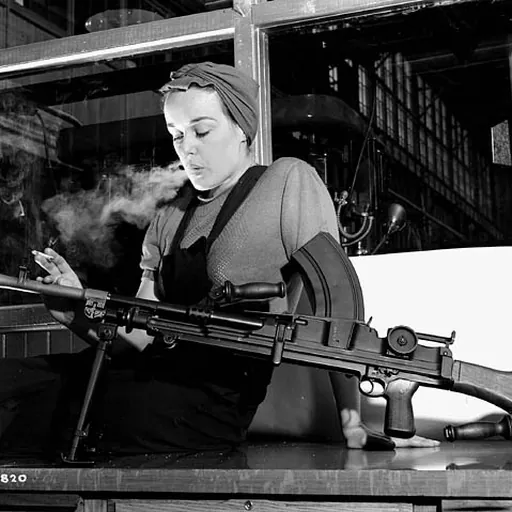
About Veronica Foster
Lived 1922 – 2000 (aged 78). Veronica Foster was a Canadian laborer and singer.
Veronica Foster (January 2, 1922 – May 4, 2000), popularly known as "Ronnie, the Bren Gun Girl", was a Canadian icon representing nearly one million Canadian women who worked in the manufacturing plants that produced munitions, weapons, and equipment during the Second World War.
Foster worked for John Inglis Company Ltd. producing Bren light machine guns on a production line on Strachan Avenue in Toronto, Ontario. While working at the John Inglis Company Ltd. she was photographed for a propaganda campaign spearheaded by the National Film Board (NFB). Her pictures were used to encourage Canadian women to participate in the war efforts. The pictures of Foster and their impact on Canadian women also inspired the creation of the American cultural icon "Rosie, the Riveter" in the United States of America. She can be seen as the Canadian precursor to Rosie.
She became popular after a series of propaganda posters were produced; most images featured her working for the war effort, but others depicted more casual settings like Foster dancing the jitterbug or attending a dinner party. After the war, she worked as a singer with Mart Kenney and His Western Gentlemen, where she met trombonist George Guerrette, whom she subsequently married. She died on May 4, 2000.
In 2000, Canada Post commemorated her influence through the creation of a stamp line featuring Foster. Moreover, in 2016, Canadian Broadcast Corporation featured Foster in their six-part series titled, "Love, Hate, and Propaganda." In 2016, her impact was also highlighted in an art history exhibition, "The Other NFB" curated by Carol Payne and Sandra Dyck.
Early life On January 2, 1922, Veronica Foster was born in Montreal, Quebec, to Daniel Leo Foster and Catherine Francis Empey Foster. She had seven siblings, four brothers and three sisters. At a young age, she moved to the Christie Pits area in Toronto, Ontario, with her mother and siblings, though as a teenager she frequently moved between both Toronto and Montreal. In her free time, her favourite things to do were playing golf and making charcoal drawings. John Inglis Company Ltd. was a massive facility that covered 23 acres, with thousands of other women working alongside Veronica in the manufacturing of Bren light and reliable machine guns used by Canadian and British soldiers. Between 1939 and 1945, the company produced over 40,000 Bren light guns. In May 1941, Foster then began working in the John Inglis Company making Bren Light Machine guns. She was discovered by the National Film Board (NFB), which had recently been assigned as the official photographer for the Canadian Government. The most famous photographs from the "Ronnie, The Bren Gun Girl" shoot showed her with her hair tied up in a headscarf, wearing a worker's uniform and smoking beside a Bren machine gun.
The NFB's primary aim for the campaign was to encourage all women to participate in the war efforts by working. while also displaying the maintenance of women's glamour and femininity. These images provided a sense of familiarity and collectivity among Canadian society, thus motivating women to join the war industry to show their continuous support for Canada. The campaign turned her into a national icon, representing a glamourized and ideal patriotic image of Canadian women working in the munition manufacturing industries during the Second World War. Foster would inspire more than one million women all across Canada to join the war industry's workforce in support of Canada. There was increased exposure for the band through this program, resulting in tours and recurring performances at the Royal York Hotel in Toronto.
Through the band, Foster fell in love with George Guerette, the band's trombonist. By 1944, Foster decided to depart from Kenney's band. Although Foster is often referred to as being a symbol of women empowerment during the Second World War, she is also perceived as upholding the narrative of women as primarily through their beauty and femininity, and not necessarily by the jobs they occupied.
While her image promoted the new role for women's involvement in the workforce, it also emphasized the idea that women should still be feminine while working in the war industry and that their roles were not directly comparable to that of their male counterparts. This would later facilitate their transition back into the private domestic sphere and back to pink-collar jobs as men came back from the war, taking back the positions they had left behind in wartime.
Women's role in the Second World War During the Second World War, Veronica Foster joined around 1,200,000 women in holding permanent jobs during the war, 50,000 of which served in the Canadian armed force. Canadian women were largely solicited to replace the men who had left vacant positions behind to go fight at the forefront of the war. Women, thus, came to occupy positions that were traditionally held by men. They filled positions in munitions factories and other industries, such as agriculture, textile and service industries in record numbers. Women enthusiastically embraced their new roles and responsibilities as gendered spaces seemingly started changing, which allowed women to play a greater role in society for the time being. However, working-class women had started taking part in the industrial workforce far before the war, and the shift in representation in the workforce came mainly from middle-class women taking on factory jobs.
Despite women's significant role in operating behind the scenes of the war, their role is largely undocumented or unknown. Ronnie, the Bren Gun Girl, for example, is rarely mentioned in documentations of the war, with her role often being overshadowed by her American counterpart – Rosie, the Riveter. Although the propaganda images created during the Second World War were perceived as a popular representation of women's power to create change, the intent behind these images was not to challenge the pre-war gendered social dynamics. Instead, many images of women during the war were "glamourized, feminized, and sexualized [...] in order to defuse potential threat that women, who were temporarily taking new roles, might pose to the stability of society and the dominance of patriarchy".
Furthermore, much of the training women were subjected to in factory jobs involved de-skilling – in other words the breaking down of a job into smaller, more manageable tasks and then assigning those smaller tasks to women. This would make it easier to replace these women by more skilled workers (i.e. men returning from war). Beauty contests, like the Miss War Beauty contest, were also very common for women munition workers to prove that women could still be beautiful and feminine even in their factory uniform. Some media would explicitly refer to women's beauty as a form of patriotism, claiming that the best way for women to express patriotism was "by having beautiful bodies". This and many other propaganda efforts served to remind society of women workers' different status when compared to men: they were not just workers but "special, temporary, feminized workers". After the war ended, many women would therefore end up returning to their pre-war occupations as housewives and mothers, and return to pink-collar jobs as nurses, midwives, secretaries and telephone operators.
Death and legacy Foster died on May 4, 2000, in Toronto, Ontario, at the age of 78. On May 8, 2020, which marked the 75th anniversary of the Victory in Europe (V-E) day, Foster's achievements were commemorated through Canada Posts' creation of stamps in her honour. Foster's and other Canadian women's stories of participation in the Second World War were referenced in the National Film Board of Canada documentary, Rosies of the North. Her photos were available for viewing at the Robert McLaughlin Gallery in Oshawa from March to May 2016, in order to highlight her profound influence in the Second World War in inspiring women to join the workforce.
In 2014, Canada's Broadcast Corporation (CBC) Radio produced a six part series on Love, Hate, and Propaganda that featured a segment on Veronica Foster and her contribution in the Second World War in the third episode, "Meet the Enemy." Though, the excerpt was later edited by Foster's son to include more information about her life and work.
Moreover, in 2016, Foster was also featured in an exhibition titled, "the other NFB" curated by Carol Payne, an arts history professor at Carleton University and Sandra Dyck, the director of the Carleton Gallery. The exhibition displayed the life of Canadians through showcasing an extensive photograph collection containing 89 pictures from years 1941–1984 taken by NFB during their role as the "official photographer" for the Canadian government.
Gallery
Don’t just read it —
keep it.
Full-length biographies made to live with: read them, listen on the way to work, watch them tonight.
- E-book
- Audio
- Video
Instant download · yours to keep · every purchase keeps this site free
Important facts
People in Veronica Foster's life
Named in this biography and alive at the same time





Related people
Same field, nearest in time



Contemporaries
People whose lives overlapped Veronica Foster's



Frequently asked questions
Who was Veronica Foster?
Canadian cultural icon during World War II (1922–2000)
When was Veronica Foster born?
Veronica Foster was born on 2 January 1922 in Montreal.
When did Veronica Foster die?
Veronica Foster died on 4 May 2000 in Toronto.
What was Veronica Foster's occupation?
Veronica Foster was a laborer and singer.
What nationality was Veronica Foster?
Veronica Foster was Canadian.
Sources & further reading
Cite this page
APA: Biography.guide. (2026). Veronica Foster. https://biography.guide/veronica-foster/
MLA: "Veronica Foster." Biography.guide, https://biography.guide/veronica-foster/.
Chicago: "Veronica Foster." Biography.guide. https://biography.guide/veronica-foster/.
Data last updated: 2026-09-21 · Spot an error? Report a correction.
Portrait: Wikimedia Commons · author & licence
Page generated 2026-09-27 05:00 UTC