
About Verena
Lived 260 – 344 (aged 83–84). Verena was a nun.
Verena of Zurzach, also known as Saint Verena ( 260 – ), was an early Christian consecrated virgin and hermit. She is venerated as a saint in the Eastern Orthodox Church, Roman Catholic Church and Oriental Orthodox Churches. She is especially venerated in Switzerland, where her cult is attested in Bad Zurzach, the reported place of her burial, from at least the 5th century. Her feast is on 1 September. If her birth before 250 is accepted (based on the identification of her mentor, bishop Chaeremon), this would imply that she was more than 95 years old at the time of her death.
Veneration
St. Verena's Mercy, Verena washing a leper's hair (Swabia, c. 1525).
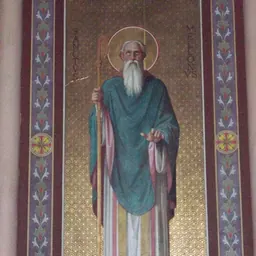
Hermitage near Solothurn, where she is said to have resided. An 18th-century depiction in Bad Wurzach parish church. Verena among other saints in celestial glory. She is depicted with her common attribute, the jar (placed at her feet), and a palm branch as a symbol of victory over the flesh. The Verena Minster in Zurzach was built over the grave of Saint Verena in a Roman cemetery.
Her cult became widespread from the 12th century, and Verena was one of the most venerated saints in medieval Switzerland.
The given name Verena is not recorded outside of the context of this saint; it has been associated with the name Berenice (i.e. Veronica). In reference to the saint, Verena came to be a commonly given feminine name in Switzerland, in hypocoristic form [Vreni" becoming an almost archetypically Swiss girls' name (cf. diminutive "Vreneli"). The name Verena or Vreneli was also transferred to numerous female figures in Swiss folklore and mythology; notable among these is the Vrenelisgärtli ("Verena's garden") glacier of the Glärnisch massif.
The Verena Gorge Hermitage north of Solothurn, ostensibly the site of Verena's hermitage, is known to have been in existence since the 12th century (the older of the two chapels has foundations of the 12th century). The presence of a resident hermit is recorded for 1442. The site features Stations of the Cross dating from 1613 (restored around 1990). In the 18th century, the gorge was developed as a landscape garden in the style of Romanticism, notably due to the advocacy of French diplomat Louis Auguste Le Tonnelier de Breteuil. During 1810–1813, the footpath along the gorge was further developed as a partly Roman Catholic pilgrimage site, and a partly national romantic shrine for the patriciate of Solothurn. In a century-old tradition, the resident hermit is provided for by the Bürgergemeinde of the city of Solothurn.
The municipality of Stäfa at Lake Zürich displays Verena in its coat of arms, from the coat of arms of Stäfa bailiwick in use since 1526.
In 1986, a delegation from Saint Verena's Church in Switzerland, brought a part of Saint Verena's relics to Egypt. The first Coptic church consecrated in the name of Saint Verena is Saint Maurice and Saint Verena's Church in Cairo, which was consecrated by Pope Shenouda III on 22 February 1994.
In October 2004, a delegation from the Diocese of Los Angeles in the United States of America, along with Metropolitan Serapion of Los Angeles, Fr. Joseph Boules and Fr. Gregory Bishay travelled to Switzerland to bring a part of Saint Verena's relics to her churches in Anaheim and Orange. The Anaheim church, now located in Yorba Linda, California, now has a shrine dedicated to her relic, as well as the church in Orange.
In popular culture There are numerous references to her as a paragon of Christian patience in the face of adversity in Charlotte M. Yonge's romantic novel The Heir of Redclyffe (1853).
Don’t just read it —
keep it.
Full-length biographies made to live with: read them, listen on the way to work, watch them tonight.
- E-book
- Audio
- Video
Instant download · yours to keep · every purchase keeps this site free
Important facts
People in Verena's life
Named in this biography and alive at the same time
Related people
Same field, nearest in time



Contemporaries
People whose lives overlapped Verena's




Frequently asked questions
Who was Verena?
Egyptian saint
When was Verena born?
Verena was born in 260 in Thebes.
When did Verena die?
Verena died in 344 in Bad Zurzach.
What was Verena's occupation?
Verena was a nun.
Sources & further reading
Cite this page
APA: Biography.guide. (2026). Verena. https://biography.guide/verena/
MLA: "Verena." Biography.guide, https://biography.guide/verena/.
Chicago: "Verena." Biography.guide. https://biography.guide/verena/.
Data last updated: 2026-09-20 · Spot an error? Report a correction.
Page generated 2026-09-27 05:28 UTC