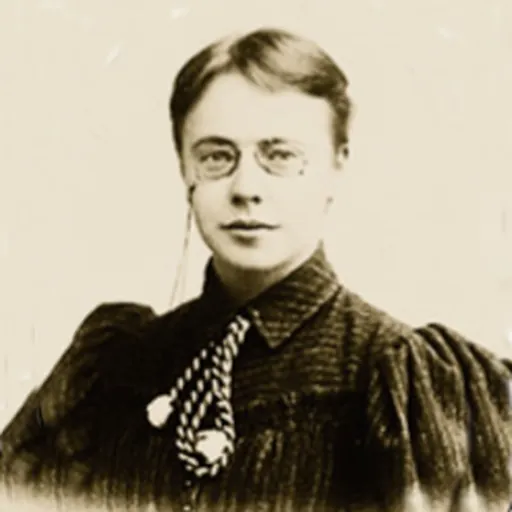
About Vera Popova
Lived 1867 – 1896 (aged 28). Vera Popova was a Russian chemist.
Career
Bogdanovskaya returned to Saint Petersburg in 1892 to work at the Bestuzhev Courses, where she taught chemistry. This was an institution founded in 1878 to encourage Russian women to stay in Russia to study. She was working as an assistant to Prof. L'vov teaching the first courses in stereochemistry. Her reputation as a lecturer and her knowledge of teaching enabled her to write her first book, a textbook on basic chemistry. She wrote reviews, translated academic papers on chemistry and, together with her professor, published the works of Alexander Butlerov, who had died in 1886. Between 1891 and 1894, she published a number of papers based on her doctoral thesis.
She was not just a chemist; she was also interested in entomology, writing and languages. In 1889, she published a description of work with bees. Bogdanovskaya published her own short stories, as well as her translations of the French short-story writer Guy de Maupassant. She was 28.
Aftermath , the chemical that she was trying to synthesize at the time of her death, was not successfully created until 1961 from phosphine and carbon. It is extremely pyrophoric and polymerizes easily at temperatures above −120 °C. Its triple point is −124 °C and it burns spontaneously even at low temperatures when exposed to air. A shorter obituary appeared in the journal Nature and a brief notice in the American journal Science. One report by the chemist Vladimir Ipatieff suggested that she might have been poisoned by her experiment or have committed suicide, but this view was not supported by other reports.
Her early death led to a fund being created in her memory by her husband to assist female students. Her portrait was also displayed at the Women's College where she had trained.
Popova is credited with classifying dibenzyl ketone. This laid the foundation for synthetic acrylic resins created from acetone cyanohydrin.
Don’t just read it —
keep it.
Full-length biographies made to live with: read them, listen on the way to work, watch them tonight.
- E-book
- Audio
- Video
Instant download · yours to keep · every purchase keeps this site free
Important facts
People in Vera Popova's life
Named in this biography and alive at the same time



Related people
Same field, nearest in time



Contemporaries
People whose lives overlapped Vera Popova's


Frequently asked questions
Who was Vera Popova?
Russian chemist (1867–1896)
When was Vera Popova born?
Vera Popova was born on 17 September 1867 in Saint Petersburg.
When did Vera Popova die?
Vera Popova died on 25 April 1896 in Izhevsk.
What was Vera Popova's occupation?
Vera Popova was a chemist.
What nationality was Vera Popova?
Vera Popova was Russian.
Sources & further reading
· DBpedia: Vera Yevstafievna Popova
Cite this page
APA: Biography.guide. (2026). Vera Popova. https://biography.guide/vera-popova/
MLA: "Vera Popova." Biography.guide, https://biography.guide/vera-popova/.
Chicago: "Vera Popova." Biography.guide. https://biography.guide/vera-popova/.
Data last updated: 2026-09-22 · Spot an error? Report a correction.
Portrait: Wikimedia Commons · author & licence
Page generated 2026-09-27 05:04 UTC