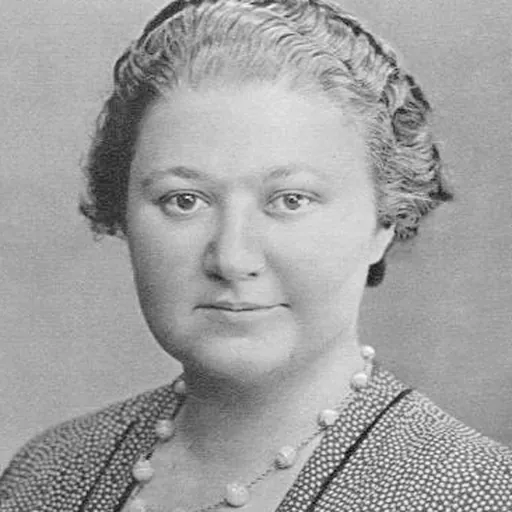
About Vera Menchik
Lived 1906 – 1944 (aged 38). Vera Menchik was a British and Czech chess player.
Vera Francevna Mencikova (, Vera Frantsevna Menchik; ; 16 February 1906 – 26 June 1944), was a Russian-born Czechoslovak chess player who primarily resided in England. She was the first and longest-reigning Women's World Chess Champion from 1927 to 1944, winning the championship a record eight times primarily in round-robin tournaments. In an era when women primarily competed against other women, Menchik was the first and only woman competing in master-level tournaments with the world's best players.
Menchik was born in Moscow to a Czech father and English mother. She began playing chess competitively in school at age 14 not long before the Russian Revolution led her family to leave Russia and move to England in 1921. She joined the Hastings Chess Club in 1923, where she began training with James Drewitt and Géza Maróczy. Menchik established herself as the best female player in the country in 1925 by defeating the British women's champion Edith Price in two matches, and then the world by winning the inaugural Women's World Chess Championship in 1927.
Menchik began competing in master-level tournaments in 1928. Following her first big success at Ramsgate in 1929 when she shared second place with Akiba Rubinstein, she was regularly invited to these elite events for the next decade, including the local Hastings Congress. Her best result in the Hastings Premier tournament was in 1931/32 when she defeated future world champion Max Euwe and Mir Sultan Khan. Late in her career, Menchik won a lone Women's World Championship match against Sonja Graf, the next-leading female player of her era. Menchik was active until her death in 1944, when she was killed in a German air raid that destroyed her home during the Second World War.
Menchik was the dominant female chess player before the war, winning at least 59 games in a row at the Women's World Championship tournaments. Highlights of her successes against male players included two victories and a positive score against Euwe and a positive score in 29 known games against George Thomas, who received the International Master (IM) title. Master-level players that Menchik defeated were said to be members of the Vera Menchik Club, which included six players who received the Grandmaster (GM) title or the honorary equivalent. The trophy for the winning team at the Women's Chess Olympiad is named the Vera Menchik Cup in her honour.
Early life and background
Vera Mencikova was born on 16 February 1906 in Moscow to Olga and František Menčík, who were English and Czech respectively. She had a younger sister Olga who was born a year later and also became a chess player. Her mother and father both worked for estate owners who were members of the Russian nobility. Her mother was a governess who acted as a private tutor for the owners' children while her father was the manager of their estates. Her mother's parents already lived in Russia, where her mother's father Arthur worked as a cotton manufacturer. Vera's father came to Russia in 1904 after an invite from his uncle to work as a mechanic at his textile factory. Her father later owned a mill and resumed working as a mechanic. She stated that the tournament "gave birth to [her] sporting spirit". In the later part of the year, she began taking private lessons with Géza Maróczy, a Hungarian who later became one of the inaugural players to be awarded the Grandmaster (GM) title in 1950. This coaching made her one of the only female chess players at the time to partake in formal training. Menchik was only able to work with Maróczy until early 1924 when he left England to go to the United States. At this point, she resumed training with Drewitt. Although she only trained with Maróczy for a short time, she credited him with inspiring her to try and compete at a higher level.
A year later, Menchik began facing Price regularly to determine who was the better player. Both of them finished in second place in their respective sections at the first class level in the 1924/25 Hastings Christmas Congress. They played a playoff to decide the top first class woman, but the game ended in a draw. Because of this draw as well as Menchik being unable to compete in the British Women's Chess Championship because she was not a British citizen, Price challenged Menchik to a match. They ended up playing two five-game matches, one in April and one in June. Menchik won both matches 3–2 (+2–1=2 and +3–2=0), establishing herself as the best female player in the country. Menchik had another big success that August at the Stratford tournament, where she finished runner-up to George Thomas. She won her game against Thomas and earned a prize of £8 (equivalent to about £ in 2022). At some point during the year, the Sussex Chess Association formally recognized Menchik as a first class player before she made it to the semifinals of the county championship. Graf won the first game with the black pieces before Menchik recovered to win the last three games and the match. Graf's performance was good enough for the two to discuss the possibility of a match for the Women's World Championship in London. It never materialised, however, in part because Graf hurt her reputation by losing a match 0–6 to Paul Heuäcker, who was better regarded as a chess composer than a competitive chess player.
Menchik was the first and only woman accepted as a master in the period she was competing. Graf had an attacking tactical playing style completely opposite to Menchik's passive style. Menchik had a dominant record against Graf of +15–3=5. Beyond Graf, Price was the only other female player to have multiple known wins against Menchik, albeit before she became world champion. The only other women to have any recorded wins against Menchik are Wally Henschel in the Women's World Championship and Elaine Saunders.
Menchik never had a FIDE title because FIDE did not establish the Grandmaster or International Master titles until 1950 after her death and they have never awarded a title to anyone posthumously. Menchik had a record of about 25% against GM-level players and a record of nearly 50% against IM-level players. As such, she is generally recognized as an IM-strength level player. Max Euwe was the only World Champion she won or drew a game against, although she achieved this (in 1930 and 1931) before Euwe became World Champion. The only other World Champions she faced regularly were Capablanca and Alekhine, who won all of their nine and eight games against her respectively. Nonetheless, both Capablanca and Alekhine regularly praised Menchik's ability. When asked "are there any women who played good chess" in 1932, Capablanca replied, "One. Her name is Vera Menchik... She played against me and she is very strong."
Vera Menchik Club Menchik had two wins against Max Euwe (pictured in 1945 with his daughter), the World Champion from 1935 to 1937, in four tournament games. For this reason, Euwe was one of the players named "president" of the Vera Menchik Club. Master-level players who lost to Menchik were said to be "members" of the "Vera Menchik Club", a term that was used by both these high-level players and the press. This concept originated at the Carlsbad tournament in 1929 when Albert Becker suggested the idea as a means of ridicule after Menchik lost her opening-round game. He also suggested players who drew against Menchik be deemed "candidate members". Before the same tournament, chess journalist Hans Kmoch also mocked Menchik by stating he would "go on stage as a ballerina" if Menchik scored more than three points. Becker himself became the first member of the club when he lost to Menchik in the third round. Although Menchik only scored exactly three points in Carlsbad, Kmoch expressed regret over his declaration and his behavior in light of Menchik's performance midway through the tournament. Bykova and Rubtsova also were awarded the IM title when they became the Women's World Champion. Gaprindashvili and Chiburdanidze were regarded as the next dominant women's champions after Menchik, owing to both of them holding the title for over a decade and their success in open tournaments. They were the first and second women respectively to receive the Grandmaster title.
Because Vera Menchik was the easily the best female chess player, her passive positional playing style led to the stereotype that women could not be good attacking tactical players. In modern chess, the opposite stereotype exists and it is believed that the strongest female chess players tend to have attacking styles. These more aggressive styles became associated with Gaprindashvili and later Judit Polgár, the latter of whom is widely acknowledged as the best female chess player in history. Polgár herself is also capable of a more long-term strategic style of play.
Honours
Menchik was inducted into the World Chess Hall of Fame in 2011. She was the 16th inductee and the first woman to be inducted. When FIDE began hosting the Women's Chess Olympiad in 1957, they named the championship trophy for the gold medal team the Vera Menchik Cup. FIDE commemorated the 50th anniversary of her death by making 1994 the "Year of Vera Menchik". Menchik has been featured on postage stamps in a few different countries, including the Czech Republic in 1996. The English Chess Federation began hosting the Caplin Menchik Memorial in London in 2022, named for Menchik and the sponsor Caplin Systems. The inaugural edition was a ten-player women's round-robin tournament designed to give lower-titled and untitled players the opportunity to earn norms for the Woman International Master (WIM) and Woman Grandmaster (WGM) titles. It was the first memorial tournament for Menchik that England hosted since an open tournament in Maidstone in 1994 for the Year of Vera Menchik.
Because of the circumstances of Menchik's death, few of her awards have survived. The Hastings Chess Club displays Menchik's gold medal that honours her long reign as Women's World Champion. The medal had been in the possession of her sister's husband.
Personal life
Family Menchik married Rufus Henry Streatfield Stevenson in October 1937 when she was age 31 and he was age 59. She changed her name to Vera Stevenson, but still used her birth name in competitions. While her husband was an editor, Menchik influenced the magazine to include more coverage of women's chess tournaments and other topics related to women's chess. Menchik and Stevenson were married for a little over five years until his death in February 1943. By 1940, his health had already began to deteriorate. Menchik and Stevenson were believed to have had a strong marriage.
Menchik's sister Olga was also an accomplished chess player. She finished in equal first at the London Girls' Championship in 1928 the year after Vera became too old to participate, ending up as the runner-up after losing the playoff. Olga participated in the Women's World Championship competitions alongside Vera twice. Her best result was in 1935 when she finished in fourth place out of ten with a score of 5½/9, a ½ point behind the bronze medallist. She defeated the three lowest-finishers, lost to her sister, and drew against her other five opponents. Olga's only other appearance was at the next Women's World Championship in 1937 when she finished in joint 17th place out of 26 players with a score of 6½/14. She did not face Vera this time due to the Swiss format used in this edition.
Work Menchik earned a living primarily through chess-related positions. Although she was not a full-time professional player, she supplemented the limited prize money she earned in competition by giving chess lessons, serving as a chess editor for different journals, and serving as a host at different chess clubs. She also earned money by giving simultaneous exhibitions. Menchik was an editor for the Social Chess journal with William Winter and later served as the opening columnist and games editor for Chess magazine during the Second World War. Also during the war, Menchik became the director of the British National Chess Centre in London in September 1939. She held the position for about a year until the building was destroyed by a fire when the German Luftwaffe bombed London during The Blitz early in the Second World War. After this bombing, Menchik joined the West London Chess Club. When chess lessons became less popular during the war, another way Menchik earned money was by giving lessons in the card game bridge.
Character Menchik was generally well-liked for her personable character and her interest in other people. Her popularity was one of the reasons she regularly received invitations to tournaments. Menchik, like most other players of IM-strength, did not aim to be fully dedicated on chess compared to the majority of the world's top players and those of GM-strength. The two strongest events of Menchik's career in Carlsbad and Moscow were both located in the two other countries where she had ties. At these tournaments, Menchik took the opportunity to visit her father at the former and visited various attractions in the city at the latter, factors that may have contributed to her last-place finishes at these events. Some of Menchik's other recreational interests were seeing plays and films, playing tennis, and modelling clay.
Death Menchik was killed on 26 June 1944 when her house in Gauden Road in south London was destroyed in a direct hit by one of the earliest V-1 flying bomb attacks during the Second World War. Her sister and her mother were also killed in the attack as the entire family had sought shelter in the basement of their home. They had the option to hide in a bomb shelter in their backyard or a shelter underneath the nearby Clapham North tube station, both of which survived the attack. Nonetheless, they would not have known whether they had enough time to reach either shelter. These flying bombs were guided missiles that the German Luftwaffe launched from occupied land across the English Channel for several months from 13 June just two weeks before Menchik's death through October. They had an intermediate range of 160 miles, but were too imprecise to be aimed at a specific target. Because of that limitation, they were used with the intent of killing random civilians from afar and inciting terror amongst the general population. The Menchiks were among a little over 6000 casualties during the almost half a year of bomb attacks. As the bomb destroyed the Menchik family's home, most of the records of Vera's life were also lost in the attack, including game records, her writings, and her trophies. One of the few surviving awards was a damaged gold medal Menchik had received to honour her then twelve-year reign as world champion in 1939.
Results Hastings Congress Menchik was an annual participant in the Hastings Christmas Congress, which comprised different-level round-robin sections, for most of her career.
+ Year Section Players W L D Score Place 1923/24 First class (Sec. A) 10 3 5 1 3½/9 =7th 1924/25 First class (Sec. 2) 8 4 1 2 5/7 2nd 1925/26 Major 10 1 4 4 3/9 =7th 1926/27 Major Reserve 10 5 1 3 6½/9 =1st 1927/28 Major Open A 10 3 4 2 4/9 7th 1928/29 Premier Reserve 10 3 5 1 3½/9 8th 1929/30 Premier 10 2 4 3 3½/9 9th 1930/31 Premier 10 2 5 2 3/9 8th 1931/32 Premier 10 3 4 2 4/9 =5th 1932/33 Premier 10 2 4 3 3½/9 =6th 1933/34 Premier 10 2 6 1 2½/9 8th 1934/35 Premier 10 1 4 4 3/9 8th 1936/37 Premier 10 0 4 5 2½/9 =9th Key: Score is the number of points scored divided by the number of games, where a win (W) is 1 point, a loss (L) is 0 points, and a draw (D) is a ½ point.Places that were shared are indicated with "=".
Women's World Championship tournaments Menchik played seven Women's World Championship tournaments, winning all of them.
+ Year Location Players Format Federation W L D Score Place 1927 London 12 Single RR Russia 10 0 1 10½/11 1st 1930 Hamburg 5 Double RR Czechoslovakia 6 1 1 6½/8 1st 1931 Prague 5 Double RR Czechoslovakia 8 0 0 8/8 1st 1933 Folkestone 8 Double RR Czechoslovakia 14 0 0 14/14 1st 1935 Warsaw 10 Single RR Czechoslovakia 9 0 0 9/9 1st 1937 Stockholm 26 Swiss Czechoslovakia 14 0 0 14/14 1st 1939 Buenos Aires 20 Single RR England 17 0 2 18/19 1st Key: Federation is the country represented by the player. Format is either round-robin (RR) or the Monrad variant of a Swiss system.Score is the number of points scored divided by the number of games, where a win (W) is 1 point, a loss (L) is 0 points, and a draw (D) is a ½ point.
Matches with Graf Menchik won two matches against Sonja Graf, the second of which in 1937 was a FIDE-sanctioned match for the Women's World Championship.
+Informal match, Rotterdam 1934 1 2 3 4 Points Vera Menchik0 11 1 3 Sonja Graf 1 0 0 0 1
+Women's World Chess Championship match, Semmering 1937 1 2 3 4 5 6 7 8 9 10 11 12 13 14 15 16 Points Vera Menchik ½ 1 ½ 1 1 1 0 1 ½ 1 0 1 1 1 ½ ½ 11½ Sonja Graf ½ 0 ½ 0 0 0 1 0 ½ 0 1 0 0 0 ½ ½ 4½
Notable games
Menchik vs. Euwe, Hastings 1931/32 + Vera Menchik – Max Euwe, 1931/32 Hastings International Christmas Congress: Round 2; Slav Defence. Menchik defeated Euwe at the Hastings tournament for the second year in a row. Some of the annotations of the game from the August 1944 edition of Chess magazine, a few of which are attributed to chess journalist W. Ritson Morry (WRM), are included below.
Khan vs. Menchik, Hastings 1931/32 + Mir Sultan Khan – Vera Menchik, 1931/32 Hastings International Christmas Congress: Round 6; Queen's Gambit Declined. W. Ritson Morry regarded the encounter as "a masterly game" in his annotations for British Chess Magazine when it was played. Some of his annotations for the game are included below.
Menchik vs. Graf, Semmering 1937
Vera Menchik – Sonja Graf, 1937 Women's World Championship match: Game 14; Semi-Slav Defense. The last of Menchik's nine wins against Graf in their 1937 match, this game is noted for Menchik's final move, a brilliant tactic offering to sacrifice a rook with the threat of sacrificing the queen for a forced checkmate. Robert Tanner, the author of a biography on Menchik, provides annotations for the game, some of which are included below.
Don’t just read it —
keep it.
Full-length biographies made to live with: read them, listen on the way to work, watch them tonight.
- E-book
- Audio
- Video
Instant download · yours to keep · every purchase keeps this site free
Important facts
People in Vera Menchik's life
Named in this biography and alive at the same time


Related people
Same field, nearest in time
Contemporaries
People whose lives overlapped Vera Menchik's


Frequently asked questions
Who was Vera Menchik?
Czech chess player (1906–1944)
When was Vera Menchik born?
Vera Menchik was born on 16 February 1906 in Moscow.
When did Vera Menchik die?
Vera Menchik died on 26 June 1944 in Clapham.
What was Vera Menchik's occupation?
Vera Menchik was a chess player.
What nationality was Vera Menchik?
Vera Menchik was British and Czech.
Sources & further reading
Cite this page
APA: Biography.guide. (2026). Vera Menchik. https://biography.guide/vera-menchik/
MLA: "Vera Menchik." Biography.guide, https://biography.guide/vera-menchik/.
Chicago: "Vera Menchik." Biography.guide. https://biography.guide/vera-menchik/.
Data last updated: 2026-09-22 · Spot an error? Report a correction.
Portrait: Wikimedia Commons · author & licence
Page generated 2026-09-27 05:03 UTC