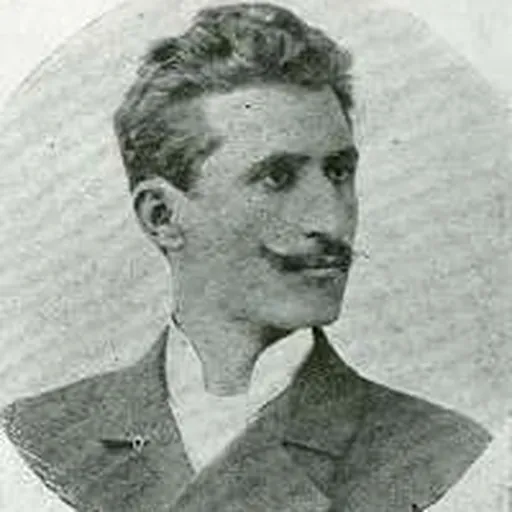
About Vasil Chekalarov
Lived 1874 – 1913 (aged 38–39). Vasil Chekalarov was a Turkish military personnel and revolutionary.
Vasil Hristov Chekalarov (Bulgarian/; 1874 – 9 July 1913) was a Bulgarian revolutionary and a leader of the Kastoria district as part of the Internal Macedonian Revolutionary Organisation (IMRO) in Macedonia. H. N. Brailsford described Chekalarov as one of the chiefs of the Bulgarian insurgent movement and "cruel but competent general" of the southern insurgents in Macedonia.
He was a leading komitaji in the bands of IMRO and took part in the battles against the Ottoman authorities as well as before the Ilinden Uprising as after it. In the 1900s, he created a channel for illegal purchase and transfer of firearms from Greece to Southern Macedonia.
Life
Early life Vasil Chekalarov was born in 1874 in the village Smardesh (modern Krystallopigi, Greece). His father was a migrant labourer like many men in the village. Chekalarov studied Greek at a local Patriarchist school. He also apparently learned Albanian, perhaps while in the village markets west of Smardesh, closer to the town of Korçe. Apart from Greek and Albanian, Chekalarov also spoke Bulgarian and the local Slavic dialect. His father made him stop attending school after the fourth grade. Chekalarov worked as his father's apprentice, who was then a mason. Afterwards, his father sent him to study in the newly established Principality of Bulgaria. Chekalarov finished high school in Shumen in eastern Bulgaria, while working at local construction sites. Along with other band leaders from the neighbouring villages of Dambeni, Roulia and Gabresh, Chekalarov maintained a strict regime of discipline and extortion in the northern parts of Kastoria. In his diary on 29 December 1902, he wrote about a "Grecoman" priest who tried to convince Chekalarov and his comrades that they were Greeks, afterwards claiming that they were neither Greeks nor Bulgarians, but Macedonians, which Chekalarov perceived as being ignorant about history. In 1903, Ottoman patrols remained active around Smardesh. Ottoman soldiers brought reservists and local volunteers, who often stole things and ransacked homes during their searches for revolutionaries and weapons. In response, Chakalarov organised several mass demonstrations to gain more support for IMRO and undermine the credibility of the Ottoman counter-insurgency.
Ahead of the Ilinden uprising, his men clashed repeatedly with Ottoman troops. Between June and July, Chekalarov executed around ten civilians from villages neighbouring Smardesh for collaboration with the authorities. On the first day of the uprising, Chekalarov murdered 26 Muslims at the village Zervaini. Chekalarov managed to occupy Neveska on 19 August. In March 1908, he attended the Kyustendil Congress of IMRO. As a commander of a Bulgarian guerrilla band, Chekalarov supported the Hellenic Army in the First Balkan War in 1912-1913. Later he fought on the side of the Bulgarian Army on the front in Eastern Thrace in the composition of the Macedonian-Adrianopolitan Volunteer Corps. He was killed by Greek troops during the Second Balkan War at Belkamen (modern Drosopigi, Florina, Greece) on 9 July 1913 and his head was publicly displayed in Florina.
Legacy In 1934, a Bulgarian village was renamed Chakalarovo in honour of Vasil Chekalarov. In the early 1950s the Yugoslav government submitted a memorandum to the UN, where the population in Bulgarian Macedonia was declared a "Yugoslav Macedonian minority", persecuted by the authorities in Sofia. A lot of old IMRO revolutionaries, including Chekalarov's wife Olga, declared themselves against these Yugoslav allegations.
His diary, describing the period from 1901 to 1903, whose originals were preserved by a relative of his, was published in 2001 in Sofia. Gane Todorovski wrote a poem about him. An equestrian statue depicting him was placed in Skopje in 2013 as part of the Skopje 2014 project. Before the placement of the statue, he was unknown to the general public in North Macedonia. The Macedonian historiography and the Bulgarian historiography regard him as a hero.
Don’t just read it —
keep it.
Full-length biographies made to live with: read them, listen on the way to work, watch them tonight.
- E-book
- Audio
- Video
Instant download · yours to keep · every purchase keeps this site free
Important facts
Related people
Same field, nearest in time





Contemporaries
People whose lives overlapped Vasil Chekalarov's


Frequently asked questions
Who was Vasil Chekalarov?
Bulgarian revolutionary (1874–1913)
When was Vasil Chekalarov born?
Vasil Chekalarov was born in 1874 in Krystallopigi.
When did Vasil Chekalarov die?
Vasil Chekalarov died on 9 July 1913 in Drosopigi.
What was Vasil Chekalarov's occupation?
Vasil Chekalarov was a military personnel and revolutionary.
What nationality was Vasil Chekalarov?
Vasil Chekalarov was Turkish.
Sources & further reading
Cite this page
APA: Biography.guide. (2026). Vasil Chekalarov. https://biography.guide/vasil-chekalarov/
MLA: "Vasil Chekalarov." Biography.guide, https://biography.guide/vasil-chekalarov/.
Chicago: "Vasil Chekalarov." Biography.guide. https://biography.guide/vasil-chekalarov/.
Data last updated: 2026-09-22 · Spot an error? Report a correction.
Portrait: Wikimedia Commons · author & licence
Page generated 2026-09-27 05:03 UTC