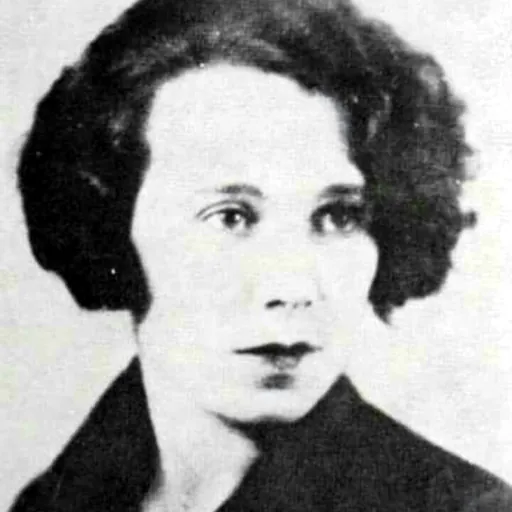
About Vahida Maglajlić
Lived 1907 – 1943 (aged 35). Vahida Maglajlić was a Yugoslav resistance fighter and partisan.
Vahida Maglajlić (17 April 1907 – 1 April 1943) was a Yugoslav Partisan recognized as a People's Hero of Yugoslavia for her part in the struggle against the Axis powers during World War II. She was the only Bosnian Muslim woman to receive the order.
Born to a Banja Luka qadi, Maglajlić was denied a higher education by her father. She took up various social and humanitarian causes, including women's rights. After Yugoslavia was invaded by the Axis powers in April 1941, Bosnia became part of the Independent State of Croatia, a fascist puppet state. Maglajlić entered the Communist Party of Yugoslavia in May and joined the growing Partisan resistance movement. Her high social status allowed her to inconspicuously shelter and equip local Partisans for several months, but she was eventually discovered by the authorities and sent to prison. After months of torture, Maglajlić escaped and joined the Partisans. She was an influential political figure in Bosanska Krajina until her death in combat with German troops in Mala Krupska Rujiška.
After the war, her remains were exhumed from Mala Krupska Rujiška and reburied at the Partisan cemetery in Banja Luka. Her image has been displayed on the cover of leaflets distributed by the Palestine Liberation Organization, which has sought to promote her as an example for Palestinian women.
Family, education and activism Vahida Maglajlić was born on 17 April 1907 in Banja Luka, Bosnia and Herzegovina, then a condominium occupied by Austria-Hungary and later part of the Kingdom of Yugoslavia. She came from a prominent Muslim Bosniak family, the oldest of ten children of qadi Muhamed Maglajlić, president of Banja Luka's Sharia court, and his wife Ćamila. The household numbered seven women and fifteen men, with Maglajlić's paternal grandparents, aunts, uncles and cousins sharing the family home. As a child, Maglajlić played with broomsticks rather than with dolls, pretending that they were actually guns and horses. She also preferred boys as playmates, but soon had to take up responsibility for her eight brothers and a much younger sister. Maintaining an elaborate network of undercover contacts, checkpoints and lodgings, she became one of the most reliable Partisan supporters in Banja Luka. She had her mother prepare food supplies for the Partisans and provided them with equipment such as radio transmitters by convincing Banja Luka's Serb, Muslim, and Jewish families to donate their property to the resistance movement rather than see it confiscated by the Ustaše.
The Ustaše eventually found out about Maglajlić's activities, but to arrest her in public meant risking a significant revolt among the Muslim population. She was requested to report to the Ustaše militia in October 1941, and the opportunity to apprehend her quietly was seized. During the two months she spent in prison, Maglajlić was interrogated under torture with the aim of extracting information about the Partisans. Because she kept silent, the authorities decided to send her to Zagreb. On 20 December 1941, the day of the transfer, Maglajlić managed to escape the prison along with a friend, Danica Marić. The two women spent several days hiding in the home of Maglajlić's father before moving to Partisan-held territory on Mount Čemernica. On 31 December 1941, they became Partisans. Her brothers had already joined the guerrilla fighters; two ended up in prison, while her father was sent to a concentration camp in 1942.
Politics and guerrilla warfare Maglajlić's sister and brothers at her grave in Mala Krupska Rujiška in 1963. Shortly after reaching the liberated territory, Maglajlić took up politics. She worked with the people of Kozara, Grmeč and Cazin, mostly with women. Her influence was most notable among the Muslim women of Cazin, and her political career culminated with her election to the Central Committee of the Women's Antifascist Front of Bosnia and Herzegovina on 6 December 1942. She represented the communists in Sanski Most and Bosanski Novi until January 1943, when the Fourth Enemy Offensive forced her to retreat over Mount Šator into Glamoč and Livno. She soon found herself back in Bosanska Krajina, and returned to Bosanski Novi.
Along with the rest of the 12th Krajina Brigade, Maglajlić arrived in Mala Krupska Rujiška on the afternoon of 31 March. She and her fellow Partisans were woken by gunfire early in the morning of 1 April, having been encircled by the Germans. The Partisans tried to break out and seek refuge on a nearby hill. Maglajlić failed to reach the hillside and was shot in the back in the ensuing crossfire. The surviving Partisans returned later that day to recover the bodies of their 28 fallen comrades, including Maglajlić, and bury them in the village. After the war, her remains were reburied at the Partisan cemetery in Banja Luka, where they remain to this day.
Legacy
Vahida was one of four Maglajlić siblings to die fighting as Partisans. The other three were her brothers, Dževad, Munib and Nedžib, who was killed by the Chetniks. On 20 December 1951, Maglajlić was recognized as a People's Hero of Yugoslavia. She is the only Bosnian Muslim woman to have received this award. The same recognition was granted to Maglajlić's brother-in-law, who was killed in action two months following her death. Maglajlić's image has been used on the covers of leaflets distributed by the Palestine Liberation Organization, which has promoted her as a role model for Palestinian women.
Don’t just read it —
keep it.
Full-length biographies made to live with: read them, listen on the way to work, watch them tonight.
- E-book
- Audio
- Video
Instant download · yours to keep · every purchase keeps this site free
Important facts
Related people
Same field, nearest in time




Contemporaries
People whose lives overlapped Vahida Maglajlić's



Frequently asked questions
Who was Vahida Maglajlić?
Yugoslav Partisan
When was Vahida Maglajlić born?
Vahida Maglajlić was born on 17 April 1907 in Banja Luka.
When did Vahida Maglajlić die?
Vahida Maglajlić died on 1 April 1943 in Mala Krupska Rujiška.
What was Vahida Maglajlić's occupation?
Vahida Maglajlić was a resistance fighter and partisan.
What nationality was Vahida Maglajlić?
Vahida Maglajlić was Yugoslav.
Sources & further reading
Cite this page
APA: Biography.guide. (2026). Vahida Maglajlić. https://biography.guide/vahida-maglajlic/
MLA: "Vahida Maglajlić." Biography.guide, https://biography.guide/vahida-maglajlic/.
Chicago: "Vahida Maglajlić." Biography.guide. https://biography.guide/vahida-maglajlic/.
Data last updated: 2026-09-21 · Spot an error? Report a correction.
Portrait: Wikimedia Commons · author & licence
Page generated 2026-09-27 05:01 UTC