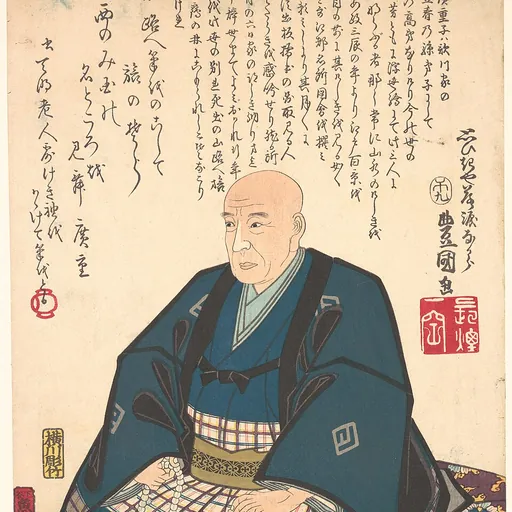
About Utagawa Hiroshige
Lived 1797 – 1858 (aged 60–61). Utagawa Hiroshige was a Japanese painter, ukiyo-e artist, xylographer, draftsperson and artist.
or nihongo|Andō Hiroshige (At around the age of ten, Hiroshige studied traditional Kanō-style painting under Okajima Rinsai, who also lived in the fire warden barracks; according to some sources, in 1806 the young Hiroshige produced an emaki handscroll as a tribute to the governor of Edo, commissioned by an ambassador from the Ryukyu Islands.) He sought the tutelage of Toyokuni of the Utagawa school, but Toyokuni had too many pupils to make room for him. A librarian introduced him instead to Toyohiro of the same school. By 1812 Hiroshige was permitted to sign his works, which he did under the art name Hiroshige. He also studied the techniques of the well-established Kanō school, the nanga whose tradition began with the Chinese Southern School, and the realistic Shijō school, and likely the linear perspective techniques of Western art and uki-e.
Hiroshige's apprentice work included book illustrations and single-sheet ukiyo-e prints of female beauties and kabuki actors in the Utagawa style, sometimes signing them Ichiyūsai or, from 1832, Ichiryūsai. In 1823, he passed his post as fire warden on to his son, though he still acted as an alternate. He declined an offer to succeed Toyohiro upon the master's death in 1828.
Landscapes, flora, and fauna
It was not until 1829–1830 that Hiroshige began to produce the landscapes he has come to be known for, such as the Eight Views of Ōmi series. He also created an increasing number of bird and flower prints about this time. About 1831, his Ten Famous Places in the Eastern Capital appeared, and seem to bear the influence of Hokusai, whose popular landscape series Thirty-six Views of Mount Fuji had recently seen publication.
An invitation to join an official procession to Kyoto in 1832 gave Hiroshige the opportunity to travel along the Tōkaidō route that linked the two capitals. As a hikeishi-dōshin fire warden, Hiroshige was entitled to certain minor privileges reserved for low-ranking samurai, which is how he came to secure an invitation to join the procession. He sketched the scenery along the way, and when he returned to Edo he produced the series The Fifty-three Stations of the Tōkaidō, which contains some of his best-known prints. Hiroshige built on the series' success by following it with others, such as the Illustrated Places of Naniwa (1834), Famous Places of Kyoto (1835), another Eight Views of Ōmi (1834). As he had never been west of Kyoto, Hiroshige-based his illustrations of Naniwa (modern Osaka) and Ōmi Province (modern Shiga Prefecture) on pictures found in books and paintings.
Hiroshige's first wife helped finance his trips to sketch travel locations, in one instance selling some of her clothing and ornamental combs. She died in October 1838, and Hiroshige remarried to Oyasu, sixteen years his junior, daughter of a farmer named Kaemon from Tōtōmi Province (modern Western Shizuoka prefecture).
Around 1838 Hiroshige produced two series entitled Eight Views of the Edo Environs, each print accompanied by a humorous kyōka poem. The Sixty-nine Stations of the Kisokaidō saw print between about 1835 and 1842, a joint production with Keisai Eisen, of which Hiroshige's share was forty-six of the seventy prints. The Sixty-nine Stations of the Kisokaidō was issued jointly by Takenouchi and Iseya Rihei. Hiroshige produced 118 sheets for the One Hundred Famous Views of Edo over the last decade of his life, beginning about 1848. In One Hundred Famous Views of Edo Hiroshige frequently places large-scale objects, people and animals, or parts of them, in the foreground. This device, derived from Western art, was intended to add depth to the composition.
Hiroshige produced over 8,000 works. He largely confined himself in his early work to common ukiyo-e themes such as women and actors . Then, after the death of Toyohiro, Hiroshige made a dramatic turnabout, with the 1831 landscape series Famous Views of the Eastern Capital which was critically acclaimed for its composition and colors. This set is generally distinguished from Hiroshige's many print sets depicting Edo by referring to it as Ichiyūsai Gakki, a title derived from the fact that he signed it as Ichiyūsai Hiroshige. With The Fifty-three Stations of the Tōkaidō (1833–1834), his success was assured. Hiroshige went on to produce more than 2000 different prints of Edo and post stations Tōkaidō, as well as series such as The Sixty-nine Stations of the Kisokaidō (1834–1842) and his own Thirty-six Views of Mount Fuji (1852–1858). Cézanne and Whistler were also amongst those under Hiroshige's influence. Hiroshige was regarded by Louis Gonse, director of the influential Gazette des Beaux-Arts and author of the two volume L'Art Japonais in 1883, as the greatest painter of landscapes of the 19th century.
Gallery
Don’t just read it —
keep it.
Full-length biographies made to live with: read them, listen on the way to work, watch them tonight.
- E-book
- Audio
- Video
Instant download · yours to keep · every purchase keeps this site free
Important facts
more
Hiroshige Utagawa, Yūsai, Ichiryūsai Hiroshige, Ichiryūsai, Hiroshige Utakawa, Hiroshige Andō, Tokubei, Khirosigė, Ichiyūsai Hiroshige, Tokutarō Andō, Ichiyo Hiroshige, Ryūsai, Tokitarō Andō, Tokubei Andō, Andō Tokutarō, Ando Hiroshige, HiroshigePeople in Utagawa Hiroshige's life
Named in this biography and alive at the same time
Related people
Same field, nearest in time



Contemporaries
People whose lives overlapped Utagawa Hiroshige's






Frequently asked questions
Who was Utagawa Hiroshige?
Japanese ukiyo-e artist (1797–1858)
When was Utagawa Hiroshige born?
Utagawa Hiroshige was born in 1797 in Edo.
When did Utagawa Hiroshige die?
Utagawa Hiroshige died on 12 October 1858 in Edo.
What was Utagawa Hiroshige's occupation?
Utagawa Hiroshige was a painter, ukiyo-e artist, xylographer, draftsperson and artist.
What nationality was Utagawa Hiroshige?
Utagawa Hiroshige was Japanese.
Sources & further reading
· Wikipedia: Utagawa Hiroshige
Cite this page
APA: Biography.guide. (2026). Utagawa Hiroshige. https://biography.guide/utagawa-hiroshige/
MLA: "Utagawa Hiroshige." Biography.guide, https://biography.guide/utagawa-hiroshige/.
Chicago: "Utagawa Hiroshige." Biography.guide. https://biography.guide/utagawa-hiroshige/.
Data last updated: 2026-09-21 · Spot an error? Report a correction.
Portrait: Wikimedia Commons · author & licence
Page generated 2026-09-27 05:01 UTC