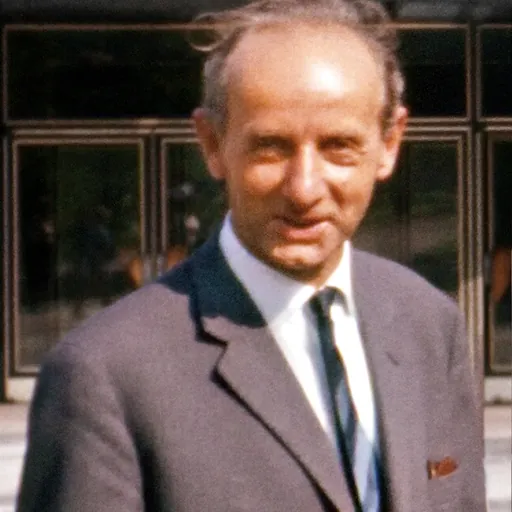
Urs Dietschi
Swiss politician
About Urs Dietschi
Lived 1901 – 1982 (aged 80). Urs Dietschi was a Swiss politician, canton of Solothurn and national Council (Switzerland).
Urs Dietschi (18 November 1901 – 29 July 1982) was a Swiss lawyer who entered government service. He then became increasingly caught up in politics and in 1929 became a co-founder of an organisation called the "Jungliberale Bewegung" ("Young liberal movement"). At the urging of like-minded liberal-radical activists, he secured election to the Solothurn cantonal parliament in 1933, remaining a member till 1937. In 1943 he secured election to the "Nationalrat" (lower house of the Swiss national parliament in Bern), representing the Free Democratic Party on behalf of his canton. Meanwhile, he remained a leading figure in cantonal governance, serving as a member of the Solothurn cantonal executive between 1937 and 1966. At both National and cantonal levels he took a consistent interest in social policy and cultural affairs, and was also prominent as an advocate of enhanced social, economic and political rights for women, at a time when Switzerland was, by European standards, widely seen as something of a laggard in such matters.
Life and career Provenance and early years Urs Dietschi was born into a well-established family in Olten (SO), a prosperous mid-sized town with a mixed economy on the western fringes of Middle Switzerland, in which he grew up. The lawyer-politician Dr. (1864–1955) was his father. His grandfather, Prof. (1830–1907) - another politician), had founded the regional newspaper back in 1869. There was a family tradition of careful scholarship, humanitarian values and an open-mindedness when it came to cultural and social values which provided context for Dietschi's upbringing. He commenced his schooling in Olten and then moved on to the "Kantonsschule" (secondary school) in Solothurn, twenty minutes to the west by train, and an institution which over the years produced a number of notable politicians from Solothurn. On leaving school he enrolled successively at the universities of Heidelberg, Berlin and Bern to study Jurisprudence. He was still only 24 when he received his doctorate from the University of Bern. His doctoral dissertation concerned "The People's Veto in Switzerland". It was, in the view of one admiring commentator, a particularly appropriate topic for a young man from Olten, firmly grounded in the liberal 1830s traditions and beliefs. A core belief in the rights of the Swiss people and the central importance of the referendum in politics would shape his entire political life.
After 1925 he was able to travel extensively, spending time in Paris and London. These were years of intensifying political polarisation across Europe, which was intensified by the Great Depression's economic hardship and surging unemployment that followed the Wall Street crash. The effects were felt in London, Paris and, especially, in Berlin, while south of Ticino, Italy had switched to what became an anti-democratic fascist political system as early as 1922. Dietschi was never drawn to the illusory simplistic "solutions" of the demagogues and populists. . a loosely organised grouping that sought to renew liberalism "in the spirit of the freedom-loving nineteenth century". Between 1941 and 1945 Dietschi would serve as the national president of the "movement". The young liberals rejected corporate and populist pressures. Instead they placed their emphasis on the power of organisation. There was much discussion of a "Wirtschaftsrat" (loosely, "Economic Assembly"), but it appears that in Switzerland of the 1930s that idea was more appealing to the corporatist right-wingers than to "liberals". To the frustration of the more hard headed among them - who evidently, in this respect, included Emmy Dietschi, Urs' wife: "Irritating to the economic liberals was the way in which the 'Young Liberals' were far more interested in social policy than in pro-business liberal economic strategies". Among the leading Young Liberals there was very little experience of commerce and manufacturing. There were teachers and journalists. Dietschi himself came from a long line of scholarly politicians and himself had a background in the law and in public administration. Historian Walter Wolf sums up the situation during the 1930s with the provocative assertion that "the Young Liberals sometimes believed that liberalism had become outdated".
Parliamentarian In 1933, with the backing of his Young Liberal comrades, Urs Dietschi was elected to the Solothurn cantonal parliament. Membership of the Solothurn Council of state did not preclude embarking on a parallel career in national politics. He served as a member of parliament between 6 December 1943 and 6 December 1959, holding true to the tenets of the Young Liberal movement throughout.
Although Switzerland was not among the belligerent nations during the war, the strategic, economic and political impact meant that there were very few government initiatives placed before the "Nationalrat" between 1939 and 1945 other than those necessitated by international developments. After 1945 Urs Dietschi's social and political views frequently placed him at odds with party comrades for whom political liberalism was primarily concerned with economics and commerce. Both at a cantonal level and nationally he was openly supportive of extending voting rights to women well before the issue rose to the top of the political agenda for many (male) Swiss liberals, though a few generations later his nuanced justification of his position comes across as quaint, at best: "I am at once both for and against [votes for women] ... Womankind would also be burdened [by the heavy responsibility of being able to vote], because they are such sensitive souls". He was backing the inclusion of women on an extraparliamentary commission as early as September 1944. As longstanding president, between 1952 and 1971, of the "Federal Commission for the Protection of Nature and the Homeland", Dietschi also used his political positions and the public profile that went with them to campaign effectively and with impressive persistence in support of . He believed that the issues involved important responsibilities, that national legislators could not simply leave to cantonal authorities and private individuals. Born into the so-called Christian Catholic Church, which had emerged out of the deist currents of the Enlightenment, Dietschi was deeply committed to religious tolerance. One example of this was his engagement with the rehabilitation of the Benedictine Monastery at Mariastein which had been twice secularized, in 1792 and again in , but was rededicated and formally re-established in 1971.
The record Urs Dietschi died at Solothurn on 29 July 1982. He had accumulated many papers, and these were donated by his widow Emmy to the archives section of the in Solothurn. During the first decade of the twenty-first century the papers were fully catalogued by the Solothurn historian-author Dr. Ruedi Graf-Vargas. The resulting archive constitutes a source and important research tool for the history of the canton during the twentieth century and on that of the "Young liberal movement". The archive fills more than 25 linear meters on the shelves of the library archived, and are complemented by recordings of eight detailed interviews that Graf-Vargas conducted with Emmy Schmidt, the widow of Urs Dietschi. The interviews focus primarily on the professional career of Urs Dietschi, but also provide extensive insights into Emmy Dietschi's own role as the wife of a politician and as a politically aware and socially engaged woman.
Don’t just read it —
keep it.
Full-length biographies made to live with: read them, listen on the way to work, watch them tonight.
- E-book
- Audio
- Video
Instant download · yours to keep · every purchase keeps this site free
Important facts
People in Urs Dietschi's life
Named in this biography and alive at the same time


Related people
Same field, nearest in time






Contemporaries
People whose lives overlapped Urs Dietschi's


Frequently asked questions
Who was Urs Dietschi?
Swiss politician (1901-1982)
When was Urs Dietschi born?
Urs Dietschi was born on 18 November 1901 in Olten.
When did Urs Dietschi die?
Urs Dietschi died on 29 July 1982 in Solothurn.
What was Urs Dietschi's occupation?
Urs Dietschi was a politician, canton of Solothurn and national Council (Switzerland).
What nationality was Urs Dietschi?
Urs Dietschi was Swiss.
Sources & further reading
Cite this page
APA: Biography.guide. (2026). Urs Dietschi. https://biography.guide/urs-dietschi/
MLA: "Urs Dietschi." Biography.guide, https://biography.guide/urs-dietschi/.
Chicago: "Urs Dietschi." Biography.guide. https://biography.guide/urs-dietschi/.
Data last updated: 2026-09-22 · Spot an error? Report a correction.
Portrait: Wikimedia Commons · author & licence
Page generated 2026-09-27 05:03 UTC