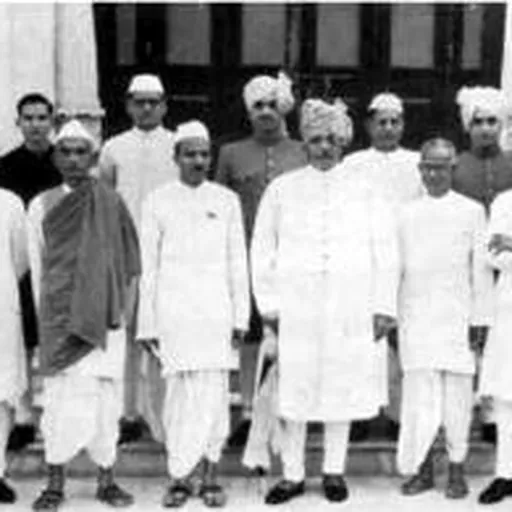
About U. N. Dhebar
Lived 1905 – 1977 (aged 71). U. N. Dhebar was an Indian politician.
Uchharangrai Navalshankar Dhebar (21 September 1905 – 11 March 1977) was an Indian Independence activist who served as the Chief Minister of Saurashtra State from 1948 to 1954 and the President of the Indian National Congress from 1955 to 1959.
Between 1938 and 1942, Dhebar led the Rajkot Satyagraha and actively participated in the Individual Satyagraha and Confederation Movement. For his role in the Indian independence movement, he was imprisoned thrice by the British colonial government, for two short spells during 1938-1939 and 1941 and later for three years from 1942 to 1945.
Early life U.N. Dhebar was born on 21 September 1905 in the hamlet of Gangajala, eleven miles from Jamnagar. After his university education, he started a legal practice as a lawyer. Dhebar gave up his legal career to join the Indian independence movement in 1936 in his hometown, Rajkot, in the Kathiawar State in Western India. In February 1937, the State Government of Saurashtra issued an order for the banishment of 14 workers who were members of the executive committee. With the backing of the Indian National Congress, Dhebar led a movement which resulted in the withdrawal of the order of banishment after multiple protest meetings and protest processions.
Dhebar served as the President of the Rajkot Mill Kamdar Mandal in 1936, the Secretary of Kathiawar Political Conference in 1937–38, and as the President of Rajkot Praja Mandal in 1938–39. The princely rulers felt free to ignore the interests of the people and use state revenues to fund their luxurious lifestyles because the British provided immunity from domestic and external aggression. In return, the British government expected the states to support them in their imperialistic policies, thereby acting against the development of nationalist sentiments. The people under the British provinces in India were given some political rights and participation in the administration after the Government of India Acts of 1919 and 1935. Many revolutionary nationalists fleeing British authority came to the princely states in the first and second decades of the 20th century and initiated political activities there. Under the nationalist movement, the subjects of the princely states established people's organizations.
In October 1947, the Nawab of Junagadh agreed to the integration of the State of Junagadh into Pakistan, despite widespread public opposition to it. Dhebar declared a total boycott of all goods going to and coming from Junagadh, outside Junagadh limits. The boycott was so effective that after being unable to sustain the economy for more than a month and half, the ruler of Junagadh went underground. Due to its success, the boycott method started being used by other smaller states, prompting intervention by the Indian government.
After the formation of Saurashtra State, the next two years were spent on fixing integration problems within both the state and the country. The state-wide problems included political integration, administrative integration, organizing the financial structure, and reorganizing the tax structure, such as introducing and removing specific taxes. Country-wide integration included the transfer of the entire customs revenue of India to the Central Government.
President of Indian National Congress In November 1954, Dhebar was brought onto the national scene by Jawaharlal Nehru. His goal was to not exclude the propertied class and to introduce large numbers of the producing classes to the INC, namely farmers, craftsmen, laborers, and students.
Until 1948, Dhebar's primary objective was the independence of India. Now, he modified this objective so that the means of production, distribution, and exchange should either be owned by the state or should be controlled by the state. However, the main purpose of the INC from 1955 to 1959 was to integrate both the man-power and resources of India for the general development of the country.
Dhebar was an avid supporter of the fight against apartheid in South Africa. Dhebar encouraged the South African Indian Congress to follow the steps of Mahatma Gandhi and India's fight to independence by applying the principles of non-violence and unity, not only amongst themselves but also with "your African brethren and all others". He also predicted that their work would "bring your peaceful struggle for elementary human rights to a successful end very soon".
At the end of his term, Dhebar tried convincing Jaya Prakash Narayan, J.B. Kripalani, Ashok Mehta, and other friends to take up the responsibility of creating an opposition party to the INC. This would have led to a reasonable constructive opposition party which could have taken the place of the INC. Unfortunately, this plan failed as Jaya Prakash Narayan did not agree. It was only when the State did not make a special effort to see that everybody fully enjoys equal rights, that the State lost the moral right to consider the issue as merely a law-and-order problem.
Two things that stood out most to Dhebar about Gandhi's approach were his solution to the problem of poverty and the principle of trusteeship. Rather than capitalizing for political purposes on the problem of poverty, Gandhi employed some of the people. It did not give the person everything they want but it did give hope to the person that they are being looked after. He did not want large scale producers to think of setting up the industries in the spheres where the traditional sector was doing its bit, simply out of motives of profit.
Don’t just read it —
keep it.
Full-length biographies made to live with: read them, listen on the way to work, watch them tonight.
- E-book
- Audio
- Video
Instant download · yours to keep · every purchase keeps this site free
Important facts
People in U. N. Dhebar's life
Named in this biography and alive at the same time

Related people
Same field, nearest in time





Contemporaries
People whose lives overlapped U. N. Dhebar's




Frequently asked questions
Who was U. N. Dhebar?
Indian politician (1905-1977)
When was U. N. Dhebar born?
U. N. Dhebar was born on 21 September 1905 in Jamnagar district.
When did U. N. Dhebar die?
U. N. Dhebar died on 11 March 1977.
What was U. N. Dhebar's occupation?
U. N. Dhebar was a politician.
What nationality was U. N. Dhebar?
U. N. Dhebar was Indian.
Sources & further reading
Cite this page
APA: Biography.guide. (2026). U. N. Dhebar. https://biography.guide/u-n-dhebar/
MLA: "U. N. Dhebar." Biography.guide, https://biography.guide/u-n-dhebar/.
Chicago: "U. N. Dhebar." Biography.guide. https://biography.guide/u-n-dhebar/.
Data last updated: 2026-09-21 · Spot an error? Report a correction.
Portrait: Wikimedia Commons · author & licence
Page generated 2026-09-27 04:59 UTC