
About Tunde King
Lived 1910 – 1980 (aged 69–70). Tunde King was a Nigerian guitarist.
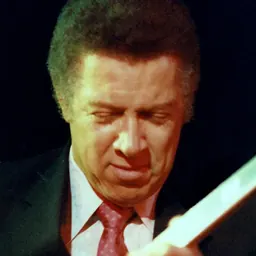
Tunde King (born 24 August 1910), was a Nigerian musician credited as the founder of Jùjú music. He had a great influence on Nigerian popular music.
Lagos in the 1920s and 1930s was peopled by a mixture of local Yoruba people and returnees from the New World. Together they created a form of music named "Palm Wine" that combined Yoruba folk music with musical idioms from countries such as Brazil and Cuba. Banjos, guitars, shakers and hand drums supported lilting songs about daily life. Jùjú music was Palm Wine music that originated in the Olowogbowo area of Lagos in the 1920s, in a motor mechanic workshop where "area boys" used to gather to drink and make music. Tunde King was the leader of this group.
Life
Abdulrafiu Babatunde King was born in the Saro-dominated Olowogbowo area of Lagos Island on 24 August 1910. He was the son of Ibrahim Sanni King, a member of the minority Muslim Saro community. His father was a chief Native Court clerk at Ilaro, and had lived for some time in Fourah Bay, Sierra Leone.
Tunde King attended a local Methodist primary school and the Eko Boys High School. A schoolmate taught him to play guitar, and he became a leading member of a local group of "area boys" who hung out at a mechanic's shop on West Balogun Street. The group talked, drank beer and sang, accompanied by improvised instruments. By 1929, King had a clerical job and worked part-time as a singer and guitarist with a trio including guitar, samba and maracas, later changing to tambourine, guitar-banjo. and sekere (shaker). By the mid-1930s, he enjoyed considerable success, with several recordings and radio broadcasts, but he still relied on live performances to earn a living, often at private functions.
With the outbreak of World War II in 1939, Tunde King joined the Merchant Marines. He returned to Lagos in 1941, then disappeared for the next eleven years. He was rediscovered playing in Francophone ports such as Conakry and Dakar, and returned to Lagos in 1954. He died in the 1980s. Other recordings include "Sapara ti sajule orun", "Dunia (Ameda)" and "Ojuola lojo agan". In all, he made over 30 records. Two of his recordings, "Oba Oyinbo" and "Dunia" were included on an anthology CD Juju Roots: 1930s-1950s, released by Rounder Records in January 1985.
Legacy
Tunde King's music influenced his contemporaries, as well as later players such as Akanbi Ege, Ayinde Bakare, Tunde Nightingale and Ojoge Daniel in the 1940s, players in the 1960s such as King Sunny Adé and Chief Commander Ebenezer Obey, who introduced electric guitars, 1970s stars such as General Prince Adekunle and continued to have great influence into the 1980s, when stars such as Sir Shina Peters and Segun Adewale were playing modern forms of Jùjú.
Don’t just read it —
keep it.
Full-length biographies made to live with: read them, listen on the way to work, watch them tonight.
- E-book
- Audio
- Video
Instant download · yours to keep · every purchase keeps this site free
Important facts
People in Tunde King's life
Named in this biography and alive at the same time






Related people
Same field, nearest in time


Contemporaries
People whose lives overlapped Tunde King's






Frequently asked questions
Who was Tunde King?
Nigerian musician
When was Tunde King born?
Tunde King was born on 24 August 1910 in Lagos Island.
When did Tunde King die?
Tunde King died in 1980.
What was Tunde King's occupation?
Tunde King was a guitarist.
What nationality was Tunde King?
Tunde King was Nigerian.
Sources & further reading
Cite this page
APA: Biography.guide. (2026). Tunde King. https://biography.guide/tunde-king/
MLA: "Tunde King." Biography.guide, https://biography.guide/tunde-king/.
Chicago: "Tunde King." Biography.guide. https://biography.guide/tunde-king/.
Data last updated: 2026-09-22 · Spot an error? Report a correction.
Page generated 2026-09-27 05:23 UTC